
Affiliate Disclosure: Some links on this page are affiliate links. As an Amazon Associate, we earn from qualifying purchases — at no extra cost to you. We do not buy, install, or physically handle the cameras we cover; our rankings come from aggregated owner reviews, ratings and expert consensus. Commissions never change our verdicts. We're reader-supported: commissions fund hosting, research and updates, so if a guide helped, buying through our links keeps it going. How we rank · full disclosure.
Short version: for most American homes, the right outdoor security camera setup is one hardwired or floodlight camera covering the main approach plus one or two battery or solar cameras on the awkward angles. The model matters far less than the power source, and the power source is the decision that predicts whether the camera is still working and still watched two years from now.
How we work: we do not buy, install or physically handle any of these cameras. Our rankings come from aggregated owner reviews, star ratings weighted by review volume, and the complaints that repeat across thousands of buyers. The full method is on how we rank. Want specific models? Start with the best outdoor security cameras rankings, or go straight to our PoE security camera system picks if you already know you want everything wired.
In Plain English
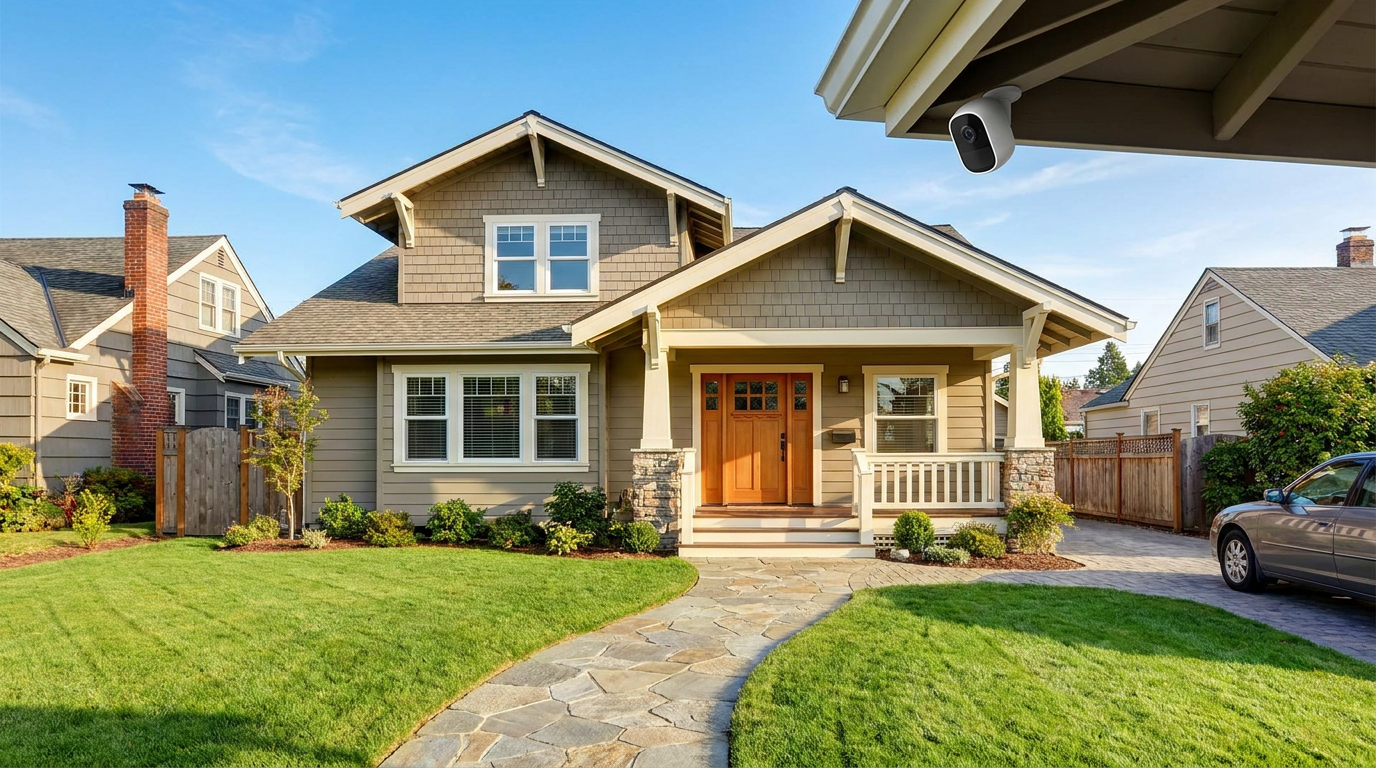
An outdoor security camera is built to live outside, through rain, sun and cold. The most important choice is not the brand. It is how the camera gets its power.
Wired cameras run on your home’s electricity, so they never need charging. Battery cameras go anywhere but need recharging, like a phone. Solar cameras are battery cameras with a small panel that tops them up. PoE cameras (Power over Ethernet) get power and data through one network cable.
Think of it like choosing between a corded and a cordless drill: the corded one never runs flat, and the cordless one goes anywhere.
Why it matters: dead batteries, weak WiFi and surprise subscription fees cause most of the complaints about outdoor cameras. Choosing power and storage deliberately avoids all three.
The one thing to check: the IP rating (a two-digit weatherproofing score). IP65 is the sensible minimum for a camera on an outside wall.
Top 3 Recommended Outdoor Cameras

Ring Floodlight Cam Wired Plus pairs motion-activated LED floodlights with 1080p color video on a permanent hardwired connection, removing the recharge chore that dominates battery-camera complaints. It carries one of the largest and most consistent review bases of any outdoor camera tracked on this site. Owners specifically credit the floodlights for turning grainy infrared footage into a usable color image at night. The honest tradeoff is that it needs an existing outdoor wired fixture or a licensed electrician to install.
Why You Should Get This
If you have an existing hardwired fixture and want the single most review-validated outdoor camera tracked on this site, this is the default starting point.
| Resolution | 1080p HD |
| Field of view | 140° horizontal |
| Power | Hardwired, existing outdoor fixture |
| Night vision | Color night vision |
| Audio | Two-way talk |
| Siren | 105dB built-in siren |
| Lighting | Motion-activated LED floodlights |
| Smart home | Works with Alexa |
Benefits
- Never needs a battery recharge, continuous wired power.
- Color night video from the floodlights, not grainy infrared.
- Large, deep review base for real confidence in the rating.
Pros and Cons
- Massive, consistent review base.
- Motion-activated floodlights double as a deterrent.
- Reliable wired connection, no dropouts.
- Needs an existing wired fixture or electrician.
- 1080p rather than 2K/4K.
- Recorded clip history needs a Ring subscription.
Features
- Motion-activated LED floodlights.
- 105dB built-in siren.
- Two-way talk.

Arlo Essential Battery 2K is the premium outdoor pick for households without an existing wired fixture, built around 2K color night vision and AI-based detection that separates people, packages, vehicles and animals. A swappable battery and dual-band WiFi round out a genuinely capable wireless setup. Owners consistently rate its detection accuracy as more reliable than budget alternatives. Full recorded history requires an Arlo Secure subscription.
Why You Should Get This
If wiring isn’t an option but you still want sharp color night detail and smart alerts, this is the outdoor camera built around exactly that combination.
| Resolution | 2K video |
| Field of view | 130° |
| Power | Swappable rechargeable battery |
| Night vision | 2K color night vision |
| Detection | Person, package, vehicle, animal |
| Siren | 80dB built-in siren |
| Lighting | Built-in spotlight, ~7m range |
| Connectivity | Dual-band WiFi |
Benefits
- 2K color night vision without any wiring required.
- Smart detection cuts down false alerts from cars and animals.
- Battery swaps out in seconds instead of a long recharge.
Pros and Cons
- Sharper night detail than most wireless rivals.
- Reliable person/package/vehicle/animal detection.
- Built-in spotlight and 80dB siren.
- Full history needs an Arlo Secure subscription.
- Higher price than budget wireless cameras.
- Spotlight use accelerates battery drain.
Features
- Built-in 80dB smart siren.
- Spotlight, ~7m range.
- Dual-band WiFi.

The REOLINK RLK8-410B4 is a complete four-camera PoE outdoor system with an 8-channel NVR and a pre-installed 2TB hard drive, recording continuously with no subscription. Each camera runs on a single Ethernet cable for both power and data, eliminating both battery and WiFi range concerns entirely. It carries the largest review base of any complete system tracked on this site. This is the right category for anyone covering more than one or two entry points seriously.
Why You Should Get This
If you want a whole-property outdoor system rather than one camera at a time, and you never want to think about a monthly fee, this is the honest entry point.
| Camera resolution | 4MP Super HD (2560x1440), 4 bullet cameras |
| NVR | 8-channel PoE NVR |
| Storage | 2TB HDD pre-installed, 24/7 recording |
| Connectivity | PoE, single cable per camera |
| Detection | Person and vehicle detection |
| Night vision | Infrared, up to 30m range |
Benefits
- 24/7 continuous local recording with no subscription ever.
- PoE removes WiFi range and battery life from the equation entirely.
- Four cameras and eight NVR channels, room to expand.
Pros and Cons
- Largest review base of any system in this comparison.
- True 24/7 recording, not just motion clips.
- No recurring cost after purchase.
- Real installation project — running Ethernet takes a weekend.
- 4MP is a middle resolution, not 4K.
- Higher upfront cost than a single camera.
Features
- Person and vehicle detection.
- 8-channel PoE NVR.
- 2TB HDD pre-installed.
How to Choose an Outdoor Camera: The Short Buying Guide
The direct answer: decide the power source first, the storage model second, the resolution third. Everything else is preference. A wired camera at the main entry with local or cloud recording, tuned so it only alerts on people, covers what most households actually want. If wiring is impossible, buy solar before battery, because solar is battery power with the recharge chore engineered out.
The reason this order matters is that it maps directly onto the complaints. Owner reviews across this entire category are dominated by three things: batteries that die faster than advertised, cameras that fall off WiFi at the far end of a property, and subscriptions discovered after purchase. Choosing power and storage deliberately eliminates all three before you have picked a brand.
Types of Outdoor Camera: The Five Kinds Worth Considering
The wall of options at any retailer collapses into five categories, and picking the right category matters far more than picking the right model inside it.
Wired cameras run on permanent household power. They never need charging and never go quiet, which is why the highest-rated outdoor cameras in our rankings are wired ones. They need power at the mounting point, which is the whole catch.
Battery cameras, the most common kind of wireless outdoor cameras, mount anywhere in ten minutes with no drilling into wiring, which makes them the only realistic option for a lot of renters. The trade is the recharge cycle, and it is a much bigger trade on a busy driveway than the box implies. See the wireless and battery cameras hub for that category in full.
PoE cameras take power and data down one Ethernet cable to a switch or an NVR. This is the most reliable arrangement available to a homeowner and the one with the fewest failure modes. It is also the most work to install. Full treatment in the wired PoE cameras hub.
Solar cameras are battery cameras with a panel that keeps the pack topped up. Where the panel genuinely sees several hours of daylight, they behave like wired cameras. Where it sits under a tree or faces north through a northern winter, they behave like battery cameras with extra steps. The solar cameras hub covers the siting rules.
Floodlight cameras combine a camera with motion-triggered lights, which does two jobs at once: it produces color night footage instead of grey infrared, and the light itself sends people walking before anything is recorded. Covered in the floodlight cameras hub.
Wired Camera, Battery Camera, PoE or Solar Camera: What Actually Differs
The honest summary is that wired wins on reliability and loses on installation flexibility, and everything else is a compromise between those two poles.
A wired camera is a camera you stop thinking about. No pack to pull down in February, no low-battery notification, no ladder. That is why owner ratings for hardwired models sit consistently above battery equivalents from the same brand, and the gap is not subtle. If there is an outdoor fixture or a junction box at the spot you want to cover, that spot should get a wired camera.
Battery cameras trade that away for placement freedom, and how bad the trade is depends entirely on traffic. A camera watching a quiet side gate may genuinely run for many months. A camera watching a driveway that catches passing cars and pedestrians can drop from an advertised year to six weeks, and cold weather compounds it. Reviews are unambiguous about this pattern across every brand.
PoE removes both the recharge problem and the WiFi problem simultaneously, because the camera has neither a battery nor a wireless radio in the signal path. The cost is running Cat5e or Cat6 to each mounting point, which is a real weekend job, and reviews warn about it more than anything else in the category.
Solar sits in an interesting middle. Given real daylight it delivers wired-like behavior with no cable, which is why four-camera solar kits appear near the top of our rankings. Given tree cover or a genuinely dark winter, the panel cannot keep up and you are back to a ladder.
Local Storage vs Cloud for Outdoor Security Cameras
This is the single most consequential thing on the box that nobody reads. Ring, Blink and Arlo record to the cloud, and the recorded video sits behind a paid plan — without it you generally get a live view and a motion alert, but not a saved clip you can hand to anyone. REOLINK, eufy and NVR-based systems record locally to a microSD card, a hub or a hard drive, with no ongoing fee.
Neither model is wrong, but the arithmetic is worth doing before you buy rather than after. An entry-level camera on a modest monthly plan adds up to a much larger total across five years. A mid-range camera recording to a card costs just the hardware. Reviews of every cloud-first brand contain a steady stream of buyers who discovered this after installation, and the tone is not gentle.
Local storage has its own trade: a camera recording to an onboard card can be stolen along with its footage, which is why higher-end local systems put the recorder inside the house. That is the argument for the kits in our best security camera systems rankings, where every camera streams back to an NVR sitting safely indoors.
What Consumer Reports says. In its outdoor camera roundup, Consumer Reports notes that most outdoor cameras run on rechargeable batteries, which lets you mount them almost anywhere as long as they are in range of your WiFi. Its testing looks at daytime and nighttime video quality, how quickly alerts reach your phone, and smart features such as person detection.
Accessories Worth Adding

Best for a clean, weatherproof cable entry for a wired or PoE outdoor camera.

Best for angling any outdoor camera under an eave or soffit.

Best for local recording on any battery or solar outdoor camera.
Resolution, Field of View and Night Vision, Explained
Three numbers appear on every outdoor camera box, and all three are commonly misread.
Resolution decides whether footage records an event or identifies a person. 1080p is the floor and is genuinely fine for knowing somebody was at the door; it is not enough to identify a stranger at thirty feet, and reviews of every 1080p camera reflect that limit. 2K is the sensible middle for most homes. 4K and above earns its keep on driveways and long approaches where you want a face or a plate rather than a silhouette.
Field of view is a trade, not a feature to maximize. A 110 to 130 degree lens suits a single approach and keeps the subject a useful size in the frame. Ultra-wide lenses distort at the edges and shrink everything, so a 180-degree camera watching a driveway gives you a panoramic view of a person too small to recognize. Two well-aimed narrow cameras beat one very wide one almost every time.
Infrared vs Color Night Vision
Night vision splits into infrared and spotlight-assisted color, and the difference matters more than the stated range. Infrared gives you distance and a grey image. A spotlight or floodlight gives you color, which is the difference between evidence and a shape in a hooded top. If a camera only ever earns its keep once, it will be at night, so weight this heavily.
What to Look For in Weatherproof Ratings: IP65, IP66 and Real Weather
Every outdoor camera claims to be weatherproof, and the claim is only meaningful when it comes with an IP number. The first digit covers dust, the second covers water, and for a wall-mounted camera the second is the one that matters.
IP65 is the practical floor for an outdoor camera and means the housing resists low-pressure water jets from any direction — in plain terms, ordinary rain, including rain that blows sideways in a squall. It is enough for a camera mounted under an eave or a soffit, which describes most residential installations. IP66 steps up to high-pressure jets and is what to look for on a camera sitting fully in the open, on a coastal wall, or anywhere a pressure washer might one day be pointed at the siding. IP67 and above adds immersion resistance, which almost no wall camera actually needs.
Two things the rating does not cover, and both appear in owner reviews as failures blamed on weatherproofing. The first is temperature: a weather resistant housing says nothing about the operating range inside it, and battery cameras in particular lose capacity sharply below freezing regardless of their IP number. Check the stated operating temperature separately if you are in a cold climate. The second is sunlight — UV degrades plastic housings and gaskets over years, which is a large part of why cameras mounted under cover outlast cameras baking in full afternoon sun.
One more practical point: the weakest link in a weather resistant install is usually the cable entry, not the camera. Loop the cable so water runs away from the connector rather than into it, and use the supplied gasket or a weatherproof junction box for any joint.
Placement: Covering Every Entry Point
Most homes need three to five outdoor angles, and they are the same ones in almost every house: the front door, the driveway or street approach, the back door, and whichever side has a gate or a low fence. A fifth camera usually goes on a shed, a garage side or a blind corner.
The useful way to plan this is to walk the property and list every entry point rather than every wall. An entry point is anywhere a person can get from public ground onto your property or into a building — the front door, the back slider, a side gate, a garage service door, a low fence panel, a basement window well. Cover the entry points people actually use first, then the ones an intruder would prefer, which are usually the ones with no light and no line of sight from the street.
Height is eight to ten feet. Aim across approach paths rather than along them. Keep the camera out of the direct line of a street light, a white sunlit wall or your own floodlight, because all three blow out the exposure at exactly the moment you need detail. And frame at least one camera tightly on the main entry at roughly head height rather than wide, since a sweeping view of the whole driveway rarely identifies anybody.
Two practical placement notes from owner reviews. First, cameras under an eave stay much cleaner and last longer than cameras fully exposed to weather and sun. Second, an infrared illuminator attracts insects, insects attract spiders, and a web across the lens triggers motion all night — mounting under cover reduces this, but nothing eliminates it entirely except occasional cleaning.
Motion Zones, Person Detection and Alert Fatigue
The most common way an outdoor camera stops being useful is not failure. It is the owner turning off notifications. A camera that alerts on every passing car, every shadow at dusk and every branch in the wind gets muted within a week, and a muted camera is a recording device rather than a security system.
Two features prevent this, and both are worth paying for. Activity zones let you exclude the sidewalk and the road from detection entirely. Object filtering — person, vehicle, package, animal — lets the camera decide what deserves a notification. Reviews are consistent that cameras with good filtering keep their notifications switched on, and cameras without it do not.
Person Detection, Package Detection and Where They Run
Person detection is the one filter almost everyone ends up wanting, because it is the difference between an alert that means something and forty alerts about headlights. Package detection is narrower and only useful where deliveries actually land in frame, which on an outdoor camera usually means a porch or a driveway rather than a side gate. The question worth asking before you buy is where the classification happens. Cloud-based detection is generally tied to a subscription and stops the day you cancel; on-device detection keeps working with no plan and no internet round trip, which also makes the alert arrive faster. Vehicle and animal filters are the other two commonly offered, and both are more useful than they sound on a property with a road or a neighborhood cat.
Expect to spend two or three weeks tuning zones and sensitivity after installation. Owners who do this report satisfaction; owners who expect it to work perfectly on day one are the ones writing the frustrated reviews.
What Outdoor Cameras Cost, from Budget to Premium
Roughly speaking, at the entry-level end you get a basic 1080p WiFi camera that works but will not identify anyone at distance — the budget cameras hub covers what that money genuinely gets. The lower-mid tier is the heart of the market, where well-rated 2K cameras with color night vision and decent detection live. The upper-mid tier buys a floodlight camera or a 4K model with real detection. Multi-camera kits run from a mid-range price for three basic battery cameras up to a premium price for four 4K solar units, and full wired systems with a recorder start at a similar premium level.
The cost most buyers miss is the subscription, and over five years it frequently exceeds the hardware. The second is expansion: almost nobody stops at one camera. Buying into an ecosystem that supports more cameras, and a recorder with spare channels, is cheaper than discovering the limit later. Our premium cameras hub covers what the top end actually buys, and the buying guides hub covers subscriptions and installation decisions in more depth.
Going Deeper: What Weatherproof Ratings, Motion Sensors and Night Vision Actually Measure
An IP rating is two separate scores. As Reolink’s guide to weatherproof ratings explains, the first digit is dust protection and the second is water protection; a 6 in the first position means completely dustproof. On the water side, IP65 means protection against low-pressure water jets from any direction, IP66 against powerful water jets, and IP67 against temporary immersion up to 1 metre for 30 minutes. That ladder is why this guide treats IP65 as the floor for a wall camera and IP66 as the upgrade for fully exposed or coastal mounts.
Motion detection on many battery cameras starts with a passive infrared (PIR) sensor. Reolink describes how these sensors measure the infrared radiation that warm bodies give off, focus it through a Fresnel lens, and react to variations as an object enters or leaves the sensor’s view. They use little power, but heat sources such as sunlight can set them off. That is the mechanism behind two pieces of advice on this page: aim across an approach so movement registers as a change, and expect a sun-baked wall to produce false alerts until zones and sensitivity are tuned.
Night vision is a filter trick. According to Axis Communications’ white paper on IR in surveillance, a day-and-night camera uses an IR-cut filter by day to keep colors accurate, then mechanically removes it as light fades so the sensor can use near-infrared light, which produces grayscale video. Integrated illuminators normally use 850nm infrared, close enough to visible light to show a faint red glow. Axis also notes that insects and dirt are drawn to the light, and that debris on the housing such as spider webs or water droplets causes reflections, which is the same insect-and-spider problem owners describe.
Floodlight cameras solve the grayscale problem by adding visible light, so the scene stays bright enough for the camera to keep producing color. Ring lists the Floodlight Cam Wired Plus with 2,000-lumen floodlights, a 105dB siren and 1080p video. The lights are what turn a gray silhouette into a color image, and they deter before anything is recorded.
More Accessories

Best for extending 24/7 recording history on a wired PoE/NVR outdoor system.

Best for powering a single PoE outdoor camera with no NVR nearby.

Where to Start
If you want a shortlist right now, go to the best outdoor security cameras rankings — that covers wired, battery and solar in one place. If you already know you want everything wired and recording locally, our PoE security camera system rankings and best security camera systems are the two pages that matter. If the problem is one specific area, the backyard and front door guides narrow the field faster than any general list can, and a video doorbell may cover the front entry better than a wall camera. The frequently asked questions below cover mounting height, weatherproof ratings and whether outdoor cameras work without WiFi, and the topical map underneath closes the loop across the whole hub.
Sources & References
- 9 Best Outdoor Security Cameras, Lab-Tested and Reviewed — Consumer Reports
- Introduction to Security Camera Weatherproof IP Ratings — Reolink Support
- PIR Motion Sensor: How It Works in Security Cameras — Reolink
- IR in Surveillance: Day-and-Night Cameras and OptimizedIR (white paper) — Axis Communications
- Floodlight Cam Wired Plus Information — Ring
- Reolink RLK8-410B4 Smart PoE NVR System with 4 Cameras — Reolink
- What Is Power over Ethernet (PoE)? — Cisco
- Solar Photovoltaic System Design Basics — U.S. Department of Energy