
Affiliate Disclosure: Some links on this page are affiliate links. As an Amazon Associate, we earn from qualifying purchases — at no extra cost to you. We do not buy, install, or physically handle the cameras we cover; our rankings come from aggregated owner reviews, ratings and expert consensus. Commissions never change our verdicts. We're reader-supported: commissions fund hosting, research and updates, so if a guide helped, buying through our links keeps it going. How we rank · full disclosure.

Ring Outdoor Cam (Stick Up Cam)
A battery-powered, weather-resistant outdoor camera with color night vision and flexible freestanding-or-wall mounting — the highest-review-volume single camera in Ring's entire outdoor lineup.
Check Price →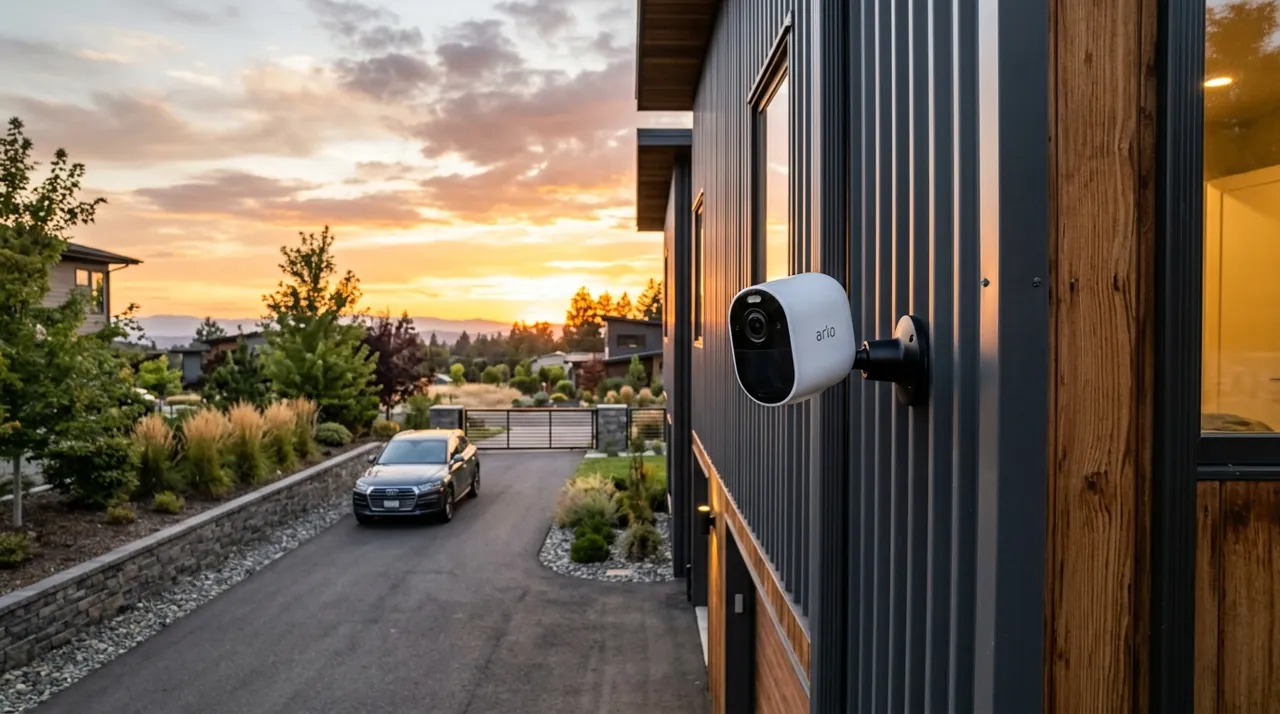
In Plain English
The Ring Outdoor Cam (once called the Stick Up Cam) is a small battery camera you can stand on a shelf, screw to a wall or hang from a ceiling. It connects to your home WiFi and sends alerts to your phone.
Think of it like a torch with a removable battery: when it runs low, you pop the battery pack out, charge it indoors and slot it back in. A solar panel accessory can keep it topped up instead.
Why it matters: the camera shows you live video for free, but it does not keep recordings unless you pay for a Ring Protect plan. Without one, you cannot scroll back to see what happened earlier.
Battery life depends on how busy the spot is. A quiet side gate may last months, while a busy driveway may need charging every few weeks.
The one thing to check: that your WiFi reaches the spot on the 2.4GHz band (the only WiFi band this camera uses), and decide up front whether you will pay for recordings.
Full Manufacturer Specifications: Weather Resistant Rating, WiFi and More
Sourced from Ring's official product page (ring.com/products/outdoor-cam) for the current-generation Outdoor Cam, the same hardware sold under this listing.
| Resolution | 1080p HD video with color night vision |
| Field of view | 110° horizontal, 57° vertical, 130° diagonal |
| Power source | Rechargeable battery pack, or battery pack + solar panel (USB-C) accessory; a separate Plug-In version is also sold |
| Mounting | Flat surface, ceiling, or wall — integrated stand with adjustable angle, freestanding or mounted |
| Connectivity | Single-band 2.4GHz WiFi |
| Weather rating | Weather resistant (no specific IP rating published by Ring for this model) |
| Two-way audio | Yes, two-way talk |
| Storage / subscription | Live view and motion alerts free; recorded video history (up to 180 days) requires a Ring Protect plan |
| In the box | Quick-release battery pack, charging cable, screws and wall anchors, security sticker |
Note: Ring's site describes this model as weather resistant but does not publish an exact IP rating for it — we report only what is verifiable and do not estimate a number Ring itself hasn't disclosed.
Summary: Owner Reviews at a Glance
The Ring Outdoor Cam is the most-reviewed single camera in the outdoor category on this site, backed by one of the deepest and highest-rated review bases in the outdoor category. Its selling points are flexibility — it can freestand, wall-mount or ceiling-mount, run on battery alone or add a solar panel — and color night vision at a mid-range price. Its main structural limit is the same as every Ring device: no recorded video history without a paid Ring Protect plan.
What Owners Praise About the Stick Up Cam
The review volume itself is the first signal — a camera this widely purchased and still holding one of the strongest ratings in the category says something about baseline reliability. Beyond that, owners consistently single out the mounting flexibility: the same unit works propped on a shelf, screwed to a wall, or hung from a ceiling without buying a different model for each position. Color night vision is called out repeatedly as genuinely useful for identifying a person rather than a gray shape, and the battery life is reported as adequate for low-to-moderate motion-event positions.
What Owners Complain About (Including the Ring Protect Subscription)
The recurring theme, consistent with every Ring device on this site, is the subscription: owners who did not realize recorded clips require a Ring Protect plan account for a meaningful share of one- and two-star reviews. Battery life in high-motion-event locations (a busy sidewalk, a driveway with regular traffic) is reported as falling short of expectations, which tracks with Ring's own guidance that battery life depends heavily on usage. 1080p resolution is also noted by some owners as behind the 2K and 4K options now common in this price range.
Who It's For
Buyers who want one flexible camera that can be placed almost anywhere without committing to a specific mount type, and who are comfortable paying for a Ring Protect plan if they want recorded history rather than just live view. It's a strong fit for a side yard, a shed, or a secondary position where the primary front-door camera is a doorbell.
Who Should Skip It
Buyers who have already decided they will never pay a subscription — without one, this camera is a live-view-and-alert device, not a recording one. Our best cameras without a subscription roundup covers the local-storage alternative.
Pros and Cons
Pros: flexible mounting (freestanding, wall, ceiling), color night vision, solar panel accessory available, large and reassuring, highly-rated review base.
Cons: no recorded history without a subscription, 1080p rather than 2K/4K, no specific published IP rating, battery life varies significantly with motion volume.
Freestanding and Wall Mounting Flexibility in Practice
The mounting story is where this camera earns most of its reputation. The included stand lets it sit freestanding on any flat surface with no tools at all — a genuinely useful option for a renter, a temporary position, or anyone who wants to reposition it seasonally without patching old screw holes. The same unit also mounts to a wall or ceiling with the included hardware for a permanent install. Owners consistently report this flexibility as the reason they bought this specific Ring camera over a fixed-mount alternative — one purchase covers a shelf-top position today and a permanently wall-mounted position later, without buying a second camera.
Ring Stick Up Cam Battery Life, Recharging and the Solar Panel Option
Like every current Ring battery device, runtime depends heavily on how much motion the position generates rather than on a single fixed number Ring publishes. A quiet side yard or shed position commonly stretches several months between charges according to owner reports, while a busy sidewalk-facing or driveway position can mean recharging every few weeks. The Ring Stick Up Cam battery is a quick-release pack, which simplifies the actual recharging step — pull it, charge it inside on the included cable, and pop it back in, rather than carrying the whole camera to an outlet. Pairing it with Ring's optional solar panel accessory is the standard fix for a sunny position that's tired of the recharge cycle altogether.
Tip If you add the solar panel, mount it where it gets at least 2 to 3 hours of direct sun a day, per Ring, or it will not keep up with the battery drain.
App, Alexa and Smart Home Integration
The Ring app handles live view, motion alerts, and — with a subscription — recorded event history and richer motion zone configuration, and owners describe it as a mature, reasonably polished experience consistent with the rest of Ring's lineup. Alexa integration lets the camera's live feed display on compatible screens and speakers on request, which owners already invested in Amazon's smart-home ecosystem cite as a real convenience. As with any WiFi camera, alert speed depends on signal strength at the mounting position, so confirming WiFi reaches wherever the camera will freestand or mount is worth doing before finalizing placement.
Typical Mounting Positions for This Camera
Because it isn't tied to a single fixed job the way a doorbell is, owners report using this camera in a wide range of secondary positions: a side yard gate, a shed or detached structure entrance, a backyard deck overlooking a pool, or as a supplementary angle on a driveway already covered by a floodlight camera. That versatility is the main reason it holds the highest review volume of any single camera in Ring's outdoor lineup — it's frequently someone's second or third Ring camera rather than their first, added once the household already trusts the ecosystem and just needs another angle covered.
Color Night Vision After Dark
Color night vision is one of this camera's more consistently praised features, and it works by using available ambient light — a porch light, a streetlight, moonlight — rather than an active spotlight, which keeps the camera less conspicuous after dark than a model with an integrated floodlight. Owners report it performing well in areas with some ambient lighting and falling back toward standard infrared performance in genuinely dark spots with no nearby light source, a limitation shared by most color-night-vision cameras rather than one specific to this model.
Going Deeper: How Battery Drain, Solar Top-Ups and Night Vision Interact
Start with the connection. Ring’s comparison page lists this model with single-band 2.4GHz WiFi, while other models in the lineup offer dual-band 2.4GHz and 5GHz, which Ring says gives a faster, more stable connection. On a single-band camera, the strength of your 2.4GHz signal at the mounting point is what decides how quickly alerts arrive, which is why this review suggests testing the WiFi before settling on a spot.
Battery life is really a motion budget. Security cameras frequently use passive infrared sensors, which Reolink explains respond to changes in the infrared radiation given off by warm bodies and use less power than other motion sensors, but can be set off by heat sources such as sunlight. Every detection wakes the camera to record and send an alert, so a camera watching a busy sidewalk spends its battery far faster than one watching a quiet side gate. That is the mechanism behind Ring’s refusal to publish one fixed battery figure.
The solar accessory only pays back what it collects. Ring’s USB-C solar panel page recommends installing the panel without obstruction from the sun and says it performs best with at least 2 to 3 hours of direct sunlight a day; it is compatible with USB-C cameras and backward compatible with barrel-plug Ring cameras through the included adapter. The U.S. Department of Energy notes that panels in the northern hemisphere collect the most over a year when pointed due south and tilted at an angle equal to the local latitude.
Color night vision behaves the way this review describes for a reason. Axis Communications explains that day-and-night cameras block infrared with a filter while there is enough light for accurate color, then remove the filter as light fades and switch to grayscale infrared video. A porch light or streetlight keeps the camera on the color side of that switch for longer, and a genuinely dark corner pushes it into infrared, which is exactly the pattern owners report.
Verdict
The Ring Outdoor Cam earns its position as one of Ring's most popular outdoor devices honestly — the review volume and rating both hold up, and the mounting flexibility is a genuine practical advantage. Buy it if you're comfortable with the Ring subscription model; if not, see our best outdoor security cameras roundup for the wider field, including no-subscription options.
Accessories for This Camera

Best for local recording on a camera with a card slot.

Best for angling this camera precisely under an eave, soffit or shelf.

Best for a clean, weatherproof cable entry point on an outdoor mount.
Alternatives to Consider
- Best Outdoor Security Cameras — the full ranked field
Sources & References
- Outdoor Camera (Formerly Stick Up Cam 3rd Gen): Tech Specs and Comparison — Ring
- Ring Home Subscription Plans — Ring
- Solar Panel (USB-C): Compatibility — Ring
- PIR Motion Sensor: How It Works in Security Cameras — Reolink
- Solar Photovoltaic System Design Basics — U.S. Department of Energy
- IR in Surveillance: Day-and-Night Cameras and OptimizedIR (white paper) — Axis Communications