
Affiliate Disclosure: Some links on this page are affiliate links. As an Amazon Associate, we earn from qualifying purchases — at no extra cost to you. We do not buy, install, or physically handle the cameras we cover; our rankings come from aggregated owner reviews, ratings and expert consensus. Commissions never change our verdicts. We're reader-supported: commissions fund hosting, research and updates, so if a guide helped, buying through our links keeps it going. How we rank · full disclosure.
Short version: a trail camera is built to detect and photograph wildlife on a trail or feeder, running for weeks or months on batteries with no network required, or optionally with a cellular SIM for real-time alerts. For most hunters and land owners who check a camera periodically in person, a non-cellular card-based model is the standard, lowest-cost choice. For a remote property you cannot easily visit, a cellular model earns its monthly data cost by sending photos straight to your phone.
How we work: we do not buy, install or physically handle these cameras. Every ranking here comes from aggregated owner reviews, star ratings weighted by review volume, and expert consensus. Method on how we rank; funding on our affiliate disclosure. Ready for models? Go to best trail camera for non-cellular picks, or best cellular trail camera for real-time alerts.
In Plain English
A trail camera is a weatherproof camera you strap to a tree or post and leave for weeks. It sleeps until something warm moves in front of it, then takes a photo or short video. Most save to a memory card you collect in person; cellular models also send the pictures to your phone for a monthly fee.
Speed matters more than sharpness. It is like trying to photograph a passing car: if the shutter is slow, you get an empty road. That is why trigger speed (how quickly the camera fires after it senses movement) is the spec to check first. The one thing to do when mounting is aim the camera across the trail rather than straight down it, at about waist to chest height, and clear branches in front of the lens so wind does not fill the card with empty frames.
Top 3 Recommended Trail Cameras
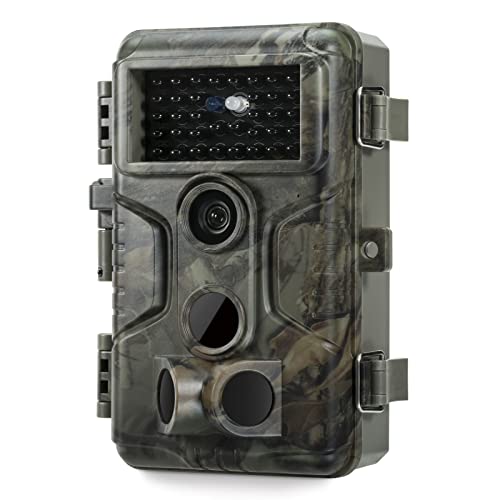
The GardePro A3S suits most hunters and landowners checking a camera every week or two, holding a solid rating from a deep review base. It pairs a fast 0.1-second trigger with genuinely high 64MP photo resolution and 1296P HD video with sound. No-glow night vision avoids spooking game. Owners consistently value the trigger speed paired with resolution at a mid-range price.
Why You Should Get This
If you want a well-rounded trail camera with a fast trigger and genuinely high resolution, this is the mid-range default.
Benefits
- Fast 0.1-second trigger speed.
- 64MP photo resolution, high for the category.
- No-glow night vision.
Pros and Cons
- Strong combination of speed and resolution.
- Solid review base at a mid-range price.
- Records video with sound.
- Non-cellular, requires a site visit to retrieve photos.
- Mid-range price versus budget options.
- No WiFi transfer.
Features
- 64MP photo, 1296P HD video with sound.
- 0.1s trigger speed.
- No-glow night vision.

The WOSPORTS holds the deepest review base of any budget trail camera tracked on this site, backed by a solid owner rating, cheap enough to place several around a property. It delivers 30MP photo and 1080P HD video with motion-activated infrared night vision in a compact, easy-to-conceal body. Owners consistently value the low cost for multi-position coverage. Resolution trails the GardePro’s.
Why You Should Get This
If you want to place several cameras around a property without a large budget, this is the deepest-reviewed budget option.
Benefits
- Deepest review base of any budget trail camera tracked on this site.
- Cheap enough to buy multiple for full-property coverage.
- Compact, easy-to-conceal body.
Pros and Cons
- Largest review base at this price point.
- Low cost enables multi-camera coverage.
- Compact, discreet body.
- Lower resolution than the GardePro A3S.
- Non-cellular, requires site visits.
- Basic feature set versus mid-range models.
Features
- 30MP photo, 1080P video.
- Motion-activated infrared night vision.
- Compact body.

The Meidase P70 2-pack is the straightforward way to cover two trails or feeders at once, with a solid owner rating and zero cellular or WiFi dependency. It matches the GardePro’s 64MP photo and 1296P HD video specs, with no-glow infrared night vision. Owners consistently value covering two positions from a single purchase with no network dependency to worry about at a remote site. It ships fully non-cellular, card-based only.
Why You Should Get This
If you need to cover two trails or feeders at once with zero network dependency, this two-pack solves it in one purchase.
Benefits
- Two cameras in one purchase, covers two positions.
- Matches the GardePro’s high resolution.
- Zero cellular or WiFi dependency.
Pros and Cons
- Two cameras for the price of covering two spots separately.
- High resolution matching the category leader.
- No network dependency at a remote site.
- Fully card-based, no remote photo delivery.
- Requires retrieving both cameras to view photos.
- No stated trigger-speed figure.
Features
- 64MP photo, 1296P HD video.
- No-glow infrared night vision.
- Fully non-cellular, card-based.
Cellular vs Non-Cellular: The Core Decision
Everything else in this category follows from one choice. Non-cellular cameras write photos and video to a memory card that you retrieve by visiting the camera — cheaper hardware, zero monthly cost, and the standard setup for hunters checking a stand or feeder every week or two anyway. Cellular cameras (wireless trail cameras) add a SIM card and send photos to an app in near-real time, which is worth the monthly data plan specifically when the property is far enough that a physical check is a real trip, or when you want to know about activity as it happens rather than days later. For ranked models, see the best cellular trail cameras.
Trigger Speed and Detection Range
Trigger speed — how quickly the camera fires after detecting motion — is the specification that decides whether you get a usable photo of an animal or an empty trail. Under half a second is the practical threshold for reliable capture; the fastest cameras trigger in 0.1-0.2 seconds. Detection range matters alongside it: a camera covering a wide feeder area needs a longer detection range than one aimed at a narrow game trail.
Battery Life and Weatherproofing
Battery life depends heavily on trigger frequency and whether the camera is transmitting over cellular — a quiet trail can run a set of batteries for months, while a busy trail or a cellular model sending every photo can drain in weeks. Every camera on this hub needs a genuine outdoor weatherproof rating, since these are mounted outside for extended periods with no daily attention.
Photo and Video Resolution: What the Numbers Actually Mean
Trail camera photo resolution figures are frequently interpolated well past the sensor's native capture resolution, so a headline number like 64MP does not translate directly to the same detail level as 64MP on a dedicated digital camera. Actual image quality depends more on sensor and lens quality than on the printed megapixel figure alone, which is why two cameras with matching megapixel specs can still look noticeably different in practice. Video resolution, expressed in figures like 1296P or 4K, is a more directly comparable spec across brands than the interpolated photo count, and it's worth weighing alongside photo resolution if video with sound matters for identifying activity rather than just a still photo.
Mounting and Placement Basics
Height and angle matter as much as camera choice. A camera mounted around waist to chest height, angled slightly downward and perpendicular to the expected direction of travel rather than facing straight down a trail, captures a fuller side profile instead of a partial glimpse as an animal passes quickly through frame. Clearing brush and branches directly in front of the lens avoids false triggers from vegetation moving in the wind, which is one of the most common sources of a card full of empty photos. Facing the camera away from direct morning or evening sun also avoids washed-out or silhouetted photos during the golden-hour periods when game is often most active.
Trail Camera Theft and Security
Trail cameras mounted on public or semi-remote land carry a real theft risk, and a locking security box bolted or cabled to the tree is a common mitigation many experienced users add regardless of camera brand. Some cellular models specifically support a "theft alert" feature that sends a notification if the camera moves or loses its mounted position, which at least gives an early warning even if it doesn't prevent the theft itself. For a camera on a boundary or gate specifically for security rather than wildlife, mounting it higher and less conspicuously than a typical wildlife-height placement reduces the chance of it being spotted and taken in the first place.
Memory Cards and Storage for Trail Cameras
A non-cellular trail camera is only as reliable as the memory card inside it, and a high-endurance card rated for continuous write cycles holds up better over a season than a standard consumer card not designed for that write pattern. Card capacity should be sized to how long the camera runs between retrieval visits and how frequently it triggers — a high-traffic trail with video-with-sound enabled burns through card space considerably faster than a quiet trail set to photo-only. See our best SD cards for security cameras guide for high-endurance card picks that suit continuous outdoor capture.
How We Rank
Every product ranked on this hub is scored the same way the rest of the site is: aggregated owner star ratings weighted by review volume, recurring themes in negative reviews, and specification differences owners raise unprompted. We never buy, install or physically test these cameras, and every star rating and review count comes from licensed Amazon data. Full method on how we rank.
Not Hunting? Trail Cameras for Security vs a Security Camera
If the goal is watching a property, gate or driveway rather than wildlife, a purpose-built security camera is usually the better fit — see best trail camera for security for the honest tradeoffs, or go straight to the no-WiFi and cellular cameras hub for cameras designed specifically for that job.
Wildlife Detection vs Person Detection
A trail camera's motion sensor is tuned for wildlife: ground-level heat and movement across a wide field, often triggering on anything from a squirrel to a deer with equal readiness. A dedicated security camera's smart detection is tuned differently, aiming to distinguish a person or a vehicle from general motion and to reduce false alerts from small animals or blowing leaves. Neither sensor type is wrong, they are simply built for different jobs, which is the core reason a trail camera repurposed for security tends to generate more notification noise than a camera designed for that role from the start.
Going Deeper: How a PIR Sensor Knows Something Moved
Almost every trail camera wakes up using a passive infrared (PIR) sensor, which is why it can run for months on batteries. Panasonic, a major PIR sensor maker, explains that pyroelectric infrared detectors convert changes in incoming infrared light into electric signals. The key word is changes: the sensor does not measure how warm a scene is, it reacts when the heat pattern in front of it shifts.
Detection zones do the rest. In Panasonic’s design, four sensing elements are polarized to create positive and negative detection zones, and the lens defines how those zones are laid out across the view. Panasonic specifies its sensors against a temperature difference of at least 4°C between the target and its background, an object moving at about 1 metre per second, and a human-sized target crossing two detection zones. Its newer PaPIRs+ line lowers the required temperature difference to 2°C and extends detection range to roughly 1.4 times that of its conventional models.
Those specifications explain the placement advice on this page. Detection is built around movement across zones, so an animal crossing the camera’s view is the case these sensors are designed for. Swaying, sun-warmed vegetation also changes the heat pattern in front of the lens, which is why clearing it cuts false triggers. And Panasonic notes that PIR sensitivity is influenced by environmental conditions; its PIR sensor FAQ adds that in summer, when a body's surface temperature is close to the background's, sensitivity decreases. Once the sensor fires, trigger speed takes over. GardePro, for example, rates the A3S at 0.1 seconds, with three PIR sensors covering a 120-degree angle and about 85 feet of detection.
Sources & References
- PIR motion sensors: technology for low power or line power applications and lens options — Panasonic Industrial Devices
- High-performance PaPIRs+ motion sensors — Panasonic Industry
- PIR Motion Sensors FAQ 2025 — Panasonic Industry
- A3S trail camera — GardePro
- FLEX-M cellular trail camera — SPYPOINT
- REVEAL X 3.0 cellular trail camera — TACTACAM
- Speed class for consumers — SD Association