
Affiliate Disclosure: Some links on this page are affiliate links. As an Amazon Associate, we earn from qualifying purchases — at no extra cost to you. We do not buy, install, or physically handle the cameras we cover; our rankings come from aggregated owner reviews, ratings and expert consensus. Commissions never change our verdicts. We're reader-supported: commissions fund hosting, research and updates, so if a guide helped, buying through our links keeps it going. How we rank · full disclosure.
Choosing the best security camera for a backyard is a different job from covering a front door. Shopping specifically for a wireless camera for a backyard? The battery-powered pick below (the Spotlight Cam Plus) is the wire-free option on this page, and our best wireless security cameras ranking covers the wider wireless field if wiring is a hard no. The short version: a backyard camera has four problems a front-door camera does not — distance, darkness, signal and vegetation. The area is wide, the subject can be forty feet away, there is usually no porch light, the router is on the other side of the house, and wind-moved trees and shrubs throw false alerts all day unless detection is tuned. That specific problem set is why the backyard needs different picks from the wider yard-and-perimeter field ranked in outdoor security cameras ranked by owner reviews. The Ring Floodlight Cam Wired Plus solves the first three at once and is the best-rated device on this page, backed by one of the deepest owner-review bases we track. If the budget is tighter, the Ring Outdoor Cam, at a mid-range price, carries the largest review base in this comparison and includes color night vision.
Before you buy anything, go and stand where the camera will be mounted and check your WiFi there. More backyard camera failures are network failures than hardware failures, and it is the one problem no amount of money spent on the camera will fix. Our install guide covers the check and the fixes; use-case guides covers why the front door and the backyard need genuinely different products.
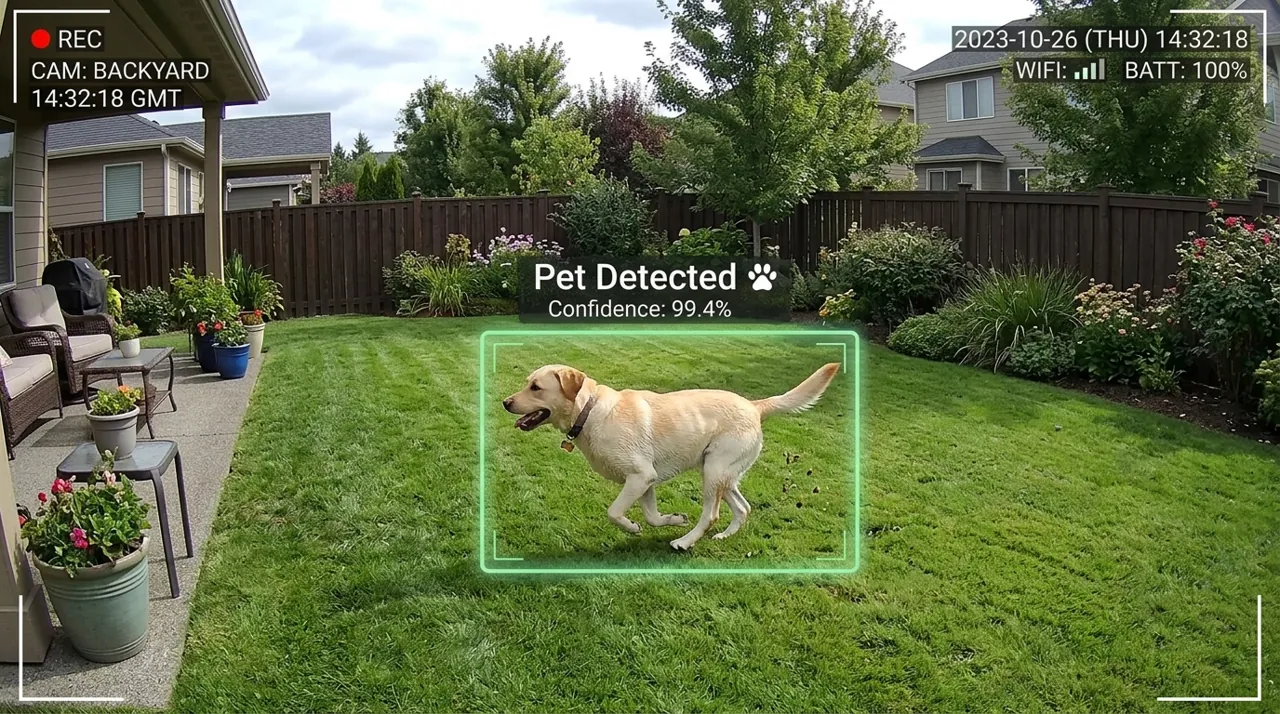
In Plain English
A backyard is a harder place for a camera than a front door. It is wide, dark and often far from the router, and a person can be forty feet away rather than on your doorstep. The router is usually on the other side of the house, too.
Light is the biggest upgrade. Standard night vision gives a grey picture that shows something moved but rarely who. A camera with its own floodlight or spotlight gives colour footage, with clothing and vehicle colours, and owners say the sudden light itself often sends people walking. The one thing to do before buying anything is stand at the mounting spot with your phone and check the WiFi, because a weak signal causes more backyard camera failures than any camera fault does.
Top Rated Picks at a Glance
Our #1 Pick: Ring Floodlight Cam Wired Plus
A backyard is dark, and darkness is the actual problem. Every camera on this page can record motion at the back fence; only two of them can light it, and only one does it with a pair of proper floodlights, rated at 2,000 lumens combined by Ring. That is the whole argument for the Floodlight Cam Wired Plus at the top of this list, and the owner data backs it: the highest-rated device anywhere in this comparison, backed by one of the deepest review bases, and one of the strongest in the outdoor category generally.
Consensus Score █████████░ 9.2 — from one of the deepest, highest-rated review bases in our outdoor research.
The practical case is about power as much as light. It hardwires to a junction box, so there is no battery to recharge at the top of a ladder in February and no gap in coverage while a pack charges. Mounted at eight to ten feet on the rear elevation, the range Ring recommends for its outdoor cameras, the wide view covers a typical suburban yard end to end, the floodlights trigger before anyone is halfway across it, and the siren gives you a response that is not just a notification. Owners describe the lights, not the footage, as the part that changes behavior.
The honest weaknesses: it is 1080p in a market where 2K is now standard at this price, which limits how much detail survives at forty feet even with the lights on. The install is a mains-voltage job at a junction box, and a meaningful share of buyers hire an electrician for it. And the motion filtering that keeps a yard camera from alerting on every cat sits behind a Ring subscription — the full cost picture is on Ring pricing and value.
The Ranked Field: Star Rating, Consensus and Price

Best for lighting and covering a whole backyard from one mounting point.
- Motion-activated floodlights that light the yard, not just record it.
- 1080p HD video with two-way talk and a built-in siren.
- Hardwired for continuous power — no ladder, no recharging.
- One of the deepest, highest-rated review bases we track.
Why buy it: A dark yard is the problem; this is the only pick here that fixes the darkness as well as recording it.

Best for flexible placement anywhere in the yard on a modest budget.
- Weather-resistant housing for year-round outdoor mounting.
- Color night vision rather than monochrome infrared.
- Live view, two-way talk and motion alerts.
- The largest owner-review sample on this page.
Why buy it: The most-reviewed camera in this comparison, at half the price of the floodlight pick, with color night vision included.

Best for far corners of a yard with no outlet and no cable route.
- Built-in spotlight enabling color night vision.
- Battery powered — mounts anywhere with no wiring.
- HD video, two-way talk and a security siren.
- Removable battery pack for swap-and-charge.
Why buy it: It brings its own light to a spot no cable will ever reach, which is exactly the backyard problem.
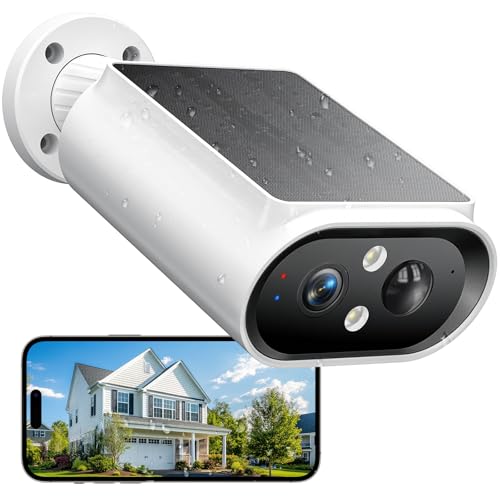
Best for a sunny corner where climbing a ladder to recharge is unrealistic.
- Solar panel charging with 2K color night vision.
- 360-degree view with AI motion detection and spotlight.
- IP67 waterproof rating, above the outdoor minimum.
- Two-way audio and a siren.
Why buy it: Solar plus 2K at an entry-level price is a striking specification — but only a thin base of owner ratings stands behind it so far.
Quick Comparison Table
| Product | Best for | Buy |
|---|---|---|
| Ring Floodlight Cam Wired Plus | Best Overall | Price |
| Ring Outdoor Cam (Stick Up Cam) | Best Value | Price |
| Ring Spotlight Cam Plus (Battery) | Best Battery Pick | Price |
| AlkiVision 2K Solar Outdoor Camera | Best Solar Option (Unproven) | Price |
How We Rank
We do not buy, install or physically handle these cameras. There is no test yard behind this page and we are not going to pretend otherwise. Our rankings are built from aggregated owner star ratings weighted by review volume, so that a 4.6 from 207 buyers does not automatically outrank a 4.6 from 64,700; from the recurring themes inside negative reviews, which are far more informative than the praise; from verified specifications; and from expert consensus across the category. Products with thin review histories are included where the specification earns it, and flagged as unproven rather than presented as equals. Full method on how we rank.
The Backyard Cameras, Reviewed
1. Ring Floodlight Cam Wired Plus — Best Overall
The most complete answer to a dark, wide space, and the best-rated device on this page. What owners praise: floodlights bright enough to genuinely light a yard rather than merely assist the sensor, mains power that removes the recharge problem permanently, the siren as an active response, and reliability across seasons of weather. What owners complain about: a 1080p sensor that is now behind the market, a mains-wiring install that is the hardest job in this comparison, motion alerts that need zone tuning before they settle down, and paid-plan gating on the smarter detection features.
2. Ring Outdoor Cam (Stick Up Cam) — Best Value
The most-reviewed camera on this page by a wide margin, holding a strong owner rating at a mid-range price. It is the flexible workhorse of the range — weather-resistant, mountable almost anywhere, with color night vision rather than monochrome infrared, which matters more at yard distances than raw resolution does. What owners praise: placement flexibility, color night footage that actually describes what happened, straightforward setup, and the price against the Ring app experience. What owners complain about: no built-in floodlight, so it depends on ambient or added light for the best night results; weather resistance that owners advise pairing with an eave or overhang in harsh climates; and the same subscription requirement for recorded clips.
3. Ring Spotlight Cam Plus, Battery — Best Battery Pick
The answer for the far corner of a yard where no cable will ever run. A built-in spotlight enables color night vision without any mains connection, and the battery pack is removable so a spare keeps the camera live while one charges. It holds a strong rating across a deep review base. What owners praise: total placement freedom — fence posts, sheds, trees, back corners — plus the spotlight and siren combination, and an install that takes twenty minutes with no electrician. What owners complain about: battery life well short of the quoted figure in a busy yard, because every motion event and every spotlight activation costs power; and the fact that a high mounting position makes recharging a ladder job, which is precisely why solar accessories sell so well alongside it.
4. AlkiVision 2K Solar Outdoor Camera — Best Solar Option, Unproven
Included because the specification directly targets the backyard problem, and flagged because the evidence base is thin. Solar charging, 2K color night vision, 360-degree coverage, AI motion detection, a spotlight, a siren and an IP67 rating at an entry-level price is a striking list. The caveat: it holds a strong rating across only a thin base of owner ratings. That is not enough history to know how the panel performs through a winter, how the app holds up, or whether firmware support continues. What early owners praise: the solar panel keeping the battery topped up in sunny positions, and 2K detail at a budget price. What to watch: solar performance collapses in shade, and an unproven brand carries real risk on long-term security updates.
Buying Guide: What a Backyard Specifically Needs
The direct answer: wide field of view, its own light source, a weatherproof housing rated IP65 or better, and a network connection you have verified at the mounting point. Resolution comes after all four.
Coverage Area and Field of View
A front door is a three-foot target; a backyard is a hundred-foot one. That pushes you toward a 130-degree-or-wider lens, and it introduces a tradeoff that catches people out: a wider lens spreads the same pixels over more scene, so a person at the fence line gets smaller as the view gets wider. Two cameras covering half a yard each will always beat one covering all of it, if the budget stretches. Where one camera has to do everything from a single high mounting point, a pan-tilt-zoom unit is the category built for that — see PTZ pan-tilt cameras.
Night Vision at Distance
This is where yard cameras are won and lost. Standard infrared gives a monochrome image that tells you something moved but rarely who or what — and at forty feet, in a category where quoted IR ranges are generous, that is often all you get. A spotlight or floodlight changes the result completely, because color footage carries clothing color, vehicle color and detail that a black-and-white frame does not. If you only upgrade one thing on a backyard camera, upgrade the light.
Weatherproofing and Mounting
IP65 is the floor, IP66 or IP67 for a fully exposed position. Mount at eight to ten feet, angled down ten to twenty degrees (Ring specifies a 20-degree tilt for its outdoor cameras), and under an eave where one exists — an overhang shelters the unit, shades the lens against glare and keeps the camera out of reach. Seal the cable entry with a drip loop and exterior silicone; that joint, not the camera body, is where water actually gets in.
Power at the Back of the Property
Mains-wired is the most reliable and the least flexible. Battery is the most flexible and needs a ladder every few weeks in a busy yard. Solar removes the ladder trips if and only if the panel gets several hours of genuine direct sun, which is the whole content of solar cameras. PoE beats all three on reliability where you are willing to pull a cable, covered in wired PoE cameras.

The WiFi Problem Nobody Warns You About
This deserves its own section because it is the leading cause of backyard camera disappointment, and it has nothing to do with the camera.
Consumer WiFi degrades sharply through exterior walls, and worst through brick, stucco over metal lath, and foil-backed insulation. A router in a front hall office, two walls and sixty feet from a back fence, will frequently deliver a signal that looks fine on a phone and is not enough for a camera uploading video continuously. The symptoms are unmistakable in reviews across every brand: clips that never appear, live view that spins, a camera that reports offline for hours. Owners write these up as broken cameras. They are network reports.
Fix it in this order. Reposition the router or add a mesh node on the yard-facing side of the house, which resolves most cases affordably. Add an outdoor-rated access point if the yard is large. Run Ethernet and switch to PoE if you want the problem gone permanently. And if the position is a detached shed, a paddock or a property with no broadband at all, a cellular camera is the category that exists for exactly that — no-WiFi and cellular cameras. If you are covering four or more yard positions, a local recorder starts to beat four cloud subscriptions on both cost and reliability, which is the argument in NVR camera systems.
Pools, Pets and Side Gates
Backyards get watched for reasons that have nothing to do with burglary, and those uses change the specification.
Pools. A camera overlooking a pool is useful for seeing who is out there and for reviewing what happened, and it should never be treated as a safety device. Fencing, self-closing gates and supervision are the safety measures — the CPSC’s Pool Safely guidance calls for a fence at least four feet high, a self-closing, self-latching gate and constant adult supervision — and the camera is a convenience. Practically, mount it high enough to see the whole water surface and expect glare off the water at low sun angles.
Pets. The requirement here is detection quality rather than image quality. A camera that alerts every time a dog crosses the lawn produces alert fatigue within days, so person-versus-animal detection and well-drawn activity zones matter more than the sensor. Two-way talk gets used far more than owners expect, mostly for telling a dog to get off something.
Side gates and sheds. The side gate is the most common unobserved entry into a backyard and deserves a camera before the open lawn does. Sheds hold tools worth more than most people insure them for, and they are usually the furthest point from the router — which is where solar and cellular options earn their place.
Best Budget and Best Premium: The Pros and Cons at Each End
The four picks above span entry-level to premium pricing, and the ends of that range behave very differently in a yard.
The best budget end is the solar camera, an entry-level pick. Pros: 2K detail, a spotlight, an IP67 housing and no recharging in a sunny spot, for less than a quarter of the price of the top pick. Cons: the thin owner-ratings base is an early signal rather than proof, the panel underperforms badly in shade, and an unproven brand carries real risk on firmware and long-term security updates. Buy it where a failure would be an inconvenience rather than a problem. The wider low end is ranked in budget cameras.
The best premium end is the floodlight camera, a premium pick plus wiring. Pros: the highest owner rating on this page across one of the deepest review bases we track, mains power that never needs a ladder, real floodlights rather than a token spotlight, and a siren. Cons: a 1080p sensor in a market that has moved to 2K, a mains-voltage install that sends many buyers to an electrician, and smarter motion filtering gated behind a subscription. If resolution rather than light is your priority, premium cameras covers the 2K and 4K field.
If Ring's subscription is the specific objection rather than the price bracket, two brands solve the backyard job without a monthly fee. Wyze's Cam v4 is indoor-outdoor rated, records locally with no plan, and holds a strong owner rating at a fraction of the Floodlight Cam's price — see our Wyze cost-versus-value analysis for the honest tradeoffs. eufy's SoloCam S340 goes further with a built-in solar panel and pan-tilt coverage, also with zero required subscription — reviewed in full at eufy SoloCam S340 review.
Warranty and Return Policy Notes
Outdoor cameras usually carry a one-year limited warranty, sometimes extended for as long as a subscription stays active on the platforms that sell one. Weather failures tend to appear in the first hard season rather than the first week, so register the warranty and keep the receipt. The return policy matters even more here than the warranty does, because signal strength at the back fence is the one thing you cannot check until the camera is in your hands — test it before the return window closes rather than after the first storm.
Renting, HOA Rules and Cameras That Face a Neighbor
Two situations put rules around a backyard camera before the specification matters.
The first is renting a house with a yard. Anything mounted to the building or wired into it is covered by the alterations clause in your lease agreement, so it needs landlord approval in writing before it goes up. A renter friendly alternative exists in this category and it is unusually good: a solar or battery camera on a free-standing post, a fence bracket or a tree strap is a genuine no drilling install into the building, and it comes down and moves with you. If you rent an apartment rather than a house, the constraints are different again and best security camera for apartment is the right page.
The second is a managed community. HOA rules commonly restrict exterior fixtures, visible wiring and anything mounted on a shared fence, and some address cameras directly. Check the covenant before you drill into a boundary fence you only half own.
Either way, one rule applies to every backyard camera: frame your own ground. A lens that fills half its view with a neighbor yard is a dispute waiting to happen, and audio is treated more strictly than video in several states. Activity zones exist for exactly this. Package theft, by contrast, is a front-entry problem rather than a yard one — that specific situation is covered in best security camera for front door.
What Owner Reviews Actually Complain About
Four themes repeat across outdoor camera reviews regardless of brand.
Battery life in a busy yard. Quoted in months, reported in weeks. Wind-moved vegetation, passing animals and every spotlight activation cost power. Tightening activity zones is the fix owners report as most effective.
Connection dropouts. Overwhelmingly a signal-strength problem at the mounting point rather than a camera fault, and it is the single most common one-star review across every outdoor brand.
False alerts from wind, rain and animals. A yard has far more moving things in it than a porch. Cameras without person detection are unusable in a windy yard at default sensitivity, and on several platforms person detection is a paid feature.
Water ingress at the connector. Rarely the housing, almost always the cable joint or the wall penetration. A drip loop and a sealed entry prevent nearly all of it, which is why the install matters as much as the IP rating.
How to Choose
If you have a junction box or can add one: the Floodlight Cam Wired Plus, the best-rated device here and the only one that meaningfully lights the yard.
If you want the best value with a large evidence base: the Ring Outdoor Cam at a mid-range price, with a deep base of owner ratings and color night vision.
If the spot has no power and no cable route: the Spotlight Cam Plus battery model, with a spare battery pack budgeted from the start.
If the spot is sunny and hard to reach: the AlkiVision solar camera, accepting that the thin ratings base is an early signal rather than proof.
If the yard needs four or more angles: price a local NVR system before buying four cloud cameras — see NVR camera systems.
Going Deeper: Why Light Fades So Fast Across a Yard
This page says quoted night-vision ranges describe when a camera registers movement, not when it can identify someone, and that useful identification tends to top out around 20 to 30 feet. The reason is geometry. Light spreads out as it travels, so its intensity falls with the square of the distance. HyperPhysics, Georgia State University’s physics reference, states the rule: if you know the radiation per unit area reaching 1 metre, it will be one fourth as much at 2 metres.
Across a yard, that adds up quickly. A person 40 feet from the light receives a quarter of the illumination that falls on someone at 20 feet, and a sixteenth of what reaches someone at 10 feet, and the light reflected from them still has to travel back to the lens. That is the physical case for this page’s advice that if you upgrade one thing on a backyard camera, you should upgrade the light.
Floodlights change the numbers because they start with far more light. ENERGY STAR explains that brightness is a description of light output, measured in lumens rather than watts, and that a 100-watt incandescent bulb corresponds to at least 1,600 lumens. Ring lists the Floodlight Cam Wired Plus with two 3000K floodlights rated at 2,000 lumens, a 140-degree horizontal field of view and a 105 dB siren. The inverse square law still applies to a floodlight, but starting from that much output leaves usable light, and therefore colour, at distances where a camera relying on its own small infrared illumination shows only a grey shape.
The Verdict
For a typical suburban backyard, the Ring Floodlight Cam Wired Plus is the camera we would point most homeowners toward. It is the highest-rated device on this page, backed by one of the deepest owner-review bases we track, it never needs charging, and it solves darkness rather than merely recording in it — which is the difference between footage that identifies someone and footage that shows a shape. Budget for an electrician if the junction box is not already there, and set the activity zones on day one.
If a premium camera plus wiring is more than the yard justifies, the Ring Outdoor Cam at a mid-range price is the honest value answer, with the largest review base in this comparison behind it and color night vision included. Either way, check the WiFi at the mounting point before you buy anything — that single step prevents the most common backyard camera failure there is. When you are ready to mount, how to install a security camera covers height, sealing and signal, and the broader outdoor field is ranked in outdoor security cameras chosen by owner consensus.
Related Accessories

Best for local recording on a camera with a card slot.

Best for angling a camera precisely under an eave, soffit or shelf.

Best for a clean, weatherproof cable entry point on an outdoor mount.
Sources & References
- Floodlight Cam Wired Plus Information — Ring
- Positioning Doorbells and Security Cameras — Ring
- Ring Outdoor Cam (formerly Stick Up Cam) Battery — Ring
- Spotlight Cam Plus Battery — Ring
- Ring Subscription Plans — Ring
- Wyze Cam v4 — Wyze
- Staying Safe in Pools and Spas — U.S. Consumer Product Safety Commission (Pool Safely)
- Introduction to the Reporter's Recording Guide — Reporters Committee for Freedom of the Press
- Inverse square law, radiation — HyperPhysics, Georgia State University
- Learn about brightness — ENERGY STAR (U.S. EPA)