
Affiliate Disclosure: Some links on this page are affiliate links. As an Amazon Associate, we earn from qualifying purchases — at no extra cost to you. We do not buy, install, or physically handle the cameras we cover; our rankings come from aggregated owner reviews, ratings and expert consensus. Commissions never change our verdicts. We're reader-supported: commissions fund hosting, research and updates, so if a guide helped, buying through our links keeps it going. How we rank · full disclosure.
Short version: for a smart garage, most buyers should start with a retrofit WiFi controller rather than replacing their whole garage door opener — it works with the existing motor unit and adds app control, remote access and door-status alerts at a fraction of the cost and installation effort of a full opener replacement. Only replace the whole unit if the existing motor itself needs replacing.
How we work: we do not buy, install or physically handle these devices. Every ranking here comes from aggregated owner reviews, star ratings weighted by review volume, and expert consensus. Method on how we rank; funding on our affiliate disclosure. Ready for models? Go to best smart garage door opener for retrofit controllers.
In Plain English
A smart garage controller is a small box that lets your phone open, close and check your garage door. It works with the opener you already have, a bit like adding a remote control to an old TV instead of buying a new one. A little sensor on the door tells the app whether it's open or shut.
Why it matters: you get an alert if you leave the door open, and you can close it from anywhere. Your normal remote and wall button keep working. The one thing to check before you buy is compatibility. Look up your opener's brand and roughly when it was made, and compare that with the controller's compatibility list. Only replace the whole opener if the motor itself is worn out or too noisy.
Top 3 Recommended Smart Garage Controllers
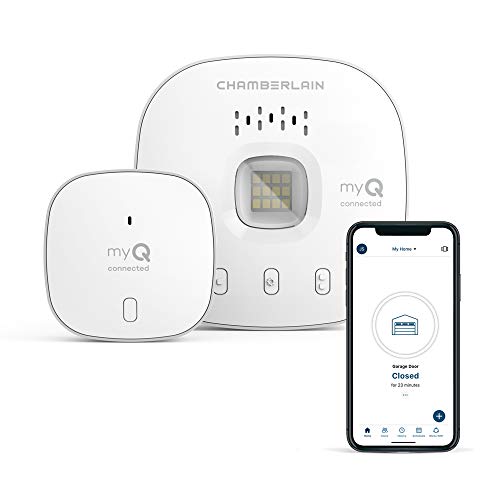
The Chamberlain Smart Garage Control holds one of the deepest review bases of any single product tracked on this entire site, backed by a solid owner rating, from an established garage-door-opener manufacturer. It retrofits WiFi and Bluetooth control onto most existing garage openers with a door position sensor and app alerts. Owners consistently value adding smarts to an opener that already works, rather than replacing it entirely. It requires compatible existing hardware.
Why You Should Get This
If your existing garage opener works fine and you just want to add smart control cheaply, this is the most review-validated way to do it.
Benefits
- One of the deepest review bases of any product tracked on this site.
- Retrofits onto most existing garage door openers.
- Door position sensor and app alerts included.
Pros and Cons
- Massive, trustworthy review base.
- Works with an opener you already own.
- Low price versus a full opener replacement.
- Requires a compatible existing opener.
- Not a full opener replacement if yours is failing.
- WiFi and Bluetooth setup needed.
Features
- WiFi and Bluetooth garage hub.
- Door position sensor.
- App alerts.
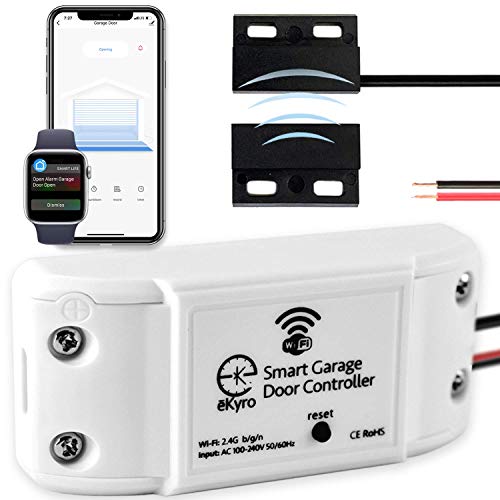
The eKyro holds the highest star rating among retrofit garage controllers tracked on this site, from a deep base of owner ratings, at a lower price than the market-leading Chamberlain. It offers universal WiFi remote control with broad opener brand compatibility and app-based control and alerts. Owners consistently rate it above the category leader on a per-review basis. Its review base is smaller than Chamberlain’s.
Why You Should Get This
If you want the highest-rated retrofit controller at a lower price than the market leader, this is it.
Benefits
- Highest star rating among retrofit garage controllers.
- Broad universal opener compatibility.
- Lower price than the Chamberlain.
Pros and Cons
- Highest per-review rating in this category.
- Lower price than the market leader.
- Broad compatibility.
- Smaller review base than Chamberlain.
- Less brand recognition.
- Requires compatible existing opener hardware.
Features
- Universal WiFi remote control.
- Broad opener compatibility.
- App-based control and alerts.
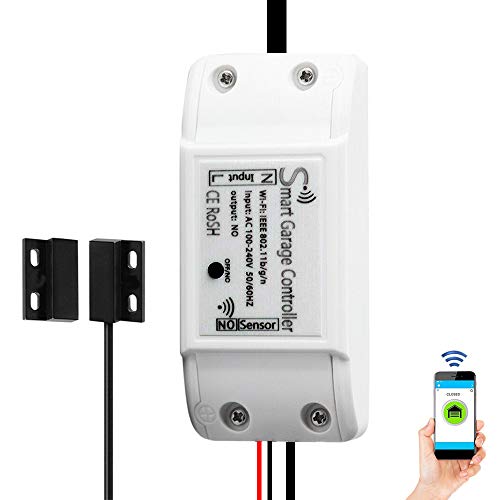
This budget controller is the lowest-cost genuinely well-reviewed retrofit option tracked on this site, with a solid owner rating from a deep review base, with smartphone app control and no hub required. It is compatible with most major garage door openers. Owners consistently value the low price while still getting a solid rating and app-based control. It trails the Chamberlain and eKyro on review depth.
Why You Should Get This
If the budget is genuinely tight, this is the lowest-cost retrofit controller that still carries a solid, trustworthy rating.
Benefits
- Lowest price of the retrofit controllers tracked on this site.
- No hub required.
- Compatible with most major openers.
Pros and Cons
- Lowest price in this comparison.
- Solid rating despite the low cost.
- No separate hub needed.
- Smaller review base than Chamberlain or eKyro.
- Fewer advanced features.
- Requires compatible existing opener hardware.
Features
- Smartphone app control.
- No hub required.
- Compatible with major openers.
Retrofit Controller vs Full Opener Replacement
A retrofit controller links to your existing garage door opener and adds WiFi connectivity, letting you open, close and monitor the door from a phone app — no new motor, no new opener installation, typically a 30-60 minute DIY job. A full smart opener replaces the entire motor unit, which makes sense if the current opener is aging, unreliable or you want quieter belt-drive operation, battery backup, or other hardware features a retrofit controller can’t add.
Checking Compatibility Before You Buy
Retrofit controllers work with most major opener brands manufactured within the last two decades, but not universally — check your existing opener’s brand and manufacture date against the specific controller’s compatibility list before ordering.
How a Retrofit Garage Door Opener Controller Works
A retrofit controller adds smarts to your existing opener without replacing the motor. How it links to the opener depends on the product. Chamberlain's myQ Smart Garage Control with WiFi hub, for example, communicates with the opener by radio and is paired with it much as a new remote would be, so it isn't wired into the opener's control board. Other brands may instead connect by wire to the opener's low-voltage wall-button terminals, which is a different kind of connection from radio pairing, so read the installation instructions for the specific model. A separate sensor mounts on the door panel, reporting open, closed or moving status back to the hub in real time.
WiFi, Bluetooth and Remote Control
WiFi and Bluetooth do two different jobs here. Bluetooth handles the initial pairing during setup. WiFi carries the ongoing remote control and alert features once everything's connected. Lose WiFi, and remote control stops, but the original opener remote and wall button keep working exactly as before, since the remote talks to the opener by radio and the wall button is wired to the opener's own control terminals, with no WiFi involved in either.
Chamberlain Smart Garage Control Install: What It Involves
Most retrofit garage controllers install in well under an hour with basic hand tools. Mount the hub, then pair it with the opener as the brand's app or instructions direct. For Chamberlain's hub that means radio pairing with the opener's program or learn button, with no wiring into the opener. Pair the door sensor through the same app.
Door Position Sensor Placement
Mount the door position sensor on the top panel of the door with its included bracket. It needs a clear, close line of sight to its magnet on the track for a reliable reading. No drilling into the door itself, and no rewiring of the motor.
Reviewers who hit installation trouble generally point to an unusual or older opener, not the hub's own hardware, which is why checking compatibility before ordering matters more than for most smart-home devices.
Checking Opener Compatibility Before You Buy
Compatibility depends on how a specific hub talks to the opener. Chamberlain says its Smart Garage Control is designed for openers made after 1993 that have a program or learn button, and it lists the opener brands it supports.
It isn't universal. An older, less common, or heavily customized opener sometimes isn't supported. Checking the specific controller's compatibility list against your opener's exact brand and manufacture date takes two minutes and avoids the single most common return reason in this category.
App, Voice Control and Power Outage Behavior
A retrofit hub needs a working WiFi connection to deliver remote features, and during an outage your router and the opener itself lose power, so remote control stops (Chamberlain's Smart Garage Control runs on a battery, but that doesn't keep your WiFi or the opener running). The opener itself typically has a manual release cord for exactly that situation, letting the door open by hand regardless of the hub's own status.
Voice control varies by controller: Chamberlain's myQ doesn't list Alexa among its partners and names Google Home and Apple HomeKit as unsupported, while some universal controllers advertise Alexa or Google support, so check the listing if this matters. Multiple household members can usually run their own login on one hub, each with independent alert preferences and their own activity history view inside the app.
Common Reasons Buyers Choose a Smart Garage Controller
Forgetting to close the garage door is the single most common reason buyers give for this purchase. A push notification catches it within minutes, not after a full day away from home. Remote closing means never having to turn the car around.
Package and delivery access is another common use case. Some owners grant a one-time remote open to a delivery driver or a trusted neighbor, then close it again once the drop-off is confirmed through the app's activity log. A vacation rental host might use the same feature for guest check-in, though a dedicated smart lock is usually the better tool for that specific job — see smart locks for that category.
Multi-User Households and Shared Access
A household with several drivers benefits from each person having their own app login rather than one shared password everyone remembers. Activity history then shows who opened the door and when, which is useful for confirming a teenager got home safely or that a contractor arrived on schedule. Most retrofit controllers support this multi-user setup as a standard app feature, not a paid add-on. Removing an old login when someone moves out takes seconds, and it's worth doing promptly rather than leaving stale access sitting on an account tied to a garage door. The same habit applies to a departing house-sitter, a former tenant, or anyone who no longer needs day-to-day access to the property, since a garage door is very much a front-line entry point into a home.
What Consumer Reports says: In its at-home review of Amazon Key's in-garage delivery, Consumer Reports describes the $30 Chamberlain MyQ Smart Garage Control as a retrofit add-on that works with garage door motors made in 1993 or later that have photo eyes. Its tester reported a setup of about 20 minutes, though pairing with the opener took more than one attempt.
Going Deeper: How Rolling Codes Keep a Garage Remote From Being Copied
Any wireless garage remote has an obvious weakness: it broadcasts a radio signal that someone nearby could, in principle, record. If a remote sent the same signal every time, a recording would be as good as a copy of your remote. Rolling code technology is the industry's answer, and Chamberlain's support article explains how its version works. Each time the remote is pressed, an algorithm rolls the code to one of more than 100 billion possible codes. The previously used code is discarded, and the opener will only respond to the new code the next time the remote is used. As Chamberlain puts it, the same code will never be used more than once, so stolen codes are useless to intruders.
This matters for the smart controllers on this hub in two ways. First, it explains why pairing is a deliberate step. Chamberlain's sell sheet for the Smart Garage Control says the hub communicates with the opener via radio control, so it has to be paired with the opener much as a new remote would be. That's also part of why compatibility lists exist: Chamberlain's list includes the radio frequencies used by the opener brands it supports, and the hub has to match yours.
Second, rolling codes protect the radio link, not your app account. Once a controller is on your home network, your garage door is only as secure as your Wi-Fi and your login. The Federal Trade Commission recommends changing default usernames and passwords, avoiding reused passwords, turning on two-factor authentication where a device offers it, and keeping firmware up to date. It also calls the router the key to privacy for connected devices, so change its default admin password and turn on its wireless encryption.
Put simply: the rolling code handles the old threat of a copied remote, and good account habits handle the newer threat of a compromised login. Give each household member their own app login, remove old logins promptly when someone moves out, and treat the garage app with the same care as a house key.
How We Rank
Every product ranked on this hub is scored the same way the rest of the site is: aggregated owner star ratings weighted by review volume, recurring themes in negative reviews, and specification differences owners raise unprompted. We never buy, install or physically test these devices, and every star rating and review count comes from licensed Amazon data. Full method on how we rank.
Looking for a Garage Camera Instead?
If you searched for a smart garage door opener with camera, note that this hub covers door control, not video. If you want to see your garage or driveway, see the outdoor cameras hub instead.
Sources & References
- At-Home Review: Amazon Key In-Garage Delivery (covers the Chamberlain MyQ Smart Garage Control) — Consumer Reports
- What Is Rolling Code Technology and How Does It Work? — The Chamberlain Group
- Garage Door Openers Compatible with the Smart Garage Control — The Chamberlain Group
- Smart Garage Control MYQ-G0401 Sell Sheet — The Chamberlain Group
- 16 CFR 1211.1 — Scope, application and effective date — Cornell Law School Legal Information Institute
- 16 CFR 1211.14 — Unattended operation requirements — Cornell Law School Legal Information Institute
- What's the Difference Between Belt Drive, Screw Drive and Chain Drive? — The Genie Company
- Securing Your Internet-Connected Devices at Home — Federal Trade Commission
- SB-969 Automatic garage door openers: backup batteries — California Legislative Information