
Affiliate Disclosure: Some links on this page are affiliate links. As an Amazon Associate, we earn from qualifying purchases — at no extra cost to you. We do not buy, install, or physically handle the cameras we cover; our rankings come from aggregated owner reviews, ratings and expert consensus. Commissions never change our verdicts. We're reader-supported: commissions fund hosting, research and updates, so if a guide helped, buying through our links keeps it going. How we rank · full disclosure.
Short version: a hidden camera is a legitimate home security tool when used lawfully — placed in a common area of your own home, recording video without audio unless every recorded party consents (required in roughly 11 states, per the Reporters Committee for Freedom of the Press), and never in a bathroom, a bedroom used by someone else, or any space with a reasonable expectation of privacy. This hub covers that lawful home-security use case specifically.
How we work: we do not buy, install or physically handle these cameras. Every ranking here comes from aggregated owner reviews, star ratings weighted by review volume, and expert consensus. Method on how we rank; funding on our affiliate disclosure.
In Plain English
A hidden camera is a small camera designed to blend into a room rather than stand out. This page covers one lawful use: keeping an eye on the shared rooms of your own home, such as a living room or playroom, for example to check on a nanny.
The law draws two firm lines. The first is sound. In roughly 11 states, recording a private conversation needs everyone’s permission, so the safe default is video only, with the microphone off. The second is place. Some spaces are never allowed: a bathroom, a bedroom someone else uses, or anywhere a person would expect complete privacy.
Think of it like someone else’s mail. The envelope may be sitting in your house, but that doesn’t make it yours to open. Hidden cameras come as ready-made disguised units, bare modules (a small circuit board you build into an object) or larger-battery models. For most homes, an ordinary visible camera is simpler. Read the lawful-use guide before you buy anything.
Lawful Use Comes First
Before any product recommendation, read lawful use of hidden cameras in full. It covers audio consent law by state category, where recording is never legal regardless of location, and the specific restrictions around tenants and employees. This is the single most important page on this hub, and it applies regardless of which product you choose.
Top 3 Recommended Discreet Cameras
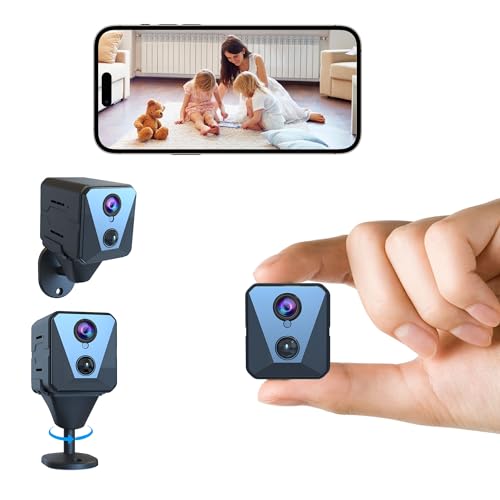
The Funstorm 4K holds the deepest review base of any discreet home camera tracked on this site, backed by a solid owner rating, in a compact, discreet housing at a genuinely accessible price. It records 4K HD video with night vision and motion detection. Owners consistently value the price relative to the review volume behind it. See our lawful-use guidance below before placing any covert camera.
Why You Should Get This
If you want the most review-validated discreet home camera available, at an accessible price, this is the starting point.
Benefits
- Deepest review base of any discreet home camera tracked on this site.
- 4K HD video with night vision.
- Compact, discreet housing.
Pros and Cons
- Largest, most trustworthy review base.
- Genuine 4K resolution at a low price.
- Motion detection included.
- No stated two-way audio.
- Battery life not a headline spec.
- Housing style limits placement options.
Features
- 4K HD video, night vision.
- Motion detection.
- Compact housing.

The realhide camera offers longer unattended battery runtime than the category norm, holding a solid rating from a smaller review base, with 4K resolution and 5GHz WiFi. Owners consistently value the extended battery life for placements that cannot conveniently be recharged often. Its review base is smaller than the category leader’s. See our lawful-use guidance below before any covert placement.
Why You Should Get This
If a placement can’t be conveniently recharged often, this is the camera built around longer unattended battery runtime.
Benefits
- Longer battery runtime than the category norm.
- 4K resolution.
- 5GHz WiFi for faster transfer.
Pros and Cons
- Extended unattended runtime.
- 4K detail.
- Faster 5GHz WiFi than most rivals.
- Smaller review base than the category leader.
- Newer product with a shorter track record.
- Price higher than the entry-level Funstorm.
Features
- 4K resolution.
- 5GHz WiFi.
- Extended battery life.
What "Hidden Camera" Means for Home Security and Privacy
This hub covers small, discreetly-housed cameras. They're designed to blend into a room rather than announce their presence, unlike a visible camera mounted openly. The lawful use case is covert home security: monitoring your own living space, a nursery, or a common area of your own home. The camera itself should never be the focal point of the room. This is not a guide to surveilling another person. No content on this site instructs on unlawful surveillance. Hidden security camera devices range widely in build. Some are fully pre-built units disguised as an everyday object. Others are bare circuit-board modules meant for a buyer's own DIY integration. The right choice depends on the specific placement, not on one style being universally better.
Types of Hidden Cameras for Home Security
The hidden camera category splits into a few distinct housing styles, not one single product type. Pre-housed discreet cameras — like the Funstorm nanny cam above — arrive already built into a small, unobtrusive shell. That shell is designed to blend into a shelf, bookcase or nursery without drawing attention. A second group prioritizes runtime, with a larger battery and sometimes a bigger housing. We do not cover bare camera modules meant to be built into household objects. None of these hidden camera types is inherently "better." For most home security purposes, a visible indoor camera does the same job with fewer legal questions.
Common Home Security and Nanny Cam Use Cases
The lawful use cases for a hidden camera cluster around a handful of genuinely common situations. Childcare monitoring is the single most common one — keeping an eye on a nanny, au pair or babysitter in your own living space. It's covered in depth in our nanny cam covert security guide. A general supplement to visible home security is another common case. A household that already has an obvious camera by the front door sometimes adds a discreet indoor camera as a second layer. The theory: an intruder who spots and disables the visible camera won't necessarily know about the second one. Monitoring a house cleaner, dog walker or contractor working unsupervised in your own home is a third recurring case, provided the placement stays within the lawful common-area, video-only rules covered above. All three share the same boundary. It's your own living space, common areas only, and no audio unless every recorded party consents.
How to Choose a Hidden Camera for Home Security
Resolution and night vision matter here just as much as on any visible camera. A discreet housing doesn't excuse blurry or unusable footage if something actually happens. Motion detection and alerting decide whether you find out about an event quickly, or discover it days later scrolling through hours of footage. Check whether a model pushes a phone notification or only stores locally. Storage approach is a real fork in the road. WiFi-connected cameras generally offer app alerts and remote viewing, but depend on a network connection. Some DIY modules and lower-power options lean on local storage alone. That's simpler, but you only find out about an event when you go looking. Battery-powered units trade convenience of placement for periodic recharging. A hardwired or plugged-in unit runs indefinitely, but constrains where it can physically go. Finally, weigh housing style against your specific placement. A pre-housed discreet camera is faster to deploy. A bare-board module offers more flexibility if you're integrating it into an existing object yourself.
Hidden Camera Detectors: If You Suspect Covert Surveillance
If you’re concerned about a hidden camera in a space someone else controls — a rental, a hotel room, an Airbnb — a dedicated detector device is the appropriate tool, not a countermeasure you build yourself. See best hidden camera detector.
How We Rank
Every product ranked on this hub is scored the same way the rest of the site is: aggregated owner star ratings weighted by review volume, recurring themes in negative reviews, and specification differences owners raise unprompted. We never buy, install or physically test these devices, and every star rating and review count comes from licensed Amazon data. Full method on how we rank.
Want a Standard, Visible Indoor Camera Instead?
For most home security needs, a visible indoor camera is simpler, avoids the legal complexity of covert recording entirely, and is just as effective as a deterrent. Visible cameras also skip an entire category of second-guessing — there's no question about whether a placement crosses a line, because everyone in the room already knows it's there. A hidden camera earns its place specifically when discretion is the point, like watching how a nanny actually interacts with a child rather than how they behave in front of an obvious lens. If that specific need isn't your situation, a standard camera is usually the simpler, equally effective choice. See the indoor cameras hub.
Going Deeper: How Recording Law Is Layered
Recording law works in layers, and audio sits at the top of the risk list. The federal wiretap statute, 18 U.S.C. § 2511, prohibits intentionally intercepting wire, oral or electronic communications, but section 2511(2)(d) says it is not unlawful for a person “not acting under color of law” to intercept a communication “where such person is a party to the communication or where one of the parties to the communication has given prior consent” — unless the purpose is a criminal or tortious act. That is the federal one-party baseline, and a violation of the main prohibition can carry up to five years in prison.
States can be stricter. The Reporters Committee for Freedom of the Press lists about 11 states that primarily require all-party consent — California, Delaware, Florida, Illinois, Maryland, Massachusetts, Michigan, Montana, New Hampshire, Pennsylvania and Washington — and notes others that apply it in narrower situations, such as Missouri and Oregon for in-person conversations and Connecticut and Nevada for phone calls. California shows the stakes: Penal Code § 632 covers recording a confidential communication without the consent of all parties, with a first offense punishable by a fine of up to $2,500, imprisonment, or both.
Video has its own layer. The RCFP notes that every state and the District of Columbia has laws outlawing certain uses of hidden cameras in private places, although many are specifically limited to recording nudity. The federal video voyeurism statute, 18 U.S.C. § 1801, which applies within federal jurisdiction, defines a reasonable expectation of privacy as circumstances where a reasonable person would believe they could disrobe in privacy, or that a private area of their body would not be visible to the public.
Taken together, those layers explain this hub’s rules: video in the common areas of your own home, microphones off unless every recorded person consents, and no camera at all in spaces where people undress or sleep.
Sources & References
- Introduction to the Reporters Recording Guide — Reporters Committee for Freedom of the Press
- 18 U.S. Code section 2511: Interception and disclosure of wire, oral, or electronic communications — Cornell Law School Legal Information Institute
- California Penal Code section 632 (eavesdropping on confidential communications) — California Legislative Information
- 18 U.S. Code section 1801: Video voyeurism — Cornell Law School Legal Information Institute
- Using IP cameras safely — Federal Trade Commission