
Affiliate Disclosure: Some links on this page are affiliate links. As an Amazon Associate, we earn from qualifying purchases — at no extra cost to you. We do not buy, install, or physically handle the cameras we cover; our rankings come from aggregated owner reviews, ratings and expert consensus. Commissions never change our verdicts. We're reader-supported: commissions fund hosting, research and updates, so if a guide helped, buying through our links keeps it going. How we rank · full disclosure.
The short version: color night vision on an outdoor camera splits into two real approaches. Knowing which one a camera uses matters more than the marketing term itself. Spotlight-assisted cameras (Ring's Floodlight Cam Wired Plus, eufy's Floodlight E340) produce the most detailed, reliable color footage because they actively light the scene. Sensor-based cameras pull color mostly from ambient light rather than a floodlight — the Wyze Cam v4 relies on a starlight sensor with only a small 72-lumen built-in LED — at a real cost to detail in true darkness.
In Plain English
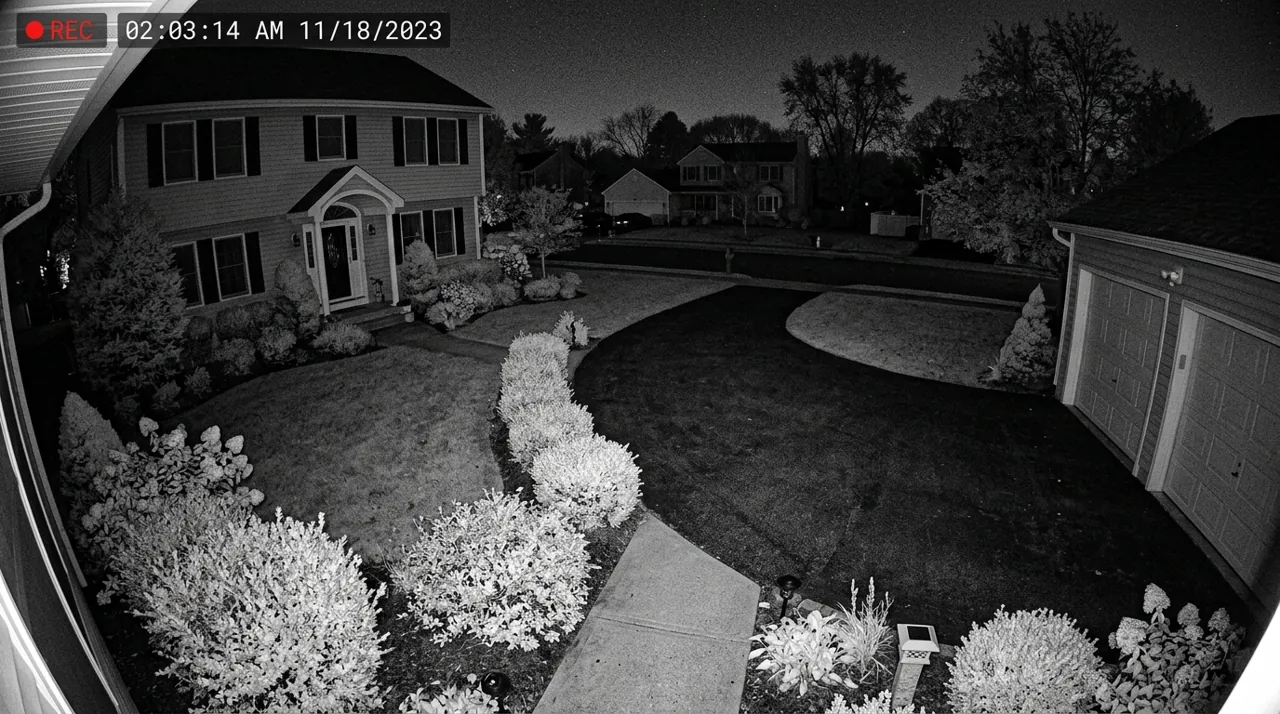
Most security cameras see in the dark using infrared light, which our eyes cannot see. The catch is that the picture comes out in black and white, so you can see a shape but not the color of a jacket or a car.
Color night vision fixes that in one of two ways. Spotlight cameras switch on a real light when something moves, a bit like a camera flash that stays on. Sensor-based cameras use an extra-sensitive sensor that squeezes color out of whatever light is already around, such as a porch light or a streetlamp.
Why it matters: color is often what turns a blurry figure into something you can describe to police.
The trade-offs: a spotlight announces the camera and uses more power, while a sensor-only camera stays discreet but struggles in pitch darkness.
The one thing to check: look for the words spotlight or floodlight, or a lumen number (a measure of brightness), on the box if you want reliable color after dark.
Top Spotlight and Sensor-Based Color Night Vision Picks
The Ranked Field

Best for a wired position that wants floodlight-assisted color night vision.
- Color night vision.
- 2,000-lumen motion-activated floodlights.
- Built-in siren.
- A deep base of owner ratings.
Why buy it: The floodlight does double duty as both a deterrent and a color-night-vision light source, which is the most reliable way to get true color footage after dark.

Best for color night vision on a budget with no subscription.
- 2.5K sensor with color night vision.
- Indoor-or-outdoor rated.
- Local recording, no subscription required.
- A deep base of owner ratings.
Why buy it: The cheapest genuine color-night-vision camera on this site, pairing a starlight sensor with a small built-in LED spotlight so it is not wholly dependent on ambient light.

Best for 360° tracking coverage with color night vision.
- 3K video with 360° pan-tilt AI tracking.
- 2,000-lumen motion-activated floodlight.
- No subscription required.
- A solid base of owner ratings.
Why buy it: Combines color night vision with genuine motorized tracking, unlike most fixed-lens color night vision cameras.

Best for a sunny position that wants both color night vision and zero recharging.
- 3K resolution, f/1.6 aperture for better low-light gathering.
- Adjustable, removable 2.2W solar panel.
- No subscription required.
- A deep base of owner ratings.
Why buy it: The lens aperture is specifically tuned to gather more light, which helps color night vision quality in marginal lighting.
Comparison Table: Resolution and Subscription Notes
| Product | Best for | Buy |
|---|---|---|
| Ring Floodlight Cam Wired Plus | Best Overall | Price |
| WYZE Cam v4 | Best Budget Option | Price |
| eufy Floodlight Camera E340 | Best Motorized | Price |
| eufy Security SoloCam S340 | Best Solar | Price |
How We Rank
We do not buy, install or physically handle these cameras. This ranking is built from aggregated owner star ratings weighted by review volume, manufacturer-published specifications on how each camera achieves color night vision, and the recurring themes inside owner reviews. Full method on how we rank.
Which Color Night Vision Camera Should You Buy?
A wired position where light doesn't bother you: Ring's Floodlight Cam Wired Plus, for the most reliable and detailed color footage.
A plug-in position on a budget: Wyze Cam v4, the cheapest genuine color-night-vision option with no subscription (it runs on USB power, not a battery).
You want motorized tracking as well as color night vision: eufy's Floodlight E340.
A sunny spot where you want zero recharging: eufy's SoloCam S340.
Pros and Cons: Spotlight, Sensor-Based and Standard Infrared
Spotlight-assisted (Ring, eufy Floodlight): Pros — the most detailed, reliable color footage after dark. Cons — an active light announces the camera's position, and installation is typically a wired, mains-voltage job.
Sensor-based (Wyze): Pros — little active light (Wyze's built-in LED is 72 lumens versus 2,000 on the floodlight models here), works discreetly, cheapest entry point. Cons — needs some ambient light to perform well, less detail in true darkness.
Arlo cameras such as the Essential Security Camera (3rd Gen), available in a 2K version, also offer color night vision using an integrated spotlight on a wire-free, rechargeable-battery camera. Worth considering if you want spotlight-assisted color without a wired install. See Arlo cameras ranked by owner reviews.
Electrical Safety, Junction Box Installation and Weatherproofing
Any wired or floodlight camera installed outdoors should carry a safety listing mark, such as UL or ETL, from a Nationally Recognized Testing Laboratory — the third-party certification labs recognized by OSHA — and be rated for outdoor use. Installation at a junction box should follow local electrical code. If you're not confident working at a breaker panel, hire a licensed electrician rather than risk an unsafe DIY wiring job.
Buying Guide: Floodlight, Lumen Ratings and Ambient Light for Identification
The direct answer: pick spotlight-assisted if identification detail matters most. Pick sensor-based if you'd rather the camera stay unobtrusive. This is a real engineering tradeoff, not a marketing distinction. It's worth understanding before comparing star ratings.
How spotlight-assisted color night vision works. An LED light, often paired with the floodlight function itself, actively illuminates the scene. The sensor captures full color under that light, the same way a phone camera does with its flash. This produces the most reliable, most detailed footage in true darkness. The cost is announcing the camera's presence with visible light.
How sensor-based color night vision works. A highly light-sensitive sensor pulls color information from whatever ambient light already exists — moonlight, a porch light, a streetlamp — without adding its own. It's more discreet and typically cheaper to implement. Performance drops in genuinely pitch-dark conditions, though, where a spotlight camera keeps working.
What to check before buying: manufacturer spec sheets rarely state which approach a camera uses in plain language. Look for "spotlight," "floodlight," or an explicit lumen rating as the signal for the assisted approach. Look for phrases like "starlight sensor" or "low-light sensor" for the ambient-only approach instead.
What Consumer Reports says. Consumer Reports highlights built-in spotlights and color night vision as features across the outdoor cameras it has tested, and its lab checks video quality in both daylight and nighttime conditions. That matches the advice above to look at how a camera lights the scene, not just at the number of megapixels.
Rain, Fog, Aperture and Low Light: How Weather Affects Color Night Vision
Color night vision depends on gathering more available light than infrared does. Rain and fog scatter that light before it reaches the sensor. The result is reduced range and softer detail in color footage during poor weather. This shows up more noticeably than with a simple infrared image. A spotlight-assisted camera holds up somewhat better here. It isn't purely dependent on ambient light the way a sensor-based camera is. Its own light source provides a more consistent baseline, regardless of what the sky is doing. A wider aperture and higher resolution sensor both help gather more usable light. Positioning still matters more than either spec on its own. A lens facing directly into wind-driven rain collects water on the housing. That degrades any night vision mode, color or infrared. An angle under an eave or soffit protects image quality more than upgrading hardware alone would.
Battery Life: What Color Night Vision Actually Costs
Color night vision draws more power than standard infrared on a battery camera. The sensor works harder to process available light. A spotlight-assisted model adds the light source itself on top of that. This is a real, measurable hit to expected battery life, not a marketing footnote. Most cameras let you toggle color night vision off, or set it to activate only on specific triggers, rather than running always-on after dark. A battery camera in a high-traffic spot with color night vision left on continuously will need recharging noticeably more often than the same camera running standard infrared. Factor that in before choosing a fully battery-powered model for a position with frequent nighttime motion.
Shooting Through a Window: Reflection Is a Real Limitation, Not Just a Color Night Vision Issue
Any camera mounted to shoot through glass at night runs into the same problem. The window reflects the camera's own light source straight back into the lens. This applies to a color night vision spotlight exactly as much as it applies to a standard infrared LED array. The fix isn't a better camera, it's a better position. Mounting the camera outdoors, rather than behind glass looking out, avoids the reflection entirely. It's the more reliable approach for any exterior position where color detail after dark actually matters.
Going Deeper: How Cameras Switch Between Color and Infrared, and What the Spec Sheets Mean
The black-and-white look of standard night vision is deliberate. Axis Communications’ white paper on IR in surveillance explains that a day-and-night camera uses an IR-cut filter during the day, blocking infrared so the sensor delivers accurate, natural colors. As ambient light fades, the camera mechanically removes that filter so the sensor can capture both visible and near-infrared light, and the result is grayscale video. Color night vision is any design that keeps enough visible light reaching the sensor to stay out of that grayscale mode for longer.
The infrared side has its own trade-off. Axis notes that integrated illuminators normally use 850nm light, which is close enough to visible wavelengths to produce a faint red glow; 940nm LEDs lower the risk of a visible glow, but sensors are slightly less sensitive at that wavelength. That is why “discreet” and “long range” pull against each other on infrared cameras, just as they do between spotlight and sensor-based color.
Spec sheets tell you which approach a camera takes if you know what to look for. Ring lists the Floodlight Cam Wired Plus with 2,000-lumen floodlights. Wyze lists a CMOS starlight sensor on the Cam v4, alongside an integrated spotlight and an IP65 weather rating. eufy says the SoloCam S340’s f/1.6 aperture allows 20% more light and pairs it with an adjustable, removable 2.2W solar panel. Arlo’s spec sheet for the Essential Security Camera (3rd Gen) lists both color night vision and IR black and white. Lumens and spotlights signal the assisted approach; starlight sensors and wide apertures signal the ambient one.
The glass problem on this page is also documented. Axis explains that part of a camera’s own IR light can leak or reflect back into the lens off nearby surfaces such as walls, eaves and ceilings, and that dirt, spider webs, water droplets or snow on the housing cause reflections too; its advice is to keep the beam clear of nearby walls, poles, ceilings and windows. Finally, on safety: OSHA’s Nationally Recognized Testing Laboratory program recognizes private organizations that certify products against OSHA electrical requirements, which is what a UL or ETL listing mark on a wired floodlight camera tells you.
Verdict: Spotlight-Assisted vs Sensor-Based Color Night Vision
If detail after dark is the priority, a spotlight-assisted camera will consistently outperform a sensor-only approach. If you specifically don't want an active light drawing attention to the camera's position, accept the tradeoff and go with a sensor-based option like the Wyze Cam v4. See best outdoor security cameras for the full outdoor category.
Related Accessories

Best for local recording on a camera with a card slot.

Best for angling a camera precisely under an eave, soffit or shelf.

Best for a clean, weatherproof cable entry point on an outdoor mount.
Sources & References
- 9 Best Outdoor Security Cameras, Lab-Tested and Reviewed — Consumer Reports
- Wyze Cam v4 — Wyze
- Floodlight Cam Wired Plus Information — Ring
- Floodlight Camera E340 — eufy
- SoloCam S340 — eufy
- Arlo Essential Security Camera (3rd Gen) Spec Sheet — Arlo
- Nationally Recognized Testing Laboratory Program — OSHA
- IR in Surveillance: Day-and-Night Cameras and OptimizedIR (white paper) — Axis Communications