
Affiliate Disclosure: Some links on this page are affiliate links. As an Amazon Associate, we earn from qualifying purchases — at no extra cost to you. We do not buy, install, or physically handle the cameras we cover; our rankings come from aggregated owner reviews, ratings and expert consensus. Commissions never change our verdicts. We're reader-supported: commissions fund hosting, research and updates, so if a guide helped, buying through our links keeps it going. How we rank · full disclosure.

eufy SoloCam S340
This eufy SoloCam S340 review covers a 3K dual-lens solar-powered outdoor camera with pan-tilt coverage, onboard storage, and no required subscription.
Check Price →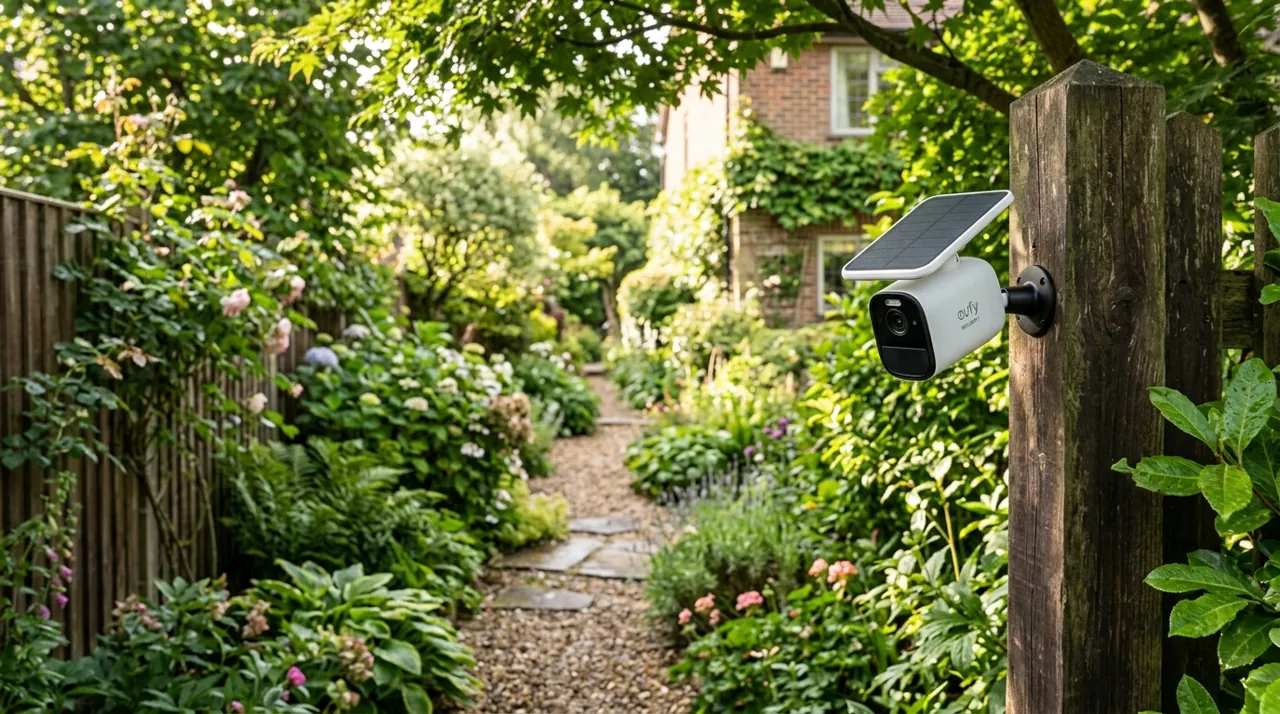
In Plain English
The S340 is an outdoor camera with two lenses, one wide and one zoomed, that can turn and tilt to follow movement. It saves video on its own built-in storage, so there is no monthly fee, and a small solar panel keeps its battery topped up.
The solar numbers are the heart of it. eufy says the panel gathers far more charge on a sunny day than the camera uses. Picture a bank account where one good day’s deposit covers several days of spending. That works well on a sunny wall and poorly in shade, where the deposits shrink and the camera draws on its savings (the built-in battery). The one thing to do is mount the panel where it gets at least two hours of direct sun, even if that means using the cable to place it a little away from the camera.
Full Manufacturer Specifications
Sourced from eufy's official product pages (eufy.com/solocam-s340 and the S340 spec listing).
| Resolution | Dual lens: 3K (2880 x 1620) wide-angle, 135° FOV, plus 2K (2304 x 1296) telephoto; 8x hybrid zoom; clear detail up to 40ft (12m) |
| Lens | f/1.6 aperture, 20% more light than a standard lens |
| Power source | Built-in rechargeable battery topped up by an adjustable, removable 2.2W solar panel |
| Solar collection | Panel collects 800-1,200mAh/day in sun; camera uses 100-200mAh/day at average use |
| Battery life | ~3 months per charge, based on 300 seconds of recording per day (before solar top-up) |
| Motion detection | Triggers at 20-26ft (day) / 13-20ft (night) at default sensitivity |
| Coverage | 360° pan and 70° tilt with automatic tracking |
| Connectivity | Direct 2.4GHz WiFi, no hub or bridge required (HomeBase 3 optional) |
| Audio | Two-way audio |
| Smart home | Streams to Alexa Echo Show and Google Chromecast |
| Storage / subscription | 8GB built-in eMMC storage, no subscription required |
Summary
The eufy SoloCam S340 is the most-reviewed solar-powered camera we've verified for this site. It's backed by a deep review base and a solid rating. Its combination of onboard storage, a built-in battery and a removable solar panel is designed to genuinely eliminate both the subscription fee and the manual recharge cycle for a sunny outdoor position — the two most common friction points with outdoor security cameras generally.
What Owners Praise
The no-hub, direct-WiFi setup is called out as simpler than eufy's HomeBase-dependent models. The solar panel's math checks out for most owners in a genuinely sunny spot. Reviews from those positions report the recharge problem effectively solved. Pan-tilt coverage and the f/1.6 lens's low-light performance are also praised, along with the flexibility of mounting the panel separately from the camera itself.
What Owners Complain About
The solar panel's effectiveness depends heavily on real sun exposure. Owners in shaded or north-facing positions report needing to fall back on manual recharging more often than expected, consistent with eufy's own stated mAh math. Some reviews note the average rating is solid but not top-tier compared to eufy's higher-rated indoor products. A handful of reviewers also mention the two-piece camera-and-panel format as one more thing to mount and align correctly compared to a single-unit battery camera.
Design and Build Quality
The eufy SoloCam S340 pairs a rounded camera housing with a separate, removable solar panel — a two-piece format eufy uses on several solar SoloCam models (others, like the SoloCam E42, integrate the panel into the body). Per eufy's spec page, both lenses carry an f/1.6 aperture, wider than the f/2.0 or narrower apertures common on budget cameras, which owners cite as a real factor in the S340's low-light performance, including its color night vision. Build quality is generally described as solid by owners, consistent with eufy's outdoor camera line. The panel mounts directly to the camera or nearby via a cable, giving installers flexibility to aim the lens and the solar panel at different angles — useful when the best security angle and the sunniest wall face don't line up.
eufy SoloCam S340 Installation and Mounting
Setup starts in the eufy Security app, which pairs the camera over direct WiFi with no hub or bridge required, per eufy's spec page. Physical mounting is a standard drill-and-screw job into the included bracket, similar to most battery and solar outdoor cameras — no mains wiring, junction box or electrician needed. The bigger decision is placement: eufy's own mAh math means the panel needs meaningful daily sun exposure to keep the battery topped up, so owners get the best results scouting the mounting wall's actual sun path across a full day before committing to a hole. A north-facing wall, a shaded eave or a spot with only an hour of direct sun will lean much harder on the built-in battery than the panel's daily collection numbers assume.
Solar Math and Battery Life
eufy's own spec sheet states the removable solar panel collects 800-1,200 mAh per day in adequate sun, against a typical camera draw of just 100-200 mAh per day, and eufy says about 2 hours of direct sunlight a day is enough to keep the camera continuously powered in a reasonably sited install. The eufy SoloCam S340 battery life is rated at roughly 3 months per charge under average use before solar top-up, per eufy's figures, and the built-in battery is the fallback reserve for a stretch of cloudy weather or a less-than-ideal mounting angle. Owners in genuinely sunny climates report the recharge cycle effectively disappears once the panel is dialed in; those in shaded or seasonally overcast regions report needing an occasional manual top-up, particularly heading into winter.
Motion Detection and Pan-Tilt Coverage
Per eufy's spec page, motion detection triggers at 20-26 feet in daytime and 13-20 feet at night at the default sensitivity setting, with 8x zoom and 3K resolution delivering clear detail up to 40 feet. The pan-and-tilt mechanism (360° pan, 70° tilt, per eufy) gives the S340 wide coverage from a single mounting point rather than the fixed single angle a static camera is limited to, which matters most on a wide driveway, a long fence line or a property corner where one static lens would miss most of the area. Owners report the pan-tilt motor moving smoothly through its full range without the jerky or delayed motion some budget pan-tilt cameras exhibit.
Smart Home Streaming and App Notifications
Per eufy's spec page, the S340 streams to an Alexa Echo Show display or a Google Chromecast-connected TV, on top of the standard eufy Security app live view. That's a genuine convenience for a household that already leans on a smart display for quick camera checks, rather than pulling out a phone every time. Push notifications fire on motion detection, and owners report the alerts arrive promptly enough to catch a person or vehicle in near-real time. Because the camera needs no hub, notification setup is a direct app-to-camera pairing step, with no separate bridge device to configure or troubleshoot.
Who It's For
Buyers with a genuinely sunny outdoor mounting position who want to eliminate both the subscription fee and the recharge cycle in one purchase. It's a strong fit for a driveway, shed or fence line with real daily sun exposure, and for anyone who already owns other eufy cameras and wants to stay within one app and one ecosystem.
Who Should Skip It
Shaded or north-facing positions won't get the full benefit of the solar panel — see solar cameras for placement guidance, or consider a wired camera instead for a spot with no real sun.
Pros and Cons
Pros: genuinely no-subscription with onboard storage, solar panel math holds up in real sun, pan-tilt coverage, no hub required.
Cons: solar effectiveness drops significantly in shade, the rating is solid but not top-tier within eufy's own lineup, higher upfront price than a comparable non-solar battery camera.
Going Deeper: Reading eufy’s Solar Math
eufy is unusually specific about the S340’s energy budget. eufy’s product page says the panel collects 800 to 1,200 mAh a day, that the camera uses 100 to 200 mAh over a day and night of average use, and that two hours of direct sunlight daily is enough to keep it continuously powered. Divide the ranges and a sunny day banks roughly four to twelve days of typical use. That surplus is what carries the camera through cloudy stretches before the built-in battery, which eufy rates at up to three months of reserve, has to take over.
Those collection figures assume adequate sun, and panel ratings in general are optimistic. A DOE-sponsored assessment of PV performance explains that modules are rated at 1,000 watts per square metre of sunlight and a 25°C cell temperature, while real sunlight is usually less intense and cells usually hotter, and output falls as temperature rises. eufy says the S340’s panel converts up to 25% of available sunlight into energy, so the light that actually reaches the panel matters more than the panel itself. A panel that sees only diffuse light under an eave collects a fraction of its rated figure, which is the shaded-wall complaint in owner reviews.
The same report notes that most variation in solar output is predictable from the time of day, the time of year and the angle at which sunlight hits the module. That is why the removable, adjustable panel matters: aiming it toward the midday sun and away from shade raises the daily deposit while the camera stays wherever the view is best. On the spending side, every recording and every pan-tilt movement comes out of the same budget, so tighter detection zones stretch the surplus as surely as better sun does.
Verdict
In the right position — real, consistent sun — this is one of the more complete subscription-free outdoor answers on this site, genuinely solving both the fee and the recharge problem at once. See solar security cameras compared side by side for how it compares against the wider field.
Accessories for This Camera

Best for local recording on a camera with a card slot.

Best for angling this camera precisely under an eave, soffit or shelf.
Alternatives to Consider
- aosu D1 Classic Solar Camera review
- Best Solar Security Cameras — the full ranked field
Sources & References
- eufy SoloCam S340 — eufy
- eufy SoloCam S340 specifications (T81701W1) — eufy
- eufy SoloCam E42 2-Cam Kit — eufy
- Understanding Solar Photovoltaic System Performance: An Assessment of 75 Federal Photovoltaic Systems — U.S. Department of Energy / NREL