
Affiliate Disclosure: Some links on this page are affiliate links. As an Amazon Associate, we earn from qualifying purchases — at no extra cost to you. We do not buy, install, or physically handle the cameras we cover; our rankings come from aggregated owner reviews, ratings and expert consensus. Commissions never change our verdicts. We're reader-supported: commissions fund hosting, research and updates, so if a guide helped, buying through our links keeps it going. How we rank · full disclosure.
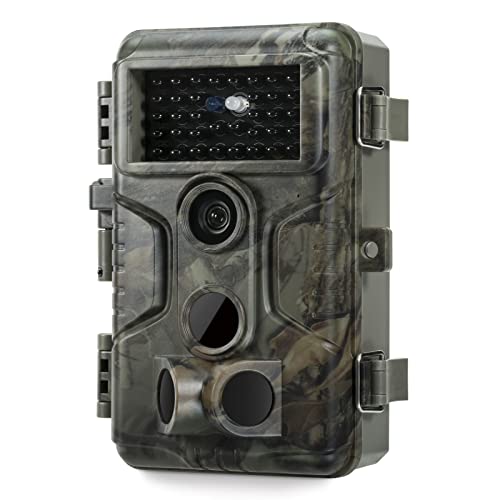
GardePro A3S Trail Camera
A fast-triggering, non-cellular trail camera with 64MP photo and 1296P video capability.
Check Price →In Plain English
The GardePro A3S is a trail camera you strap to a tree and visit every week or two to swap the memory card. It has no phone connection and no monthly fee. Its big strength is speed: it fires almost the instant something moves, so you catch the deer instead of the empty trail behind it.
At night it lights the scene with infrared (light just beyond what our eyes can see), so the camera records a black-and-white picture while the woods stay dark. This model uses a no-glow type that does not show the faint red dot some older cameras give off. The one thing to do before your first trip is buy a full-size SD card, because none comes in the box, plus a spare set of AA batteries for cold weather.
Full Specifications
| Photo resolution | 64MP |
| Video resolution | 1296P HD, with sound |
| Trigger speed | 0.1 seconds |
| Night vision | 940nm no-glow infrared, about 100ft range |
| Detection | 3 PIR sensors, 120° angle, about 85ft range |
| Power | 8 AA batteries; 12V DC or GardePro solar panel optional |
| Storage | Full-size SD card up to 512GB (not included) |
| Weather rating | IP66 |
| Screen | 2.4-inch color display |
| Connectivity | None — fully card-based, non-cellular |
Summary: GardePro Trail Camera Review
The GardePro A3S holds a solid rating across a deep base of verified owner ratings, making it one of the more thoroughly evidenced non-cellular trail cameras on the market. Its 0.1-second trigger speed and 64MP photo capability are the two specifications owners praise most, and together they cover the two things that matter most for actually catching game on camera: speed and detail.
What owners praise
The trigger speed comes up in nearly every positive review — owners specifically note capturing fast-moving deer that a slower camera would have missed entirely. Photo detail at 64MP is enough to identify individual animals at real distance, and the no-glow infrared night vision is reported as genuinely non-disruptive to wildlife compared to red-glow alternatives.
What owners complain about
As with most trail cameras in this price range, battery life varies significantly depending on trigger frequency — a high-traffic trail drains batteries faster than the marketing figures suggest. A minority of reviews mention the included instructions as sparse, requiring some trial and error to configure sensitivity settings optimally.
Setup and Mounting
The GardePro A3S sets up with a menu accessed on its built-in screen, no app or phone pairing required. Insert an SD card, load batteries, set the date and trigger sensitivity, and mount it. The whole process takes most owners well under 20 minutes.
Mounting uses an adjustable strap around a tree trunk or post. Height and angle matter more than most first-time buyers expect. Too low catches mostly grass and legs. Too high misses smaller animals entirely. Waist to chest height, angled slightly downward toward the trail, works well for most setups.
Storage: Memory Card and Capture Format on the GardePro A3S
The GardePro A3S writes every capture to a full-size SD memory card (up to 512GB, per GardePro), sold separately. No card ships in the box, so ordering one alongside the camera avoids an unpacking-day surprise. A high-endurance card designed for continuous write cycles holds up better over a season than a basic consumer card built for occasional phone photo storage.
Card capacity determines how long the camera runs between visits. A larger card at 64MP photo resolution stores meaningfully more images than the same capacity would at a lower resolution, since each file is larger. Buyers checking a remote trail infrequently should size the card up accordingly rather than assuming any SD card handles a full season at this resolution.
Photo Resolution and Video Quality in Practice
64MP photo resolution is high for this price category. Owners report clear enough detail to identify individual animals at real distance, not just a blurry silhouette. The 1296P HD video, recorded with sound, adds a second capture format for the same trigger event.
Detail like this matters most at range. A trail camera aimed across a wide field or clearing benefits far more from high resolution than one mounted a few feet from a feeder, where even a modest camera captures enough detail up close.
No-Glow Night Vision
The GardePro A3S uses 940nm no-glow infrared LEDs, a wavelength outside what most wildlife perceives as visible light, with a night range of about 100 feet per GardePro. Owners report it as genuinely non-disruptive compared to older red-glow infrared cameras, which can flash a faint red light some animals notice and avoid.
This matters most for skittish game like mature deer, which learn to avoid a visibly flashing camera over repeated encounters. A no-glow camera keeps capturing natural behavior on a trail an animal has already grown wary of.
Battery Life and Power
Eight standard AA batteries power the GardePro A3S, with no proprietary battery pack to source; GardePro also lists 12V DC and solar panel options for longer deployments. Trigger frequency is the single biggest factor in battery life. A quiet, low-traffic trail stretches a set of batteries much further than a busy feeder spot with dozens of daily triggers.
Cold weather shortens battery life on any battery-powered outdoor device, this camera included. Owners in colder climates commonly report keeping a spare set on hand through winter, the same practical habit that applies across the trail camera category.
How This Non-Cellular Trail Camera Compares
Within the non-cellular category, the GardePro A3S sits in the mid-range on price with genuinely high-end specifications for that tier. Its 0.1-second trigger speed and 64MP resolution match or beat some pricier cameras. Buyers wanting to cover two trails at once rather than one might prefer the Moultrie Edge 2 vs TACTACAM Reveal X 3 comparison for cellular alternatives, or the GardePro A3S vs SPYPOINT Flex-M comparison for a direct cellular-vs-non-cellular tradeoff against this exact camera.
Weatherproofing and Long-Term Outdoor Durability
The GardePro A3S ships in an IP66-rated housing built for extended outdoor exposure, the standard for this category. Owners report it holding up through rain, humidity and temperature swings across a hunting season with no reported water intrusion issues.
A few basic habits extend the life of any trail camera left outdoors for months. Angle the lens slightly downward to shed rain rather than collect it. Check the battery compartment seal periodically. Avoid mounting directly under a spot where snow or ice regularly slides off a branch onto the housing. A locking security box, sold separately, adds real protection against both weather and theft for a camera left unattended on land you don't visit daily. It's a small extra cost worth considering for any trail camera mounted somewhere without regular foot traffic or a clear line of sight from the house.
Who It’s For
Hunters and land owners who check a camera every week or two and want fast, detailed capture without a monthly cellular cost.
Who Should Skip It
If the property is far enough that a physical check is impractical, a cellular model makes more sense — see a ranked list of cellular trail cameras.
Pros and Cons
Pros: fast 0.1s trigger, high 64MP photo detail, no-glow night vision, no monthly cost, solid review base.
Cons: battery life varies with traffic volume, sparse included instructions.
Going Deeper: How 940nm No-Glow Infrared Stays Out of Sight
Infrared night vision works because camera sensors record light our eyes barely register. A study published in PNAS notes that human visual perception is most responsive to light in the 400 to 720 nanometre range, and that sensitivity falls off steeply beyond it: at 1,050 nm, the peripheral retina’s sensitivity to ordinary one-photon stimulation is less than a trillionth of its maximum at 505 nm. Trail-camera infrared sits in that fading zone just past visible red, and the further an emitter sits beyond the visible range, the less the eye responds to it.
That is the principle behind no-glow designs. GardePro specifies 940nm no-glow IR LEDs for the A3S, with a night range of about 100 feet, and says the camera adjusts infrared LED power based on the animal’s distance, so a nearby deer is not lit at full range power. Owners describe the result as non-disruptive to wildlife, and no-glow is the usual choice when a camera also needs to stay unnoticed by people after dark.
Invisible is still not the same as undetectable. The same PNAS research found that people can perceive some infrared: pulsed laser light at 1,040 nm was seen as green through a two-photon process, although continuous light of the same average power produced much weaker perception. A trail camera’s LEDs are nothing like a laboratory laser, but the finding is a reminder of why this page says no infrared technology is completely undetectable to every species. Pair the no-glow flash with sensible placement, such as a camouflaged housing and a camera that is not pointed at a path people use, and it does its job.
Verdict
A well-evidenced, fast-triggering non-cellular trail camera and the right default for most hunters checking a camera in person. See best trail camera for how it compares against the wider field.
Accessories for This Camera

Best for local recording on a camera with a card slot.

Best for angling this camera precisely under an eave, soffit or shelf.
Alternatives to Consider
- Moultrie Edge 2 review
- SPYPOINT Flex-M review
- Best Trail Camera — the full ranked field
Sources & References
- GardePro A3S Non-Cellular Trail Camera — GardePro
- SPYPOINT Transmission Plans — SPYPOINT
- Moultrie Mobile Plans — Moultrie
- Human infrared vision is triggered by two-photon chromophore isomerization (PNAS, 2014) — PubMed Central, National Library of Medicine