
Affiliate Disclosure: Some links on this page are affiliate links. As an Amazon Associate, we earn from qualifying purchases — at no extra cost to you. We do not buy, install, or physically handle the cameras we cover; our rankings come from aggregated owner reviews, ratings and expert consensus. Commissions never change our verdicts. We're reader-supported: commissions fund hosting, research and updates, so if a guide helped, buying through our links keeps it going. How we rank · full disclosure.
Want the best solar security camera with no subscription for your home? You are in the right place — every camera on this page records locally or to built-in storage with no monthly cloud fee, which is exactly the pairing most solar-for-home buyers are after: no outlet, no plan. The short version: the aosu D1 Classic four-camera kit is the most review-validated solar system tracked on this site, backed by one of the deepest owner-review bases in this category, with 32GB of local storage on its included hub and no subscription. If you need one camera rather than four, the entry-level AlkiVision carries the highest star rating on this page, and the equally affordable GALAYOU R6 solves the problem most solar buyers actually hit — a great camera position that happens to be in the shade — with a detachable panel on a cable.
Before choosing, be honest about the sun at your mounting spot. Our solar cameras hub covers panel siting, sun-hour requirements and the winter problem in full. If the position is shaded or north-facing, skip this category and read best wireless security cameras, where battery capacity rather than sun exposure is the deciding number. And if there is no WiFi at the location, go to cameras without WiFi, most of which are solar-powered anyway.
In Plain English
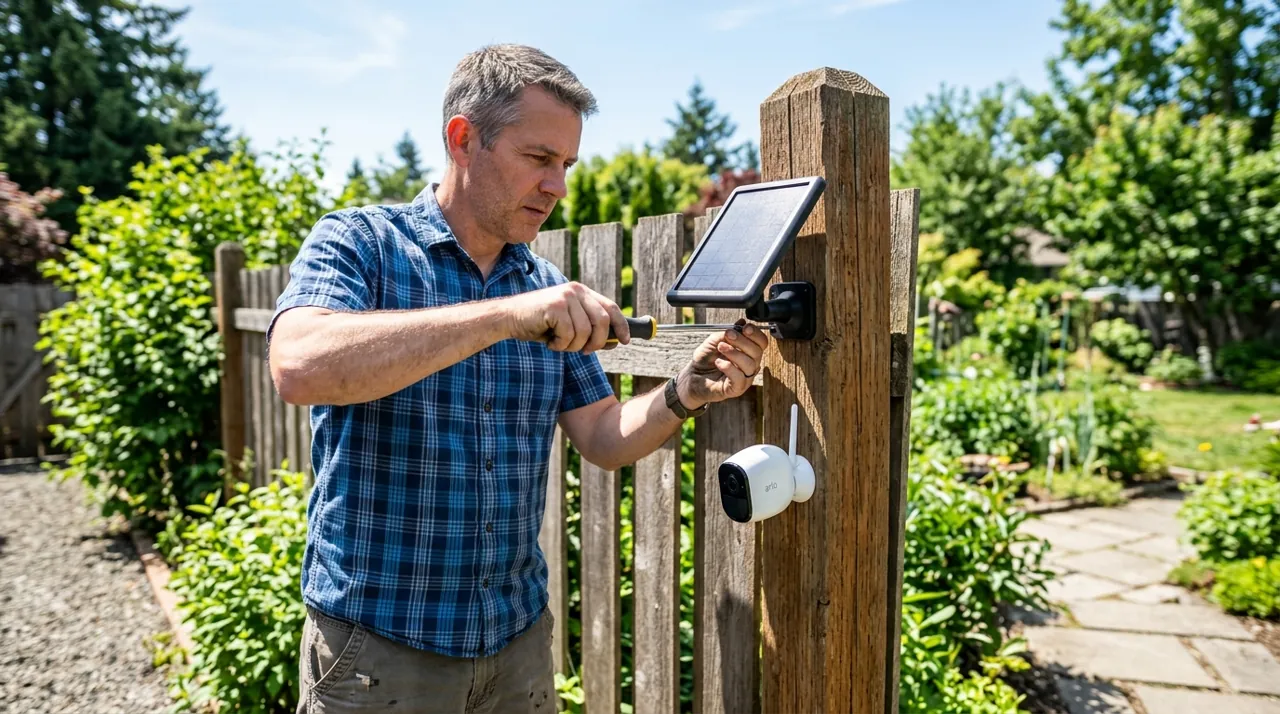
Every camera on this page runs on a battery that a small solar panel tops up during the day, and none needs a monthly fee to save footage. That removes two chores at once: climbing a ladder to recharge, and paying for cloud storage.
The catch is that solar is only as good as the sunlight it gets. A panel in shade is like a phone charger plugged into a switched-off socket: it looks connected, but very little flows. That is why a detachable panel (one on a cable, so it can sit in the sun while the camera sits where the view is) matters more than resolution for many homes. The one thing to do before buying is check your mounting spot at 9am, noon and 4pm, and make sure it gets at least two hours of direct sun.
Top Rated Picks at a Glance
Our #1 Pick: aosu D1 Classic 4-Cam Kit
Solar cameras are a category where review depth matters more than usual, because the failure mode you care about — a camera that quietly stops keeping up with its own power consumption — takes a full year and a winter to appear. Most solar cameras on Amazon have a few hundred ratings, which is not enough time for that to show. The aosu D1 Classic has roughly 3,800, and that is the strongest argument for it.
Consensus Score ████████▓░░░ 8.6 — from one of the deepest verified owner-review bases in this category.
What owners describe is the thing solar is supposed to deliver and often does not: four cameras installed on a Saturday that have not been touched since. The 360-degree auto-tracking is the second most praised feature, because it means one camera covers a whole side of a property rather than a single fixed cone. And the 32GB of local storage on the included aosuBase means there is no card to buy and no monthly fee to cancel — the hub simply sits indoors — reviewers who arrived from a subscription brand mention that repeatedly.
The honest weaknesses. Its 2K (roughly 3MP) resolution is modest, clearly outclassed by the 4K eufy kit and no sharper than the 2K budget cameras below — if you need to read a plate at thirty feet, this is not the kit. Auto-tracking draws power on every event, so a high-traffic frontage will test the panel harder than the review average suggests. The 32GB is shared by all four cameras and aosu lists no expansion option, so long events overwrite older ones sooner than owners expect. And at a mid-range price for four cameras it is a real outlay compared to the entry-level singles here.
The Ranked Field: Star Rating, Consensus and Price

Best for covering a whole property with no wiring and no monthly fee.
- Four solar cameras with 360-degree auto-tracking.
- 32GB of local storage on the included aosuBase, no subscription required.
- 2K (3MP) color night vision.
- Fully wire-free camera installation on any sunlit wall.
Why buy it: One of the deepest review bases in solar at 3,800-plus owner ratings, and the consensus favors it as the kit that genuinely stops needing attention.
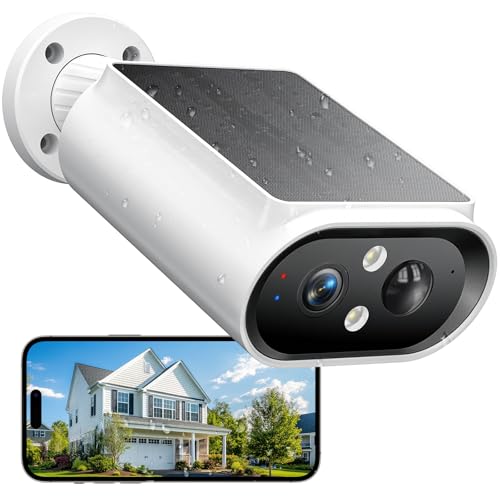
Best for a single sunlit corner, shed or side gate.
- 2K resolution with color night vision.
- 360-degree view with AI motion detection.
- Spotlight, siren and two-way audio.
- IP67 weatherproof rating for exposed positions.
Why buy it: The highest star rating on this page at forty dollars — the caveat is a review base of only around 200, so treat it as promising rather than proven.

Best for a spot where the camera and the sun are not in the same place.
- 2K video with color night vision.
- Detachable solar panel on a cable.
- Designed for garages, farms and outbuildings.
- Runs on 2.4GHz WiFi with local storage.
Why buy it: The detachable panel is the feature that solves the real-world problem — mount the camera where the view is, the panel where the sun is.
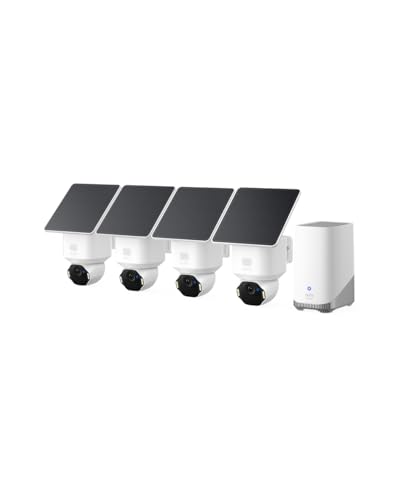
Best for buyers who want 4K detail and no subscription across four positions.
- 4K resolution across all four cameras.
- Integrated solar panel on each unit.
- Local storage with no monthly fee.
- On-device AI detection to cut false alerts.
Why buy it: The only 4K solar kit here, and eufy is the one brand on this page with a long track record of subscription-free operation.
Comparison Table: Price, Star Rating and Panel Type
| Product | Best for | Buy |
|---|---|---|
| aosu D1 Classic Solar Camera — 4-Cam Kit | Best Overall | Price |
| AlkiVision 2K Solar Security Camera | Best Budget | Price |
| GALAYOU R6 Solar Camera with Detachable Panel | Best Single Camera | Price |
| eufy SoloCam E42 4K — 4-Cam Kit | Best Premium | Price |
How We Rank
We do not buy, install or physically handle solar security cameras. There is no test property, no sun-hour meter and no pretence otherwise. What we do is read the evidence that already exists at scale: aggregated owner star ratings, weighted by review volume so that a 4.6 from 207 buyers does not automatically outrank a 4.3 from 3,800; the recurring themes in negative reviews, which in solar are overwhelmingly about winter charging and panel siting rather than about image quality; the specification differences owners raise unprompted; and expert consensus across the category. Review depth carries extra weight here specifically because a solar camera’s real failure mode only appears after a full year. Every star rating and review count on this page comes from licensed Amazon data rather than from us, and a product with no verified rating renders no stars at all. Full method on how we rank.
Every Solar Camera Reviewed: Pros and Cons
1. aosu D1 Classic 4-Cam Kit — Best Overall
The most thoroughly reviewed solar system in the category and the one with the best evidence of surviving a full year unattended. What owners praise: genuine set-and-forget operation in sunny positions; 360-degree auto-tracking that follows a subject across the frame rather than watching them leave it; 32GB of local storage on the included aosuBase that removes both the card purchase and the subscription; straightforward setup across four cameras; and per-camera pricing around seventy-five dollars. What owners complain about: 2K (3MP) resolution that is fine for knowing something happened and weaker for identifying who; auto-tracking that occasionally loses a subject and resets mid-event; storage that fills and overwrites sooner than expected on a busy camera; and northern owners reporting midwinter charging, which is the category-wide issue rather than a fault of this kit.
2. AlkiVision 2K Solar Camera — Best Budget
The highest star rating on this page at around forty dollars, and the entry that most needs its caveat stated plainly. What owners praise: 2K detail and color night vision at a price where 1080p is normal; a spotlight and siren that deter rather than merely record; AI motion detection that reviewers say cuts false alerts meaningfully; an IP67 rating suitable for fully exposed mounting; and 360-degree coverage. What owners complain about: app polish and documentation well below the established brands; occasional pairing difficulty on setup; and the decisive one — a review base of roughly 200, far too thin to say anything confident about how it performs after two winters. Buy it for a supplementary position, not for your primary coverage.
3. GALAYOU R6 Solar Camera — Best Single Camera
The cheapest camera here and the one that solves the most common real-world solar problem. What owners praise: the detachable panel on a cable, which lets you mount the camera where the view is and the panel where the sun is — a distinction that decides whether a solar install works at all; 2K video with color night vision; and a price low enough that covering a garage, a farm gate and a side path becomes affordable. What owners complain about: a modest 349-rating review base; a single-camera app experience that gets clunky once you own several; 2.4GHz-only WiFi, which is normal for the category but limits placement to within reasonable router range; and a mount that reviewers describe as adequate rather than solid in high wind.
4. eufy SoloCam E42 4K — 4-Cam Kit — Best Premium
The most capable system here, and the best 4K solar security camera kit on this page, is also the most expensive, at a premium price, aimed at buyers who want detail rather than just presence. What owners praise: 4K footage that survives heavy cropping, which is what actually turns a recording into evidence; on-device AI detection that reduces false alerts without a subscription; local storage on the included HomeBase 3 or microSD with no monthly fee, which eufy has a longer track record on than any other brand here; and integrated panels that keep the install tidy. What owners complain about: the price, plainly, at a premium rate per camera; a rating that, while solid, rests on a review base still thin for a premium product; 4K consuming noticeably more power per event, so the sun-hour requirement is at the top of the range; and integrated panels forcing the camera position and the sun position to be the same place.
Buying Guide: Sunlight Exposure, Panel Angle and Battery Backup
The direct answer: assess your sun exposure first, then battery capacity, then whether the panel detaches. Resolution comes fourth, and in this category it trades directly against how much sun you need.
Sun Hours at the Panel
Two to four hours of direct sun per day is the consensus requirement. Check the spot at 9am, noon and 4pm rather than assuming, because a position that looks bright at one hour is often in a building’s shadow at another. Mounting angle is the free upgrade almost nobody uses: a panel flat against a vertical wall receives light at a poor angle for most of the day, and tilting it toward the midday sun is a real output gain that costs nothing. In snow country it also lets the panel shed snow instead of collecting it.
Battery Capacity
The panel does not power the camera; it trickle-charges a battery, and the battery does the work. That means battery capacity is the buffer that carries the camera through a run of gray days. A larger battery generates nothing, but it decides whether five overcast days is a non-event or a dead camera. In northern climates this is arguably the more important of the two numbers.
Detachable vs Integrated Panels
A detachable panel on a cable lets you separate the coverage decision from the charging decision, which is the difference between a working install and a frustrating one. Integrated panels are tidier and have one fewer connector to admit water, but they force the camera and the sun into the same spot. If your position is at all shaded, buy detachable — the GALAYOU R6 here is the clearest example.
Storage and Detection
Solar is a strong category for avoiding subscriptions, so the best solar security cameras without subscription fees are easy to find: built-in storage and microSD slots are common, and all four systems here keep recording with no monthly fee. Detection intelligence matters more on solar than anywhere else, because every false trigger is charge you do not get back. A camera that fires on every swaying branch will drain a panel that would comfortably sustain a smarter one, so person and vehicle filtering is a power feature as much as a convenience feature.
Off-Grid Placement: Where Solar Charging Earns Its Keep
Detached structures. Sheds, barns, workshops and detached garages — a roofline, sun exposure and no convenient outlet. This is the classic case and the one that produces the most satisfied owners.
Gates, driveways and property lines. Long distances from the house where running power would mean trenching. Provided WiFi reaches, solar is dramatically cheaper than the alternative.
Seasonal and second properties. A cabin nobody visits for two months is exactly where a camera that never asks for a charge matters most.
Rentals and HOA properties. No wiring means no permission and nothing to restore when you leave.
Where solar is the wrong answer: north-facing walls, heavily wooded lots, covered porches, balconies under other balconies, and any high-traffic frontage where event volume outruns a small panel. In those cases, run power and read the wired PoE hub, or accept the recharge cycle and buy on battery capacity from the wireless and battery hub.
What Owner Reviews Complain About: Cloudy Days and Battery Drain
Four themes recur across every brand in this category.
Winter charging. The dominant negative theme above roughly the 40th parallel. Shorter days, lower sun angle, cold-reduced battery capacity and snow on the panel stack up at once, and the low-battery alert typically arrives during the first long cold snap. Not a defect, and worth planning for with a swappable battery or a reachable panel.
Panel siting. The second most common complaint and the most avoidable. Owners who upgrade to a bigger panel in a shaded position report modest improvement; owners who move the same panel a few feet into the sun report the problem disappearing entirely.
Water at the connector. On detachable-panel models, the cable connection rather than the camera body is where reviews report moisture getting in. Point the connector downward and use the supplied weather seal.
App and setup quality on the budget brands. The cheap end of solar delivers surprisingly good hardware and consistently underwhelming software. Expect sparse instructions and a functional rather than polished app at the entry-level end.
Warranty and Returns: What the Listing Does Not Say
Solar cameras have two parts that can fail independently, and the warranty usually treats them as one product. The mainstream brands here — eufy in particular — publish a limited hardware warranty, and eufy has a long-established US support operation behind it. The entry-level brands are a different proposition: cover is often nominal, the return window on the retail listing is the practical remedy, and replacement parts such as a spare panel or a matching cable frequently are not sold at all.
That asymmetry matters more than it sounds, because the part most likely to need replacing is the cheap one. A cracked panel, a chewed cable or a corroded connector can retire an otherwise healthy camera if no spare exists. Two practical habits from owner reviews: register the product if the brand offers it, and mount everything within the return window — problems with sun exposure show up in the first fortnight, well before any warranty question arises.
No Outlet Needed: What Solar Actually Removes
The reason this category sells is simple. No outlet needed, no cable through a wall, no electrician, no trench across a lawn. For a shed, a gate, a barn or a rental, that removes the entire reason most people never installed a camera there. Installation on all four systems here is a bracket, two screws and a few minutes of app pairing.
What solar does not remove is the network. Every camera on this page still needs WiFi to reach your phone, and 2.4GHz WiFi at that, so a gate 300 feet from the house may be beyond reach even in full sun. It also does not remove the recharge entirely — it makes it rare rather than routine, and in a northern winter it may still be once or twice a season. Judge the category on those honest terms and it delivers; expect a wired camera without wires and it will disappoint.
How to Choose Between These Four
If you are covering a whole property and want it to stop needing attention: the aosu D1 Classic four-camera kit. Deepest review base on this page, no subscription, no card to buy.
If you need detail rather than just presence: the eufy SoloCam E42 4K kit, accepting the price and the higher sun requirement.
If your best camera position is shaded: the GALAYOU R6, because the detachable panel is the only thing that actually solves that.
If you want one cheap camera for a sunny corner: the AlkiVision 2K, treated as a supplement rather than as your main coverage.
Not sure solar is right at all? If the spot gets under two hours of direct sun, it is not — read best wireless security cameras and buy on battery capacity instead. If there is also no WiFi, read cameras without WiFi. And if the camera is going on a busy front elevation, a floodlight camera on mains power will outperform anything on this page.
Best Value in 2026: Solar Panel Size Against Price
Best value in solar is not the cheapest camera, and it is not the highest star rating either. It is the most panel and the most battery per dollar in the position you actually have. On that measure the GALAYOU R6 is the best value pick on this page at an entry-level price, because the detachable solar panel removes the constraint that ruins most cheap installs, and a working cheap camera beats a stranded expensive one.
The aosu kit is the better value at scale: a modest price per camera with storage included and no monthly fee is difficult to match once you need three or four positions. By comparison, adding a first-party solar panel to a Ring, Arlo or Blink battery camera you already own typically adds a moderate amount on top of the camera, which is worth knowing before you replace hardware that is working. Reolink sits between the two, undercutting the mainstream brands while still shipping a proper app.
Why the Best Solar Security Cameras 2026 Still Need an Occasional Recharge
No camera on this page is genuinely maintenance-free everywhere, and any listing that implies otherwise is overselling. In a south-facing position with three or more hours of direct sun, owners report years without touching the camera. In a marginal position, or anywhere north of roughly the 40th parallel, expect one or two manual recharge events per year, clustered in December and January.
Plan for it rather than being surprised by it. A camera with a removable battery turns a recharge into a two-minute swap indoors; a sealed camera with a USB-C port on the body still beats one that must come off the bracket entirely. Mount within ladder reach, charge the battery to full before the camera goes up, and treat the first winter as the real evaluation period while returns are still an option.
Going Deeper: Why Shade and Cold Hit Solar Cameras So Hard
Solar panels are rated under conditions real walls rarely match. A DOE-sponsored review of 75 federal PV systems notes that modules are rated at 1,000 watts per square metre of sunlight and a 25°C cell temperature, while in practice sunlight is usually less intense and cells usually run hotter; output drops according to a temperature coefficient, and module efficiency degrades with age at about 0.5% a year. DOE’s solar office lists soiling, module operating temperature and partial shading among the sources of power loss during operation.
Shade is the loss buyers underestimate, because a partly shaded panel still looks mostly sunny. The advice on this page to move the panel into the sun rather than buy a bigger one follows directly: siting decides the input, and the input is small to begin with. eufy’s own figures for the SoloCam S340 show the size of the margin. Its panel collects 800 to 1,200 mAh a day in adequate sun against 100 to 200 mAh of daily use, and eufy says two hours of direct sunlight is enough. That is a comfortable surplus in sun and a thin one in shade.
Cold works on the other end, the battery. The government’s fueleconomy.gov notes that battery performance decreases in cold weather, and that an electric vehicle’s range can drop by about 41% in cold conditions with the cabin heater running, or about 12% without it. A camera battery has no heater to feed, but the same principle means stored charge does less work in January, when shorter days and a lower sun angle also leave the panel collecting less. That combination, not a defect, is why northern owners report one or two manual charges each winter, and why a removable battery or a reachable mount is worth prioritizing.
The Verdict
The aosu D1 Classic four-camera kit is the solar system we would point most readers toward, and the reason is evidence rather than specification. Solar cameras fail slowly — a camera that cannot quite keep up with its own consumption takes a year and a winter to reveal it — so review depth is worth more in this category than anywhere else on the site. At 3,800-plus ratings, this kit has roughly ten times the verified history of anything else here, and the recurring praise is precisely the outcome buyers want: installed once, never touched again.
If image detail matters more than review depth, the eufy SoloCam E42 4K kit is the honest upgrade, and eufy has the longest track record of genuinely subscription-free operation among these brands. If you only need one camera, buy the GALAYOU R6 for its detachable panel rather than the slightly better-rated AlkiVision, because in solar the panel siting decides more outcomes than the sensor does. Whatever you buy, spend five minutes checking the mounting spot at three different times of day first. That check prevents more solar disappointment than any product choice on this page.
Related Accessories

Best for local recording on a camera with a card slot.

Best for angling a camera precisely under an eave, soffit or shelf.
Sources & References
- SolarCam D1 Classic Kit — aosu
- eufy SoloCam E42 2-Cam Kit — eufy
- eufy SoloCam S340 — eufy
- Understanding Solar Photovoltaic System Performance: An Assessment of 75 Federal Photovoltaic Systems — U.S. Department of Energy / NREL
- Photovoltaic system design and energy yield — U.S. Department of Energy
- Fuel economy in cold weather — U.S. Department of Energy (fueleconomy.gov)