
Affiliate Disclosure: Some links on this page are affiliate links. As an Amazon Associate, we earn from qualifying purchases — at no extra cost to you. We do not buy, install, or physically handle the cameras we cover; our rankings come from aggregated owner reviews, ratings and expert consensus. Commissions never change our verdicts. We're reader-supported: commissions fund hosting, research and updates, so if a guide helped, buying through our links keeps it going. How we rank · full disclosure.
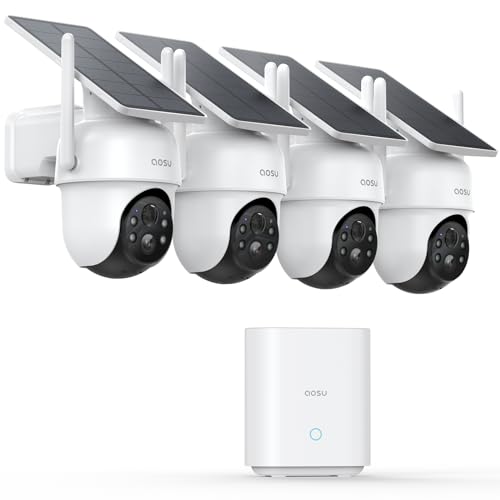
aosu D1 Classic Solar Camera — 4-Cam Kit
The deepest-reviewed solar camera system this site tracks — four auto-tracking cameras, no subscription.
Check Price →
In Plain English
This kit gives you four wireless cameras, each with its own small solar panel and battery, plus a small base station (the aosuBase) that sits indoors and stores the recordings. There is no monthly fee and no memory card to buy.
Each camera can turn to follow movement, so one camera can watch a whole side of the house. The important thing to understand is that every camera depends on its own patch of sun. It is like four houseplants on different windowsills: the one on the sunny side thrives while the one in the shade struggles. aosu says roughly two hours of direct sun a day is enough. So before drilling any holes, check how much direct sun each of the four spots actually gets.
Full Specifications
| Cameras included | 4, with 360-degree auto-tracking |
| Resolution | 2K (2560 x 1440, 3MP) with color night vision |
| Storage | 32GB on the included aosuBase hub (shared), no subscription |
| Weather rating | IP65 |
| Power | Solar, fully wire-free |
Summary
The aosu D1 Classic Solar Camera holds a solid rating across the deepest review base of any solar camera system this site tracks. Four cameras with 360-degree auto-tracking, 32GB of local storage on the included aosuBase and no subscription cover a whole property from a single purchase. For a buyer facing four separate blind spots around a house, that single-purchase framing solves a real, common problem at once.
What owners praise
The set-and-forget quality is the recurring theme — four cameras installed once that continue working with no monthly fee and no card to manage. Auto-tracking is specifically praised for covering a whole side of a property from one camera, and reviewers repeatedly mention the peace of mind of genuinely complete coverage rather than one or two gaps left by a smaller camera count.
What owners complain about
2K (3MP) resolution is modest compared to newer 4K solar cameras, a real tradeoff for the review-validated system. The 32GB on the aosuBase is shared by all four cameras and aosu lists no expansion option, so busy positions overwrite footage sooner than owners expect, and a few reviewers wish the kit offered a way to expand storage.
Design and Build Quality
Each of the four cameras in the kit uses a compact, weatherproof housing with an attached solar panel, similar in general layout to other wire-free solar cameras on this hub. Owners describe the plastic build as solid, not premium, which tracks with the kit's positioning as a value-focused whole-property solution rather than a single flagship camera. The four units ship in matching housings, which reviewers say gives a uniform look when mounted around a property rather than a mismatched mix of brands and styles. Cabling stays minimal by design, since each camera runs on its own solar panel and battery and talks to the included aosuBase wirelessly.
Auto-Tracking and Multi-Camera Coverage
Each camera includes 360-degree auto-tracking, following a detected subject across the frame rather than only alerting within a fixed field of view. Owners specifically praise this for covering a whole side of a property from one camera, reducing the number of mounting points needed compared to fixed-lens alternatives. Reviewers running all four together say the coverage genuinely reaches around a typical house perimeter, front, back and both sides, from a single kit purchase. That whole-property framing is the main reason buyers choose a 4-camera kit over buying single cameras individually.
Setup and Installation
Setup for four cameras takes longer than a single-camera purchase, simply due to volume, but each individual camera follows the same wire-free pairing process. Owners describe mounting each camera and its solar panel, connecting to the app, and repeating for each of the four units. No wiring runs between cameras, since each operates on its own solar power; the only plugged-in component is the aosuBase hub indoors. Reviewers who mounted all four in a single afternoon say the repetitive but simple process was the main time investment, not any technical difficulty.
Solar Charging and Battery Performance
Like other solar cameras this site tracks, performance depends heavily on sun exposure at each mounting spot; aosu says the integrated panel is designed to keep the camera charged with approximately 2 hours of direct sunlight per day under typical usage. Owners in consistently sunny climates report the panels keep all four cameras charged without manual intervention across most of the year. Northern owners, or anyone with a shaded mounting spot, report needing occasional manual charging during low-sun winter stretches, a pattern common to solar cameras generally. Because each camera has its own independent panel, uneven sun exposure around a property can mean one camera holds a charge better than another, which is worth planning for when choosing the four mounting spots.
App, Storage and No Subscription
The 32GB of local storage on the included aosuBase means no subscription and no separate SD card to manage across four units, a genuine convenience reviewers specifically call out — aosu estimates up to about 60 days of motion-triggered events for the 4-camera kit under typical usage. There's a real tradeoff: that storage is shared across all four cameras and aosu lists no expansion option, so a busy mounting position eats into it faster than a quiet one. The app manages all four cameras from one account, letting owners switch between live feeds without juggling separate logins each time. Reviewers describe the app as functional for the core job of viewing and managing four separate cameras at once, without the added polish of premium single-camera systems.
Price and Value as a Whole-Property Kit
Buying four cameras as a kit costs meaningfully less than four single premium solar cameras purchased separately, which is the core value proposition reviewers cite. The tradeoff for that value is 2K (3MP) resolution, modest next to 4K solar cameras on this hub, and a less refined app experience than the premium tier. For a buyer who wants complete perimeter coverage on a single budget rather than the sharpest possible image from any one camera, owners consistently say the math favors this kit.
Who It’s For
Buyers wanting to cover a whole property with wireless solar cameras and no ongoing subscription, prioritizing evidence and review depth over top-tier resolution. It particularly suits a property with four distinct sides or entry points where one kit purchase replaces buying and configuring several single cameras separately, one at a time.
Who Should Skip It
If 4K detail matters more than review depth, see best solar security cameras for the sharper eufy SoloCam E42 alternative instead.
Pros and Cons
Pros: deepest review base of any solar camera system, 4 cameras with auto-tracking, no subscription, 32GB local storage on the included aosuBase, one-app management for the whole kit, lower total cost than buying separately, matching hardware across all four units.
Cons: modest 2K (3MP) resolution, 32GB storage shared across four cameras with no listed expansion, app polish trails premium single-camera systems, uneven sun exposure can affect individual cameras differently.
Going Deeper: Why Panel Angle and Placement Decide Each Camera’s Charge
Every camera in the kit has an independent panel, so solar siting applies four times over. aosu’s product page quotes approximately two hours of direct sunlight per day under typical usage and says performance varies with season, weather, temperature, camera orientation, shade and daily activity. That list is the honest version of the solar promise: the figure is a typical average, not a guarantee for every wall.
Orientation and tilt are the free variables. The U.S. Energy Information Administration notes that in the Northern Hemisphere panels are usually oriented toward the south, and that tilting a panel south at an angle equal to the site’s latitude maximizes annual exposure to direct sunlight, with steeper tilts further north. The same logic explains the winter complaints in owner reviews. A DOE-sponsored assessment of PV performance notes that most variation in the solar resource is predictable from the time of day, the time of year and the angle at which sunlight hits the module, so a panel that is well placed in June can be poorly placed in December.
Shade does disproportionate damage. DOE lists partial shading, soiling and module operating temperature among the main sources of power loss in operating PV systems, which is why the camera under an eave or beside a tree is usually the one in the kit that falls behind. Practically, that means walking the property at a few different times of day, putting the camera with the least sun where events are rare, and keeping the busiest positions, where auto-tracking runs most often, on the sunniest walls. Busy positions also fill the shared 32GB on the aosuBase fastest.
Verdict
The most thoroughly evidenced solar camera system available, and the right default for most whole-property solar installs. The resolution tradeoff is real, but for buyers prioritizing complete coverage on one budget over the sharpest single image, the deep review base gives genuine confidence in the choice. Very few competing kits at this price point can point to the same volume of verified owner feedback backing up the auto-tracking and storage claims. See best solar security cameras for how it compares against the field.
Accessories for This Camera

Best for local recording on a camera with a card slot.

Best for angling this camera precisely under an eave, soffit or shelf.
Alternatives to Consider
- eufy SoloCam S340 review
- Best Solar Security Cameras — the full ranked field
Sources & References
- SolarCam D1 Classic Kit — aosu
- SolarCam D1 Classic — aosu
- eufy SoloCam E42 2-Cam Kit — eufy
- Most utility-scale fixed-tilt solar photovoltaic systems are tilted 20 degrees-30 degrees — U.S. Energy Information Administration
- Understanding Solar Photovoltaic System Performance: An Assessment of 75 Federal Photovoltaic Systems — U.S. Department of Energy / NREL
- Photovoltaic system design and energy yield — U.S. Department of Energy