
Affiliate Disclosure: Some links on this page are affiliate links. As an Amazon Associate, we earn from qualifying purchases — at no extra cost to you. We do not buy, install, or physically handle the cameras we cover; our rankings come from aggregated owner reviews, ratings and expert consensus. Commissions never change our verdicts. We're reader-supported: commissions fund hosting, research and updates, so if a guide helped, buying through our links keeps it going. How we rank · full disclosure.
Short version: the Ring Floodlight Cam Wired Plus is our overall pick for a security camera with a motion sensor, because motion triggers the lights, the camera and the siren together. The eufy SoloCam S340 is the pick if you want people and vehicle alerts processed on the camera with built-in storage, and the Blink Outdoor 4 suits a low-maintenance battery setup. The kind of sensor matters less than a handful of practical settings, which we explain below.
One honest note about a phrase that shows up in product listings. “Motion sensor camera” can mean a dedicated PIR sensor, video analysis, or both, and some makers do not say which on their public spec pages. Where we could not confirm the sensor type from the manufacturer’s own pages, this guide says so instead of guessing. Our wider motion detection and alerts hub covers the settings side in more depth.
In Plain English
A motion sensor camera watches for movement and only bothers you, or records, when it sees some. That saves battery, saves storage and, in theory, saves your phone from buzzing all day.
There are two main ways it can notice movement. One is a small heat sensor, called PIR, which is the same idea as a motion-activated porch light: it notices a warm body moving across its view. The other is the camera itself comparing frame after frame and spotting changes in the picture. Some cameras add AI on top so they can tell a person from a passing car.
Why it matters: heat sensors are quick but cannot tell what moved, and picture-based detection can be more selective but can be fooled by shadows and headlights. What matters most is how you set it up. Aim it so people walk across its view, point it away from heat vents and busy streets, and draw zones that ignore the sidewalk. Do that and almost any camera on this page will be far quieter and more useful.
Top Picks at a Glance
The Ranked Field

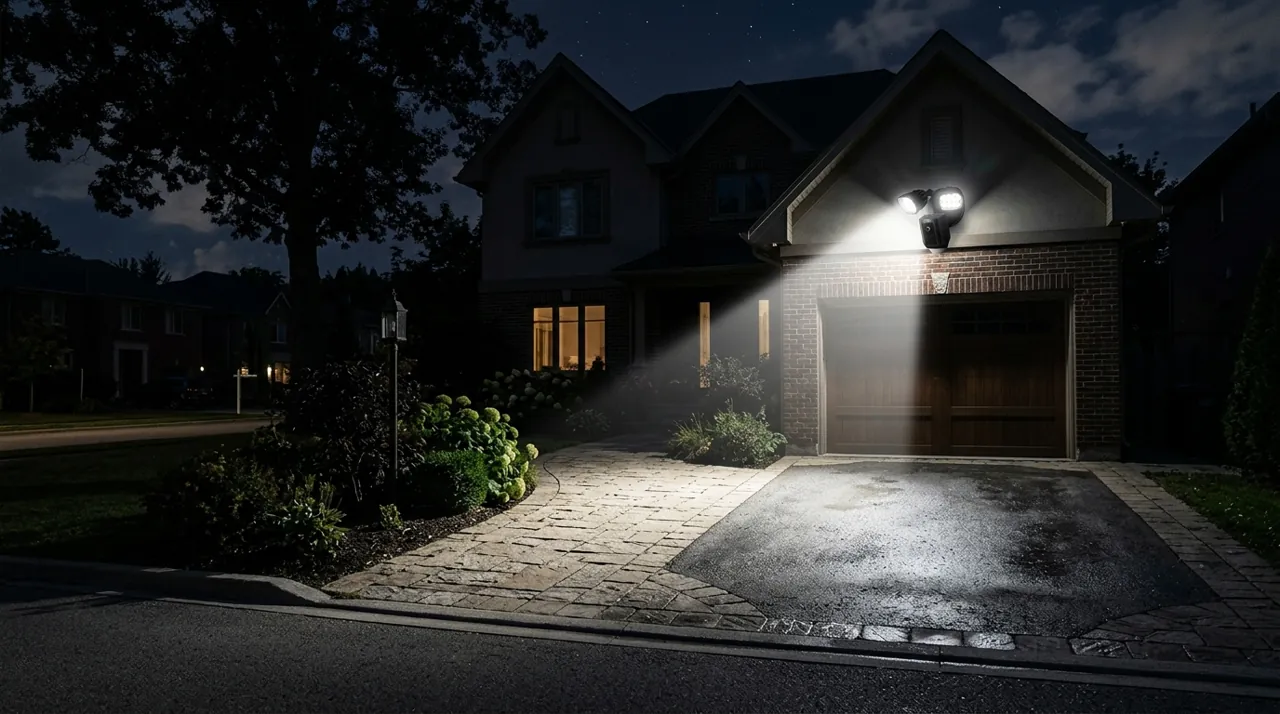
Best for a wired camera where motion also switches on floodlights and can sound a siren.
- Advanced motion detection with customizable motion zones.
- Two 2,000-lumen floodlights.
- 140° horizontal field of view.
- 105 dB remote-activated siren.
Why buy it: Motion does something visible: the lights come on, the camera records and you can trigger the siren, which suits a driveway or back door.

Best for people and vehicle alerts processed on the camera itself, with built-in storage.
- Human and vehicle detection run on local AI.
- Activity zones.
- 8 GB built-in storage with no monthly fee required.
- Solar panel, about 2 hours of sun a day to stay powered.
Why buy it: The detection that filters out leaves and headlights runs on the camera, so it does not depend on a paid cloud plan.

Best for a wire-free outdoor camera with a long battery life at default settings.
- Battery life up to 2 years at default settings.
- 143° field of view.
- Infrared night vision.
- Two-way audio.
Why buy it: Fewer battery changes matter on a camera that watches a driveway all night, and the two-year figure is Blink’s own for default settings.

Best for a camera that can sit indoors or outdoors, on a wall or a shelf.
- Indoor or outdoor use.
- 110° horizontal field of view.
- Rechargeable battery with optional solar.
- Free motion zones, paid person detection.
Why buy it: Consumer Reports’ public product page lists free activity zones and paid person detection, a useful thing to know before buying.
Comparison Table
| Product | Best for | Buy |
|---|---|---|
| Ring Floodlight Cam Wired Plus | Best Overall | Price |
| eufy SoloCam S340 | Best No-Fee Smart Detection | Price |
| Blink Outdoor 4 | Best Low-Maintenance Battery | Price |
| Ring Stick Up Cam (Battery) | Best Flexible Placement | Price |
How We Rank
We do not buy or physically test these cameras. Each pick comes from the manufacturer’s published specifications and support pages, cross-checked against owner ratings wherever our licensed rating data has them. Where a card shows no star rating, that is because no verified rating was available, not because we hid one. The order reflects fit for a motion-first buyer rather than a single score. Full method on how we rank.
What “Motion Sensor” Means on a Camera
A PIR, or passive infrared, sensor is a separate component that watches for changes in infrared heat. Panasonic’s technical FAQ for its PIR sensors explains that the sensor does not send anything out; it responds when a warm body moves across zones in front of it. That is why it can trigger quickly and use very little power, which is how battery cameras stay asleep between events.
Video motion detection is different. It compares consecutive frames for changed pixels, so it needs the camera and processor awake. Basic versions react to any change, including shadows, headlights and swaying branches. Smart versions add classification, so the camera can say person, vehicle, package or animal. Some cameras combine both, letting a cheap trigger wake the camera and a smarter check decide whether to alert. Our PIR versus video motion detection page compares them in more depth.
For the cameras above, here is what the makers say. Ring lists advanced motion detection with customizable motion zones for the Floodlight Cam Wired Plus, plus 140° horizontal coverage, but the page we read does not describe the sensor type. eufy says the S340’s human and vehicle detection run on its local AI, and does not mention a PIR sensor on the product page. Blink’s public spec page focuses on battery life, field of view and night vision rather than motion sensing. That is why we recommend choosing on range, zones and plan terms rather than on a sensor label.
What to Look For
Detection range and how it is measured. Ring says most of its devices have a standard 30-foot detection range. eufy ties the S340’s range to its sensitivity setting, quoting 20 to 26 feet in daylight and 13 to 20 feet at night at its default level. Reolink says distance depends on how big the moving object is, how it moves and how sensitive the camera is, so no single figure holds everywhere. Use published range as a guide, then set the camera so its zone covers only the area you care about.
Motion zones. Zones let you exclude the sidewalk, the street and the neighbor’s hedge. Ring lets you create up to three motion zones per device, and notes that some battery-powered devices may need Advanced Motion Detection turned on to use them. eufy lists activity zones for the S340. Zones cost nothing and are usually the biggest single fix for noisy alerts.
Sensitivity and schedule controls. A slider that lowers sensitivity, and the option to schedule active hours, keep a camera from waking for every passing car.
What is free and what is a plan. Consumer Reports’ public page for the Ring Stick Up Cam lists activity zones as free and person detection as a paid feature. eufy says the S340’s human and vehicle detection are processed on the camera and that its built-in 8 GB of storage needs no monthly fee. Whatever you choose, read the plan page before purchase, not after.
Power. A wired camera can watch continuously. A battery camera leans on efficient triggers. Blink states up to two years of battery life at default settings, with a note that customized settings, usage and conditions may reduce it, and eufy says two hours of direct sun a day is enough to keep the S340 continuously powered.
Placement That Helps the Sensor
Placement can double a sensor’s usefulness. Reolink’s guidance for its PIR cameras is to install them so movement crosses the field of view instead of heading straight at the camera, because the sensor responds more strongly to side-to-side motion, and to mount at roughly 2 to 3 meters. It also advises keeping cameras away from air-conditioner vents, humidifier outlets, mirrors and glass, direct sunshine, and roads with frequent vehicle traffic.
Ring makes a similar point about reflective surfaces: a camera installed near a window or mirror can have its detection affected by the reflection. The Panasonic FAQ adds that a sudden change in sunlight on or off the sensor can change the temperature it sees and cause a false trigger. Put those together and the checklist is simple. Aim across the approach, not down it. Keep vents and glass out of the view. Avoid facing east or west if you can. Use zones to drop the street. If you want a separate trigger for doors and windows rather than open space, our window and door sensors hub covers sensors that pair with an alarm system.
Which Motion Sensor Camera Fits You
A driveway or back door with power nearby: the Ring Floodlight Cam Wired Plus, where motion turns on light, video and optionally the siren.
You want smarter alerts without a cloud plan: the eufy SoloCam S340, with on-camera people and vehicle detection and built-in storage.
You dislike changing batteries: the Blink Outdoor 4, with its two-year battery figure at default settings.
You want one camera that can move indoors or out: the Ring Stick Up Cam Battery, keeping in mind that person detection is a paid feature per Consumer Reports.
Going Deeper: Why PIR Sees Some Things and Misses Others
A PIR sensor is built around pyroelectric material that produces a signal when the amount of infrared reaching it changes. A lens in front divides the scene into detection zones, and motion registers when a warm body moves from one zone to the next. Panasonic’s FAQ says its sensors work from a temperature difference of about 4°C between a person and the background, which is why a warm body against a cold wall in winter can be easier to pick up, and why a warm day can make detection harder.
That physics explains the quirks owners complain about. The sensor cannot see through glass, because ordinary glass passes only wavelengths up to about 2 micrometers, while the sensor needs infrared above roughly 5 micrometers. It can be fooled by sudden sunlight changes, and by heat sources such as air-conditioner vents. It reacts most to movement across zones, so a person walking straight at the lens crosses fewer boundaries and can be picked up later than someone walking past.
Video detection has its own physics. It needs light or infrared illumination to see anything change, and it is at its best when a scene is stable. Shadows, headlight sweeps and swaying plants all change pixels, which is why smarter systems add classification. When a camera combines the two, the sensor wakes the camera cheaply and the picture check decides whether the event deserves your attention.
The practical lesson is to design around the sensor rather than expect it to be perfect. Put the camera where movement crosses the frame, keep heat and glass out of view, use zones to ignore areas you do not care about, and treat sensitivity as a dial to be adjusted over the first week rather than a setting to leave alone. That combination does more for real-world alerts than any single spec line on a product page.
The Verdict
For most homes, the Ring Floodlight Cam Wired Plus is the strongest all-round answer because motion triggers something useful: light, video and a siren you can sound. Choose the eufy SoloCam S340 for on-camera people and vehicle alerts and built-in storage, the Blink Outdoor 4 for battery life, and the Ring Stick Up Cam Battery for flexibility. Whichever you buy, spend ten minutes on zones, sensitivity and placement, because that is where a motion camera earns its keep.
Sources & References
- PIR Motion Sensors FAQ 2025 — Panasonic Industry
- Reolink Camera Installation Tips — Reolink
- What is the Motion Detection Range/Distance — Reolink
- Using Motion Zones for Cameras and Doorbells — Ring
- Floodlight Cam Wired Plus Information — Ring
- eufy Security SoloCam S340 — eufy
- Blink Outdoor 4 Technical Specifications — Blink Support
- Ring Stick Up Cam (Battery) 3rd gen — Consumer Reports