
Affiliate Disclosure: Some links on this page are affiliate links. As an Amazon Associate, we earn from qualifying purchases — at no extra cost to you. We do not buy, install, or physically handle the cameras we cover; our rankings come from aggregated owner reviews, ratings and expert consensus. Commissions never change our verdicts. We're reader-supported: commissions fund hosting, research and updates, so if a guide helped, buying through our links keeps it going. How we rank · full disclosure.
Short answer: a neighbor security camera facing your house is, in most of the United States, legal when it is mounted on their own home and happens to capture part of your property in the frame. There is broadly no expectation of privacy in what is plainly visible from a neighboring property or a public street. What changes the picture is deliberate intrusion — a camera aimed into your windows, angled over a fence to watch an enclosed yard, or recording the audio of conversations on your patio. Those cross from "captures your house incidentally" into territory where privacy law, local ordinances and in some states criminal statutes genuinely apply.
So the practical question is not "is a camera pointed my way legal?" but "what is it actually recording, and was that the point?" This page walks through where the line usually sits and the steps that resolve these situations without a lawyer. It is general information, not legal advice — camera and recording laws differ meaningfully from state to state, so verify anything consequential against your own state’s rules or with a local attorney.
Recommended Cameras

Best for wired outdoor coverage with the deepest review base tracked on this site.

Best for front-door coverage with no wiring required.

What Is Generally Legal
Homeowners are allowed to secure their own property, and a camera covering a front door, a driveway or a side gate will nearly always include some of what sits beyond the property line. Courts and ordinances have generally landed on the principle that anything visible from a place the camera owner is entitled to be — their own yard, their own wall, the sidewalk — is not private. That covers a lot of everyday overlap:
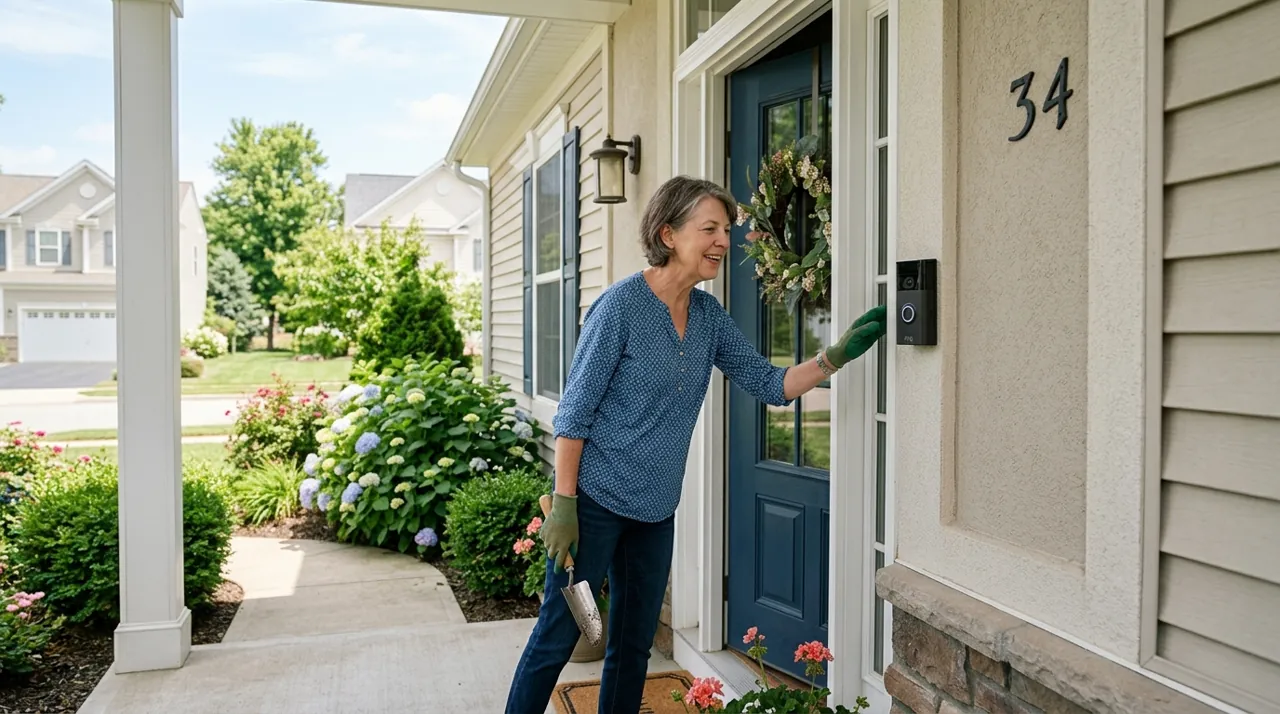
- A doorbell camera that sees part of your front lawn or your parked car.
- A driveway camera whose wide lens takes in your fence and front path.
- A backyard camera that includes the shared fence line and whatever is visible above it.
- Footage of people coming and going from a house, viewed from the street side.
None of that is typically actionable, and it is worth internalizing before the conversation starts, because arriving with "this is illegal" when it probably is not tends to end the discussion rather than open it. Wide-angle lenses are also worth understanding here: most consumer cameras have a field of view somewhere around 100 to 160 degrees (the Wyze Cam v4, for example, is listed at 115.8 degrees diagonal), so a camera that looks like it is staring at your window is very often aimed at a walkway ten feet to the side. If you want a sense of how much frame these things actually cover, the category breakdowns in outdoor cameras and video doorbells give the typical figures.
What Crosses the Line: Surveillance, Harassment and HOA Rules
Three situations are meaningfully different from incidental capture, and these are the ones worth taking seriously.
A camera aimed into a private interior space. A lens pointed at a bedroom or bathroom window, or a camera positioned and zoomed so its useful frame is the inside of your home rather than the outside of theirs, is the clearest problem. Many states have voyeurism or unlawful surveillance statutes that apply where someone has a reasonable expectation of privacy, and a window into a bedroom is close to the textbook example — California’s disorderly conduct statute, for instance, specifically covers using a camera to look into a bedroom or bathroom with intent to invade the privacy of the people inside. Intent and framing matter: a camera that can see a window from sixty feet away is a different thing from a camera mounted on a pole and tilted to see through it.
Audio recording of your conversations. This is the caveat most people miss, and it is frequently the stronger claim. US wiretapping and eavesdropping law treats audio very differently from video, and about 11 states primarily require the consent of all parties to record a private conversation, with several others applying that rule to in-person conversations only, according to the Reporters Committee for Freedom of the Press. A camera microphone that picks up conversations on your own patio is a genuinely different legal question from the same camera’s video feed. Our page on whether it is legal to record audio on a security camera covers the consent rules in more detail.
Surveillance used as harassment. A camera that tracks you, is repositioned whenever you move, is paired with threats or messages about your movements, or exists in the context of an ongoing dispute can support a harassment or stalking complaint even where a single static camera would not. Pattern and context are what make this one, and documentation is what proves it.

Practical Steps, In Order
Escalation is expensive and rarely necessary. Work through these in sequence and most situations end at step one or two.
- Look at it properly first. Stand at the camera and follow the lens direction, or look at the mounting angle from your side. Note whether it is fixed or a pan-tilt model that can be steered, and whether the mount looks aimed at a path or at your house.
- Talk to your neighbor. Assume the overlap was accidental, because usually it was. Ask if the angle can be tilted down or the field narrowed. Most modern cameras also support privacy or exclusion zones — software masks that black out part of the frame permanently — which lets them keep full coverage of their own property while removing yours from the recording entirely. Offering that specific solution makes a yes much easier.
- Document what you see. If the first conversation goes nowhere, start a dated log with photos of the camera position, notes on any repositioning, and copies of anything written. Documentation is what turns a disagreement into a complaint an authority can act on.
- Check the local layer. Some cities and counties have ordinances on camera placement and on surveillance of adjoining property. If you are in an HOA or a condo association, the governing documents very often address exterior cameras and where they may point, and the association can enforce that far faster than a court. Renters should read the lease and raise it with the landlord or property manager, who has leverage a tenant does not.
- Send it in writing. A polite, factual letter that describes the camera, the concern and the requested change creates a record and is often the point at which an unresponsive neighbor engages.
- Escalate only then. Police involvement makes sense where there is a plausible criminal element — recording into a window, audio capture in an all-party-consent state, or a harassment pattern. A civil attorney makes sense where the harm is ongoing and the informal routes are exhausted. A single one-hour consultation with a local attorney is usually enough to tell you whether you have anything, and it is money well spent before a lawsuit rather than after.
One thing to avoid entirely: do not touch their equipment. Covering, obstructing, damaging, or electronically interfering with a camera is its own offense, and it converts a situation where you were the aggrieved party into one where you are not. Screening your own property with a fence or planting, within your local rules, achieves the same result lawfully.
Being the Good Neighbor With Your Own Camera
The same principles run in reverse, and getting this right at install time avoids the whole conversation. Mount for the area you actually need — a doorway, a driveway, a side gate — and tilt down rather than out. Use the privacy or activity zones in the app to exclude the sidewalk, the road and anything past your boundary. If your camera has a microphone and you are unsure of your state’s consent rules, the conservative choice is to turn audio recording off. And a small visible notice near an entrance is both a courtesy and, in some jurisdictions, a factor in whether recording was reasonable.
The mounting height and angle guidance in how to install a security camera is written around exactly this trade-off: the positions that produce usable footage of your own property are generally also the positions that keep your neighbor out of frame. If you are still choosing hardware, the wider decision framework sits in our buying guides, and how we reach these conclusions is documented in how we rank.
Sources & References
- Introduction to the Reporters Recording Guide — Reporters Committee for Freedom of the Press
- California Penal Code § 647 (including subdivision (j) on viewing or recording private interiors) — California Legislative Information
- California Penal Code § 632 (recording confidential communications) — California Legislative Information
- Wyze Cam v4 specifications — Wyze