
Affiliate Disclosure: Some links on this page are affiliate links. As an Amazon Associate, we earn from qualifying purchases — at no extra cost to you. We do not buy, install, or physically handle the cameras we cover; our rankings come from aggregated owner reviews, ratings and expert consensus. Commissions never change our verdicts. We're reader-supported: commissions fund hosting, research and updates, so if a guide helped, buying through our links keeps it going. How we rank · full disclosure.
Short answer: recording video around your own home is broadly legal in the United States, but recording audio on a security camera is governed by a completely separate body of law — federal and state wiretapping and eavesdropping statutes — and the rules genuinely differ by state. Federal law and most states follow a one-party consent rule, meaning a recording is lawful if one participant in the conversation consents. About 11 states primarily require all-party consent, according to the Reporters Committee for Freedom of the Press, meaning everyone in the conversation must agree — and a handful more apply it only to phone calls or only to in-person conversations. Recording a private conversation you are not part of, on a camera microphone, is the situation that gets people into trouble.
The practical takeaway for most homeowners: video on, audio off unless you know your state’s rule and have a reason to want it. This page explains the distinction so the choice is informed. It is general information rather than legal advice, and audio recording law is one of the areas where state-by-state variation is real — confirm your own state’s rule, and speak to a local attorney if anything about your situation is consequential.
Recommended Cameras

Best for wired outdoor coverage with the deepest review base tracked on this site.

Best for front-door coverage with no wiring required.

One-Party vs All-Party Consent, Plainly
Nearly every US state has its own statute covering the interception of oral communications (Vermont is the commonly noted exception, relying on federal law), and they divide into two camps.
One-party consent is the federal standard and the majority state rule. If you are a participant in the conversation, you can record it, because your own consent satisfies the requirement. A doorbell that records you talking to a delivery driver sits comfortably inside this rule.
All-party consent — often called two-party consent — requires everyone in the conversation to agree. The Reporters Committee for Freedom of the Press lists California, Delaware, Florida, Illinois, Maryland, Massachusetts, Michigan, Montana, New Hampshire, Pennsylvania and Washington as primarily all-party-consent states (Michigan at least for recordings made by someone who is not part of the conversation). Several more split the rule: Oregon and Missouri require all-party consent for in-person conversations but not phone calls, Connecticut and Nevada require it for phone calls but not in-person conversations, and Hawaii and Maine require it in particularly private places. That split matters more than it sounds for a camera microphone, which captures in-person speech: a state can be all-party for phone calls and one-party for face-to-face speech, or draw the line around whether the parties had a reasonable expectation of privacy. California, for example, makes it a crime to record a confidential communication without the consent of all parties, with fines of up to $2,500 for a first offense. Because these statutes get amended and reinterpreted, treat any list — including this one — as a starting point for checking your own state rather than the final word.
Two qualifiers apply almost everywhere and often matter more than which camp your state is in. First, these laws generally protect private conversations, so speech in a genuinely public setting where nobody could reasonably expect privacy is treated differently. Second, penalties in all-party states are not trivial — several attach criminal liability plus a private right of action, which is why "just leave audio on and see" is a poor plan.
Why Doorbells and Two-Way Talk Are a Gray Area
A video doorbell is an awkward fit for statutes written decades before it existed, and that is the honest state of things.
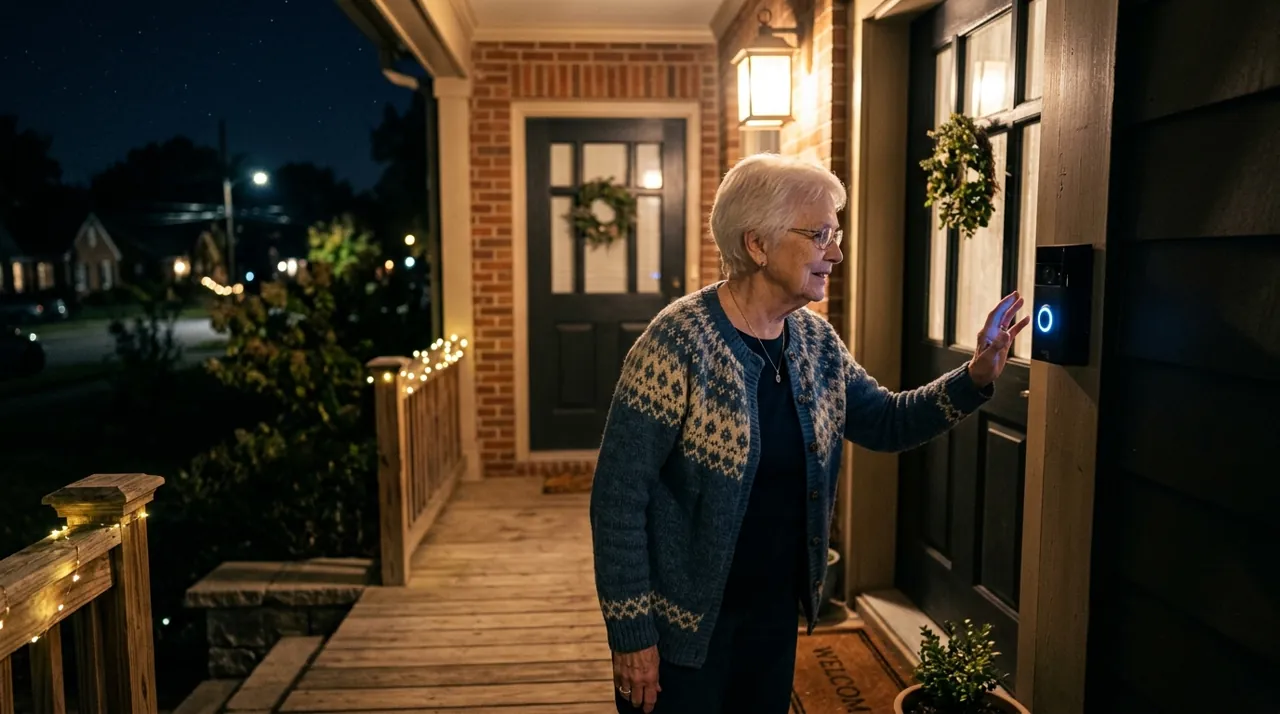
When you press the talk button and speak to a courier, you are a participant. That is a conversation, and under either consent rule your own participation is doing the work. The complication is that the doorbell is also saving audio for the whole event clip — including the ten seconds before you answered, and including whatever two people standing on your porch said to each other while they waited. In that stretch you are not a participant. You are a recording device capturing a conversation between other people, which is precisely what eavesdropping statutes address.
The same problem appears with an outdoor camera near a shared boundary. A microphone with a range of twenty or thirty feet will pick up a neighbor’s patio conversation, and if that lands in a saved clip in an all-party-consent state, the video is fine and the audio is the exposure. Indoor cameras raise a related but different version — a camera in a living room that records visitors, cleaners, or a babysitter is capturing people who did not consent and who may not have noticed the device. Our page on whether home security cameras are legal covers the disclosure side of that.
There is no settled national answer to the doorbell question, and anyone telling you there is with confidence is overstating it. What can be said accurately is that the risk sits in stored audio of conversations you are not in, and that the risk is highest in all-party-consent states.
The Practical Approach
Four steps cover almost every household.
- Find out which rule your state follows before deciding anything. Your state attorney general’s office and state bar association both typically publish plain-language summaries of the recording statute, and those are better sources than a forum thread.
- Default to audio off if you are unsure. This is the single highest-value line in this article. Every mainstream camera and doorbell lets you disable the microphone or audio recording independently of video, and losing audio costs you almost nothing evidentially — identification and event reconstruction come from the picture. If you are in an all-party-consent state and your camera covers a boundary, a shared hallway, or a porch where people talk, off is the sensible position.
- Post a visible notice. A small sign at the entrance stating that the property is under video and audio surveillance is a reasonable, good-faith step. It puts people on notice, it supports an argument that recording was not surreptitious, and in some jurisdictions it is a factor in the analysis. It is not a magic exemption, but it is worth doing.
- Aim microphones the way you aim lenses. Keep cameras pointed at your own doorways and paths rather than at a fence line or a neighbor’s outdoor space, and mount at the seven-to-nine-foot working height described in how to install a security camera. A camera positioned for your own property picks up far less of anyone else’s conversation. If a neighbor’s camera is the one pointed your way, the practical steps are in neighbor security camera facing my house.
Hardware and Storage Notes
A few equipment-side points affect how much audio you are actually accumulating. Most battery and wireless models include a microphone by default with recording enabled out of the box — see wireless and battery cameras for the category. Systems that record locally to an NVR or a card give you more direct control over what is retained and for how long, covered in NVR camera systems, and the retention question is worth thinking about because a shorter retention window means less stored audio to worry about either way. If audio matters enough to you to want it on, the trade-offs between local and cloud retention are laid out in local storage vs cloud.
Two closing points of honesty. Consumer camera audio is generally poor — compressed, wind-affected, and often unintelligible beyond ten or fifteen feet — so the evidentiary value people imagine it has usually is not there. And any recording you might want to rely on in a legal proceeding raises admissibility questions that depend on how it was made, which is another reason the conservative setting is the better default. How we reach conclusions like these is documented in how we rank.
Sources & References
- Introduction to the Reporters Recording Guide — Reporters Committee for Freedom of the Press
- 18 U.S. Code § 2511 - Interception and disclosure of wire, oral, or electronic communications prohibited — Cornell Law School Legal Information Institute
- 18 U.S. Code § 2520 - Recovery of civil damages authorized — Cornell Law School Legal Information Institute
- California Penal Code § 632 (eavesdropping on or recording confidential communications) — California Legislative Information