
Affiliate Disclosure: Some links on this page are affiliate links. As an Amazon Associate, we earn from qualifying purchases — at no extra cost to you. We do not buy, install, or physically handle the cameras we cover; our rankings come from aggregated owner reviews, ratings and expert consensus. Commissions never change our verdicts. We're reader-supported: commissions fund hosting, research and updates, so if a guide helped, buying through our links keeps it going. How we rank · full disclosure.
Short answer: to check for hidden cameras in a home or rental, turn off the lights and shine a flashlight around looking for tiny lens glints, scan the room with your phone camera for infrared glow, look closely at everyday objects that face beds and bathrooms, and check the Wi-Fi network for devices you do not recognize. No single method catches every camera, so combine them. If you find one, do not touch it. Photograph it, leave, and call the police.
The legal side is a patchwork that varies by state, so check your state’s rule. Recording people in places where they expect privacy, such as bedrooms and bathrooms, is unlawful in many places, and Airbnb and Vrbo bar most indoor cameras. This guide covers detection and consent law only. It does not cover covert recording, and we do not sell or test detectors here. For a ranked list of tools, see our best hidden camera detector roundup. It also sits inside our wider camera privacy and hacking guide.
In Plain English
A hidden camera is a small camera made to go unnoticed. It might be built into a clock, a phone charger, a smoke detector or a picture frame. Most homes will never have one. But if you are staying in a rental, moving into a new place, or something simply feels off, a careful check is worth ten minutes.
Nothing here needs special gear. You are looking for three kinds of clue: a lens that catches light, a tiny glow that a phone camera can pick up in the dark, and an unfamiliar device on the network. Think of it as a walk-through with a torch, the way you would check a room for a lost earring.
Why it matters: recording private areas without consent is illegal in many places, though the details vary by state, and Airbnb and Vrbo bar most indoor cameras. If you do find something, the rule is to leave it alone, take photos and call the police, rather than pull it out and risk losing evidence.
Where Hidden Cameras Tend to Hide
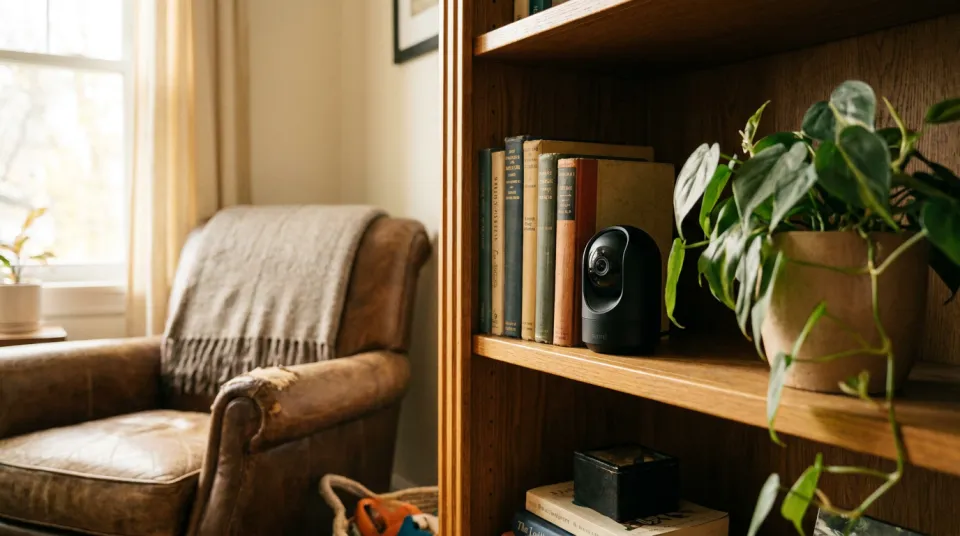
Hidden cameras are disguised as ordinary things that plug in or sit on a shelf. Reolink’s detection guide lists smoke detectors, alarm clocks, USB chargers, wall adapters, picture frames, air purifiers and motion sensors among the common disguises, and says to give priority to items facing bedrooms, bathrooms, showers and changing areas. A useful habit is to ask of every object: does it have a reason to be here, and does it face where people undress or sleep?
Signs that something is out of place include an object with a tiny hole or lens-like dot pointing at the bed or shower, a device plugged in with no obvious function, a charger with no cable attached, or a smoke detector in a place where you would not expect one, such as beside a mirror. Mirrors deserve their own look too, since a lens can sit behind glass. None of these is proof, but each is a reason to look closer.
A Room-by-Room Walk-Through
Start with the light off. Draw the curtains, switch the lights off and use your phone flashlight. Reolink describes lenses as reflecting light back as small bright spots, so sweep the beam slowly across shelves, vents, electronics and decor at eye level and look for a pinpoint glint that does not belong.
Use your phone camera for infrared. In a dark room, view the room through your phone’s camera. Reolink notes that some cameras give off infrared that a phone screen may show as a white, pink or purple light.
Listen. In a quiet room, some devices give off faint humming, clicking or buzzing. That is not reliable, but it is free.
Check mirrors. Look for odd gaps, tiny holes or a lens-like dot around the mirror’s edges, especially in bathrooms and bedrooms.
Scan the network. If you are authorized to use the Wi-Fi, connect and use a network scanner app to list devices. Look for unfamiliar names or anything labeled as a camera. This only finds cameras that are connected to that network. Do not log in to, reset or alter any device you find; note it and report it.
Finish with the big five. Check the bedroom, bathroom, living area, any smoke detector or alarm clock, and any USB charger or wall adapter facing the bed or shower. Then repeat the sweep from bed height, since that is the view a camera is meant to have.
What These Checks Cannot Do
Every method has a blind spot, and it helps to know them. Researchers describing hidden-camera detection in a paper on smartphone time-of-flight sensing note that lens-reflection methods can miss designs that do not reflect well, infrared detection struggles with cameras that emit little infrared, radio-frequency scanning misses cameras that do not transmit, and network scanning misses devices that are offline or on a separate network. A camera that records straight to a memory card, for example, can pass every wireless check.
That is why layering matters and why a careful physical look is still the base of the check. If you are staying somewhere and remain uneasy after a sweep, you can ask for another room, check out, or contact the platform. Trusting your judgment about a space is not paranoia, and you do not need proof to leave.
If You Find One
The order matters. First, do not touch, unplug, reset or move the device, since that can destroy evidence or alert whoever placed it. Photograph it in place, including its surroundings, and note the date and time. Leave the room and, if you are in a rental, leave the property if you feel unsafe. Contact the police to report what you found and ask how they want it handled. If the stay is booked through a platform, report it there and keep the messages, booking confirmation and listing pages.
If the camera might be yours, for example an old indoor camera a previous occupant left, still check before you decide. Look for a brand, serial number or app account tied to the device. This is general information, not legal advice, and a local attorney or victim-support service can help with anything more serious.
What the Law Says
US law on hidden cameras is a patchwork, so there is no single rule. At the federal level, 18 U.S.C. § 1801, the video voyeurism statute, makes it a crime to intentionally capture images of a person’s private areas without consent when they have a reasonable expectation of privacy, punishable by a fine, up to one year in prison, or both. But it applies only within the special maritime and territorial jurisdiction of the United States, so most cases are prosecuted under state laws that use similar ideas.
Audio is a separate issue. Federal law, 18 U.S.C. § 2511, covers intercepting oral, wire and electronic communications and includes an exception where one party to the conversation has consented. The Reporters Committee for Freedom of the Press says federal law sets the minimum, requiring the consent of at least one party, and that about 11 states, including California, Florida, Illinois, Maryland, Massachusetts, Michigan, Montana, New Hampshire, Pennsylvania, Washington and Delaware, are generally described as requiring everyone’s consent, with variations: some turn on secret recording, and Michigan’s rule is clearest for recordings by someone outside the conversation. It also explains that hidden camera laws generally address video, and where they do not cover audio, the sound portion of a recording falls under the state’s recording law.
Rental platforms add their own layer. Airbnb’s policy, in effect since April 2024, says it does not allow hosts to have security cameras or recording devices that monitor indoor spaces in homes, even if the devices are turned off. Outdoor cameras are allowed if they are disclosed in the listing. Vrbo also bars indoor cameras in most cases, with narrower exceptions such as common areas of some multi-unit buildings. A camera that breaks the rules of the booking is a reason to report it, whether or not it is also a crime.
Going Deeper: Consent, Expectation of Privacy and Why Location Matters
Two ideas run through nearly every hidden-camera law: consent and reasonable expectation of privacy. Consent asks whether the people being recorded agreed. Expectation of privacy asks whether they were somewhere they could reasonably assume nobody was watching. A camera aimed at a front porch is a different thing from one aimed at a shower, and the law treats them very differently even when the equipment is identical.
That is why the federal video voyeurism statute is so specific. It defines the private areas it protects, describes capturing as videotaping, photographing, filming, recording or broadcasting, and carves out lawful law enforcement and intelligence activity. It is narrow on purpose, and it is one reason state laws matter so much: they often cover more places and more situations.
Audio raises a separate question because of how consent is counted. Under federal law, one participant’s consent is enough, but in the roughly eleven all-party-consent states, everyone must agree. A camera with a microphone in a shared space can therefore be a bigger legal problem than the picture it takes. That is a reason for any owner of a legitimate camera to disclose it, disable audio where it is not needed, and keep lenses pointed at their own property.
The same logic protects you as a guest or tenant. A host may put a camera on the outside of a property if it is disclosed, but the inside is off-limits under most platform rules, and private spaces are protected under many states’ laws. If you are not sure whether something you found is allowed, treat it as a report rather than an argument: photograph it, leave, and let the police or the platform decide. The right response to an unwelcome camera is documentation and distance, not confrontation.
For the broader picture of accounts and who can see camera footage you own, our hub on security camera privacy and hacking covers the other side of the same problem, and lawful use of hidden cameras and the hidden camera FAQs go deeper on consent rules.
Sources & References
- 18 U.S. Code § 1801 - Video voyeurism — Cornell Law School Legal Information Institute
- 18 U.S. Code § 2511 - Interception and disclosure of wire, oral, or electronic communications prohibited — Cornell Law School Legal Information Institute
- Introduction to the Reporter's Recording Guide — Reporters Committee for Freedom of the Press
- Use of cameras and recording devices — Airbnb Help Center
- LAPD: Hidden Spy Camera Detection using Smartphone Time-of-Flight Sensors (ACM SenSys ’21) — National University of Singapore and Yonsei University
- How to Find Hidden Cameras in Room: Top 7 Easy Ways — Reolink