
Affiliate Disclosure: Some links on this page are affiliate links. As an Amazon Associate, we earn from qualifying purchases — at no extra cost to you. We do not buy, install, or physically handle the cameras we cover; our rankings come from aggregated owner reviews, ratings and expert consensus. Commissions never change our verdicts. We're reader-supported: commissions fund hosting, research and updates, so if a guide helped, buying through our links keeps it going. How we rank · full disclosure.
The short version: both are battery-powered, no-wiring-required video doorbells from the same Amazon-owned family, aimed at the same front-door buyer. The Ring Battery Doorbell carries the stronger rating, the deeper review base and head-to-toe video framing. The Blink Video Doorbell undercuts it meaningfully on price while still offering the same two-year battery life Blink is known for across its camera lineup.
In Plain English
Both of these are doorbells with a small camera built in. When someone walks up or presses the button, your phone buzzes and you can see and talk to them from anywhere. Both run on batteries, so there are no wires to connect, and both come from companies owned by Amazon.
The main difference is how you keep them running. Think of Ring like a phone you recharge every few weeks to a couple of months, and Blink like a TV remote whose AA batteries you swap every year or two. Ring’s tall head-to-toe picture is well proven at showing a parcel on the mat as well as a face. Blink costs less up front and each month. To watch saved clips later, both need a paid plan (a monthly subscription), unless you add Blink’s Sync Module 2 (a small plug-in hub) and a USB stick, which saves clips at home for free. Decide first whether you would rather pay less or have the better-proven doorbell.
Top Picks: Ring, Blink and an Alternative

One of the most-reviewed video doorbells we track, and the higher-rated of these two. Its head-to-toe view shows the package on the mat rather than cropping it out. It runs on a removable rechargeable battery with no wiring required.
Why You Should Get This
If you want the most review-validated doorbell of the two, this is it.
Benefits
- One of the deepest review bases of any video doorbell.
- Head-to-toe view shows the whole doorstep.
- No wiring required.
Pros and Cons
- Largest, most trustworthy review base.
- Higher star rating than Blink.
- Motion zones cut sidewalk false alerts.
- Recorded clip history needs a Ring subscription.
- Higher price than Blink.
- HD rather than the 2K of Ring’s newer Battery Doorbell 2K.
Features
- Head-to-toe 1:1 view.
- Removable battery or hardwiring.
- Two-way talk.

The lowest entry price of the two at an entry-level price, with a genuinely long two-year quoted battery life on the same Amazon-owned platform. It holds a lower rating than Ring but is a meaningfully cheaper doorbell for buyers on a budget.
Why You Should Get This
If price and battery longevity matter more than Ring’s app polish, this is the value pick.
Benefits
- Lowest entry price of the two.
- Two-year quoted battery life.
- Same Amazon ecosystem as Ring.
Pros and Cons
- Cheapest of the two doorbells.
- Longer quoted battery life than Ring.
- Cheaper Blink subscription than Ring Protect.
- Lower star rating than Ring.
- Smaller review base than Ring.
- App less polished than Ring’s.
Features
- Two-year rated battery life.
- Head-to-toe video.
- Two-way talk.

A third option worth knowing about if neither Amazon brand fits: one of the few doorbells that keeps detection and recording working with no subscription at all, pairing 2K (4MP) resolution with a 180-degree diagonal head-to-toe field of view. A plug-in chime ships in the box. It holds a solid owner rating.
Why You Should Get This
If avoiding a subscription entirely matters more than staying in the Amazon ecosystem, this is the alternative.
Benefits
- Subscription-free local storage and on-device detection.
- Plug-in chime included in the box.
- Higher resolution than either Amazon doorbell.
Pros and Cons
- No subscription required for full recording and detection.
- Chime included, unlike Ring or Blink.
- Higher rating than Blink.
- Smaller review base than Ring or Blink.
- Less mature ecosystem.
- Person/vehicle/package detection accuracy varies by lighting.
Features
- 2K+ video, 180° field of view.
- On-device detection.
- Battery or existing-wiring power.
Representative Products Compared
Where the Real Differences Are
Rating and review depth. Ring leads clearly here, with both a higher average rating and a review base more than three times as deep as Blink's.
Price. Blink undercuts Ring meaningfully on hardware price and again on subscription tiers, consistent with Blink’s positioning as the budget option within the Amazon-owned doorbell and camera family.
Video framing. Ring’s head-to-toe vertical field of view is a specifically praised feature in owner reviews for catching packages and full-body visitor detail that a standard wide-angle doorbell view can miss.
Battery life. Both doorbells draw on Blink and Ring’s respective battery engineering, and Blink’s two-year battery claim carries over from its camera line to its doorbell, giving it an edge on maintenance frequency similar to the pattern seen between Blink and Ring’s outdoor cameras.

Field of View and Video Quality
Both doorbells use a vertical, head-to-toe field of view. That's not universal in this category — many doorbells only show a visitor's upper body. Ring's version is well established. Owner reviews specifically praise it for catching packages left flat on the mat. Blink's head-to-toe framing is newer to its doorbell line, carried over from its camera hardware. Both record in HD rather than 2K (Blink lists 1080p), so neither wins outright on sharpness; Ring now also sells a newer Battery Doorbell 2K if resolution matters more. The real difference is polish: Ring's motion zones cut down false alerts from a passing car or a neighbor's dog, a feature Blink's simpler app handles less precisely.
Night Vision
Both doorbells switch to infrared night vision after dark. That means black-and-white footage, not color. Neither doorbell in this comparison offers color night vision. That feature shows up on select premium models from other brands, not on these two doorbells. For most porches, infrared night footage is enough to identify a visitor or a package. If color night detail matters more to you than price, see Ring compared with Arlo instead.
Power and Installation
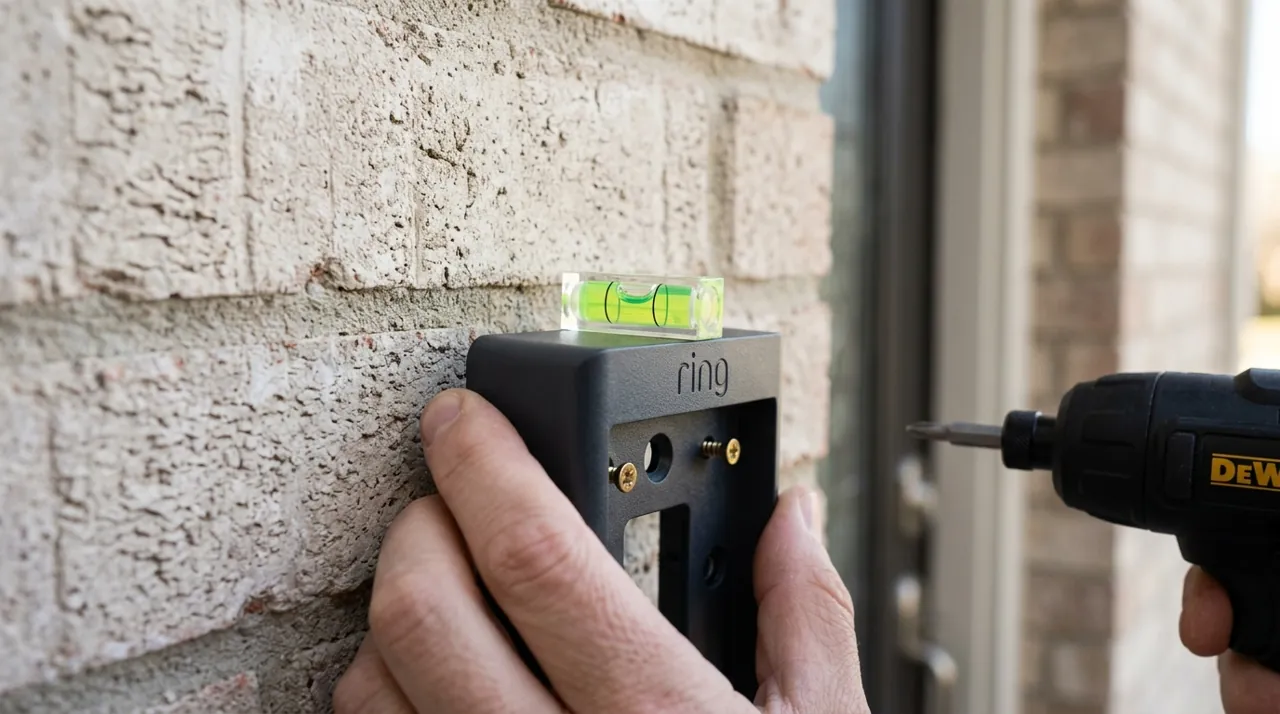
Both doorbells run on battery power, with no wiring required at the door, but in different ways. Ring's removable battery recharges over USB. Blink's doorbell runs on two non-rechargeable AA lithium batteries that you replace rather than recharge. Owner reports put typical recharge intervals at a few weeks to a couple of months, depending on motion volume. Blink's doorbell is built around a genuinely long two-year battery claim, the standout figure in this comparison. Both doorbells can also connect to existing doorbell wiring where it's present, skipping the battery question entirely. Installation itself is a same-afternoon job for either: mount the bracket, connect the battery or wiring, then pair with the app.
Connectivity, App and Notifications
Both doorbells connect over your home WiFi. Ring needs no separate hub; Blink's doorbell can run without one, but Blink ties its two-year battery figure and on-demand live view to pairing it with a Sync Module. Ring's app is the more mature of the two, with a longer track record and features like Motion Zones for cutting false alerts. Blink's app is simpler and gets the basics right: live view, two-way talk, motion alerts. Notification speed is a specifically praised point for Ring in owner reviews. Blink's alerts work reliably too, just without the same depth of customization Ring offers.
Storage and Subscription Plans
Cloud clip history needs a paid plan on both — Ring Protect for Ring, a Blink subscription plan for Blink. Live view and real-time motion alerts work on the free tier for both. Blink's plans run cheaper than Ring's equivalent tiers, part of why Blink positions itself as the budget option in the Amazon-owned doorbell family. The one real exception is Blink: add the doorbell to a Sync Module 2 system with a USB flash drive (sold separately) and it can save clips to local storage with no monthly fee, according to Blink's own FAQ. Ring has no equivalent free local-storage option.
Ecosystem and Smart-Home Integration
Both doorbells work with Alexa, given their shared Amazon ownership. Ring has the broader current device lineup — cameras, floodlights, alarm hardware — all in one app alongside the doorbell. Blink's lineup is smaller but still covers indoor, outdoor and doorbell cameras in the same ecosystem. If you're building out a full smart-home setup with several devices, Ring's wider catalogue gives you more to add later without leaving the app.
Common Use Cases
A battery doorbell like either of these suits a renter or a homeowner who wants no wiring project and no electrician visit. It suits anyone who wants to see who's at the door from their phone, at home or away. Ring's head-to-toe framing and stronger review base make it the safer default for most front doors. Blink's lower price and long battery life suit a budget-conscious buyer, a second entrance, or anyone who'd rather swap a pair of AA batteries every year or two than recharge every few weeks.
Who Should Buy Which
Choose the Ring Battery Doorbell if you want the most review-validated doorbell in this category, the fastest notifications, and head-to-toe framing that reliably catches packages. Choose the Blink Video Doorbell if price and battery longevity matter more than app polish, and a slightly lower rating is an acceptable tradeoff for paying less upfront and recharging far less often.
Winner by Use Case
Best all-round rated doorbell: Ring Battery Doorbell, on both rating and review depth.
Best for catching packages and full visitor detail: Ring Battery Doorbell, on head-to-toe framing.
Best value on price: Blink Video Doorbell, cheaper on both hardware and subscription.
Best for minimizing recharge trips: Blink Video Doorbell, carrying over Blink’s long battery life advantage.
Read More
See the full Ring Battery Doorbell review, and the wider video doorbells hub and best video doorbell cameras roundup for where the Blink Video Doorbell sits against the full field. For the subscription math on each ecosystem, see the Ring owner-sentiment summary and is Blink worth it.
Going Deeper: Why Battery Doorbell Life Varies So Much
A battery doorbell spends most of its life asleep. It wakes when someone approaches or presses the button, records, uploads, then goes back to sleep, and every wake-up costs power. That is why both brands tie their battery figures to usage rather than time alone. Blink’s own FAQ says the Video Doorbell can reach up to two years of battery life “with default settings and normal use” when it is paired with a Sync Module. Without one, live view and two-way audio are only available within 60 seconds of a notification. Blink also says wiring the doorbell to compatible chime wiring extends battery life to up to two years and lets your indoor chime sound on button presses.
Ring lists its drains plainly. Ring’s battery troubleshooting guide says the more live views, linked events and motion events a device performs, the more often you need to recharge it. It notes that rechargeable batteries drain faster when it is cold outside, and that a device with a weak Wi-Fi connection may keep losing and regaining its connection, which runs the battery down faster. Ring even suggests stopping a charge at roughly 90 percent, because overcharging can make a battery run out faster and take longer to charge, and it notes that batteries may not work as well after years of use.
Battery chemistry explains part of the gap between the two. Blink runs on non-rechargeable AA cells, and Blink’s battery guide recommends 1.5-volt lithium batteries, noting that lithium cells hold up in extreme temperatures. Ring uses a removable rechargeable pack. The practical takeaway is that the headline figure for either doorbell is a best case. A busy street, frequent live checks, winter cold or a doorbell at the edge of your Wi-Fi will all shorten it, which is why motion zones and sensitivity settings matter as much as the battery itself.
Verdict
Choose the Ring Battery Doorbell for the strongest all-round rating, the deepest review base and head-to-toe video framing. Choose the Blink Video Doorbell specifically to save money on both hardware and subscription while still getting Blink’s long battery life, and accept a smaller, slightly lower-rated review base in exchange.
Sources & References
- Blink Video Doorbell Technical Specifications — Blink
- Blink Video Doorbell FAQ — Blink
- Blink Subscription Plans — Blink
- Understanding Ring subscriptions — Ring
- Battery Doorbell 2K — Ring
- Tapo D225 Smart Video Doorbell — TP-Link Tapo
- Troubleshooting battery performance — Ring
- Battery guide for your Blink cameras — Blink