
Affiliate Disclosure: Some links on this page are affiliate links. As an Amazon Associate, we earn from qualifying purchases — at no extra cost to you. We do not buy, install, or physically handle the cameras we cover; our rankings come from aggregated owner reviews, ratings and expert consensus. Commissions never change our verdicts. We're reader-supported: commissions fund hosting, research and updates, so if a guide helped, buying through our links keeps it going. How we rank · full disclosure.
The short version: Ring and Arlo are both subscription-model, cloud-first brands, so choosing between them is not about avoiding a fee — both require one for recorded history. Ring’s advantage is scale and polish: the largest review base in this category and an app widely regarded as the fastest for notifications. Arlo’s advantage is video quality: 2K and 4K HDR options with genuinely strong color night vision, at a correspondingly higher price on both hardware and subscription.
In Plain English
Ring and Arlo both make home security cameras that send alerts to your phone and store video online. With both, you pay a monthly plan (a subscription) to keep recordings. So the choice is not about avoiding a fee — it is about what you get for it.
Think of it like choosing between a reliable family car and a sportier one. Ring is the reliable one: cheaper, with an app that owners say alerts them fastest, and a huge number of reviews. Arlo is the sportier one: sharper pictures, including HDR (a setting that keeps detail in both the bright and dark parts of the same picture), and better color after dark, but it costs more for the camera and the plan. If you use Apple’s Home app, some Arlo cameras work with it; Ring’s don’t. Decide whether one sharp camera at a key spot matters more to you than a cheaper, smoother everyday experience.
Top Picks: Ring, Arlo and an Alternative

The largest, most reliably-rated review base of any camera in either lineup, with one of the highest ratings and deepest review bases we track. Motion-activated LED floodlights pair with 1080p color night video on permanent wired power. It needs an existing wired outdoor fixture or an electrician to install.
Why You Should Get This
If you want the single most review-validated camera of the two brands, this is it.
| Resolution | 1080p HD |
| Field of view | 140° horizontal |
| Power | Hardwired, existing outdoor fixture |
| Night vision | Color night vision |
| Audio | Two-way talk |
| Siren | 105dB built-in siren |
| Lighting | Motion-activated LED floodlights |
| Smart home | Works with Alexa |
Benefits
- Largest review base of the two brands.
- Never needs a battery recharge.
- Color night video from the floodlights.
Pros and Cons
- Massive, consistent review base.
- Motion-activated floodlights double as a deterrent.
- Reliable wired connection.
- Needs an existing wired fixture or electrician.
- 1080p rather than Arlo’s 2K.
- Recorded clip history needs a subscription.
Features
- Motion-activated LED floodlights.
- 105dB built-in siren.
- Two-way talk.

Premium 2K HDR video quality with 12x digital zoom, and a solid owner rating. 2K head-to-toe video in a square 1:1 aspect ratio captures the whole doorstep, with a chime included. Package, person, vehicle and animal detection require an Arlo Secure plan.
Why You Should Get This
If sharper 2K HDR detail at the door matters more than Ring’s review depth, this is the pick.
Benefits
- Sharper 2K video than Ring’s 1080p.
- Chime included in the box.
- HDR handles bright and dark areas well.
Pros and Cons
- Best detail-at-the-door of the two brands.
- Doorbell-specific framing.
- Chime included, unlike Ring.
- Full detection needs an Arlo Secure subscription.
- Smaller review base than Ring.
- Lower star rating than Ring.
Features
- 2K head-to-toe video.
- HDR video handling.
- Chime included.
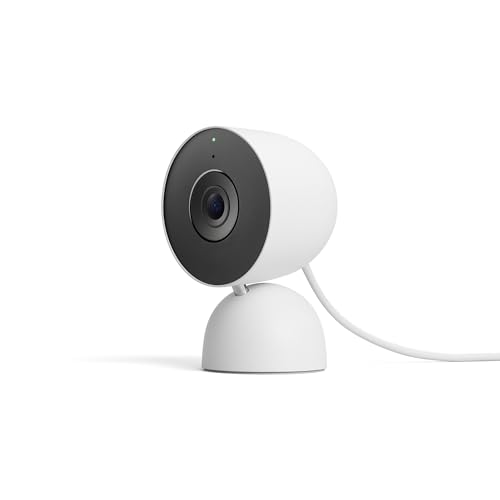
A third option worth knowing about if neither Ring nor Arlo fits: on-device person, animal and vehicle detection that works with no plan required at all, at an entry-level price and a solid owner rating. Up to 6 hours of free event video previews are included on this 3rd-gen model.
Why You Should Get This
If you want free on-device detection with some included recorded history, this is the alternative worth comparing.
| Resolution | Up to 1080p at 30fps |
| Field of view | 135° diagonal |
| Sensor | 2-megapixel color, HDR video |
| Zoom | 6x digital zoom |
| Power | AC wired |
| Connectivity | 2.4GHz and 5GHz WiFi |
| Storage | Up to 3 hours event history included |
Benefits
- On-device detection works with no subscription at all.
- Up to 6 hours of free event video previews.
- Strong Google Home integration.
Pros and Cons
- Genuinely generous free tier versus Ring or Arlo.
- HDR video quality.
- Wired power, no battery to manage.
- Indoor camera, not a doorbell or floodlight.
- Longer history needs Google Home Premium (formerly Nest Aware).
- Needs an outlet at the mount point.
Features
- On-device detection.
- Up to 6 hours free event previews.
- HDR video.
Representative Products Compared
| Product | Best for | Buy |
|---|---|---|
| Ring Floodlight Cam Wired Plus | Ring pick | Price |
| Arlo Video Doorbell 2K + Chime | Arlo pick | Price |
Where the Real Differences Are: Video Quality, Price and Review Base
Video quality. Arlo’s premium tier (2K HDR, some 4K options) is a genuine step above the 1080p Ring models that still make up much of Ring’s range (Ring only introduced its first Retinal 4K and 2K cameras in late 2025), and HDR specifically helps in high-contrast doorway lighting where Ring cameras more often blow out highlights.
Notification reliability. Ring is the more consistently praised brand here across owner reviews, and it’s one of the most frequently cited reasons buyers choose Ring even when a competitor’s hardware specs look better on paper.
Price. Arlo runs higher on both hardware and subscription. If cost is the deciding factor, Ring is the cheaper of the two subscription-model brands, though neither is the cheapest option overall — that’s Wyze or eufy.
Ecosystem and review base. Ring’s review counts run into the tens of thousands per device; Arlo’s are meaningfully smaller across every product we’ve verified, which is worth factoring into how much confidence to place in either brand’s ratings.
Field of View, 2K, 4K and HDR Resolution Detail
Arlo's premium tier reaches 2K, and select models push to 4K, above the 1080p Ring Floodlight Cam Wired Plus compared here. Ring now sells its own Retinal 4K models (Wired Doorbell Pro, Floodlight Cam Pro, Spotlight Cam Pro and Outdoor Cam Pro), so the resolution gap depends on which models you compare. HDR on Arlo's higher-end cameras also helps in high-contrast doorway lighting, where a 1080p Ring camera more often blows out bright highlights or loses shadow detail. Field of view is broadly similar across both brands for a standard outdoor camera, though Arlo's doorbell-specific models add a head-to-toe framing option similar to Ring's. If sharper zoomed-in detail is the priority, Arlo's resolution tier is the clearer winner on paper.
Color Night Vision
Arlo's color night vision on its premium models is generally regarded as sharper and more detailed than Ring's comparable offerings, based on owner reviews and published specs. Ring has added color night vision to several of its own devices in recent generations, narrowing the gap. Neither brand's budget-tier hardware matches the night detail of their own respective flagship models, so compare the specific device rather than the brand name alone.
Power and Battery
Both brands offer battery and wired power options across their lineups, so neither wins outright on power flexibility. Battery life varies by specific model and usage pattern more than by brand. Heavier users of color night vision and frequent motion drain either brand's battery faster. Check the specific model's rated battery life rather than assuming a brand-wide pattern, since Ring and Arlo both span entry-level and premium hardware with different battery engineering.
App and Notifications
This is Ring's clearest, most consistently reported advantage across owner reviews. Alerts arrive faster and more reliably on Ring, and the app itself is described as more mature. It's one of the most frequently cited reasons buyers choose Ring even when a competitor's hardware specs look better on paper. Arlo's app covers the same core functions — live view, two-way talk, motion zones — without matching Ring's reputation for notification speed specifically.
Storage and Subscription
Both are subscription-model, cloud-first brands. Recorded video history requires a paid plan on either — Ring Protect or Arlo Secure — so the Arlo vs Ring subscription cost is a real part of the decision. Full detection features on Arlo, including person, vehicle and package alerts, also sit behind the Arlo Secure subscription. Neither brand offers free cloud history; Arlo's local recording through a SmartHub or Base Station is the closest thing to a free path, while Ring Edge local storage requires a paid Ring Pro plan and a Ring Alarm Pro. Choosing between them isn't about avoiding a subscription fee; it's about which brand's subscription and hardware combination you'd rather pay for.
Installation
Both brands offer battery models that mount wire-free in an afternoon, and wired models that need an existing power source or an electrician. Installation difficulty tracks the specific model chosen more than the brand. A battery Ring Stick Up Cam and a battery Arlo Essential install almost identically. A wired floodlight camera from either brand is a bigger project regardless of brand.
Ecosystem, Accessories and HomeKit
Ring's current lineup is broader, spanning doorbells, floodlights and alarm hardware in one app. Arlo's catalogue is smaller but leans premium, with HomeKit compatibility on select models (through an Arlo Pro SmartHub) that Ring doesn't match. If you already use Apple Home and want native integration, that's a genuine Arlo advantage Ring can't offer on any current device.
Common Use Cases
Ring suits a buyer who wants the smoothest day-to-day notification experience and the largest verified review base to lean on, across a whole-property, multi-camera setup. Arlo suits a buyer who wants the sharpest video quality available at one or two specific spots and is willing to pay more, on both hardware and subscription, for it. Neither escapes the subscription question — if that's your real objection to both brands, look at Reolink or eufy instead.
Arlo vs Ring Pros and Cons: Who Should Buy Which
Choose Ring for the smoothest, most widely-validated day-to-day experience at a lower price, with the deepest review base of the two and the broadest current device lineup. Choose Arlo specifically because premium 2K or 4K HDR video quality and stronger color night vision are worth paying more for to you, especially at a single high-priority spot.
Winner by Use Case
Best all-round notification experience: Ring.
Best video quality for the price you’re willing to pay: Arlo, if premium 2K/4K HDR matters more than cost.
Best value within the subscription-required category: Ring, at a lower price point than Arlo for comparable coverage.
Largest, most battle-tested review base: Ring, by a wide margin.
Read More
See Ring cameras ranked by owner reviews and a ranked list of Arlo cameras for the full lineups, and Ring’s worth-it guide and is Arlo worth it for the subscription math on each.
Going Deeper: What 2K, 4K and HDR Actually Change
Resolution is a pixel count, and more pixels mainly help when you zoom in after the fact. Take Arlo’s own doorbell: Arlo’s spec sheet for the Video Doorbell 2K (2nd Generation) lists 1944 x 1944 video in a square frame, a 180° diagonal field of view and 12x digital zoom. That square works out to about 3.8 million pixels, against roughly 2.1 million in a standard 1920 x 1080 frame. Digital zoom enlarges part of the frame rather than moving a lens, so the extra pixels are what keep a face or a parcel label readable once you crop in.
HDR tackles a different problem. Arlo describes HDR as a software method of adjusting high-contrast images that contain both bright highlights and deep shadows, so detail survives in both. Its cameras apply Auto HDR by default whenever a scene would benefit, unless you switch it off in the app. A front door is exactly that kind of scene — a sunlit street behind a visitor standing in a shaded porch — which is why this comparison notes that 1080p cameras without HDR are more likely to blow out the highlights.
Ring has since moved up the resolution ladder too. Amazon’s announcement of Ring’s first 4K cameras lists Retinal 4K on the Wired Doorbell Pro, Spotlight Cam Pro, Floodlight Cam Pro and Outdoor Cam Pro, with 10x zoom and enhanced low-light performance, and Retinal 2K on models such as the Indoor Cam Plus and Wired Doorbell Plus. So a fair comparison is model to model, not brand to brand. Sharper video also has a network cost: Ring’s Wi-Fi guidance recommends 2 Mbps of upload speed for a 1080p device, 10 Mbps for 2K and 15 Mbps for 4K, and says the figures add up across devices.
Verdict
Choose Ring for the smoothest, most widely-validated day-to-day experience at a lower price. Choose Arlo specifically because premium video quality is worth paying more for to you. Neither escapes the subscription question — if that’s your real objection, look at eufy or Reolink instead.
Sources & References
- Which Arlo cameras and doorbells work with Apple Home — Arlo
- How do I set up local storage backups using my Arlo SmartHub or Base Station? — Arlo
- What Arlo subscription plans and cloud recording options are available? (United States) — Arlo
- Ring Protect subscription plans — Ring
- Ring Pro plan — Ring
- Ring unveils first-ever 4K security cameras — Amazon
- Learn about event and 24/7 video history — Google Nest Help
- Arlo Video Doorbell 2K (2nd Generation) spec sheet (AVD4001) — Arlo
- How do I use HDR with my Arlo camera? — Arlo
- Understanding wifi recommendations for Ring devices — Ring