
Affiliate Disclosure: Some links on this page are affiliate links. As an Amazon Associate, we earn from qualifying purchases — at no extra cost to you. We do not buy, install, or physically handle the cameras we cover; our rankings come from aggregated owner reviews, ratings and expert consensus. Commissions never change our verdicts. We're reader-supported: commissions fund hosting, research and updates, so if a guide helped, buying through our links keeps it going. How we rank · full disclosure.
Short version: these are full garage door opener motor replacements, for buyers whose existing motor needs replacing rather than just adding smart features. The Genie Chain Drive 550 is the highest-rated pick and the best value. The Genie StealthDrive Connect is the quietest belt-drive option for a garage near living space. The Genie QuietLift Connect bundles a wireless keypad in the box.
If your existing opener works fine and you just want app control, a retrofit controller is cheaper and faster — see top-rated smart garage door openers.
In Plain English
A garage door opener is the motor on your garage ceiling that lifts and lowers the door. This page covers full replacements, the whole motor and rail, not add-on gadgets. The main choice is the drive type: a chain (like a bicycle chain) or a belt (like a strong rubber strap with steel inside).
Why it matters: a chain drive is cheaper and tough, while a belt drive is much quieter, which is worth it if a bedroom is above or beside the garage. Some models also have Wi-Fi built in so you can use an app. The one thing to check first is your door. Make sure the opener is rated for your door's weight and height, and get a professional if you're not comfortable working near the door's tightly wound spring.
Top Rated Picks at a Glance
The Ranked Field: Star Rating, Consensus and Price

Best for the highest-rated full opener replacement, built for heavy-duty daily use.
- Heavy-duty chain drive motor.
- Limited 10-year motor warranty.
- Smart-connectable via Aladdin Connect add-on.
- Over 3,500 verified owner ratings.
Why buy it: The highest star rating of any full opener replacement on this page, at a price well below the premium belt-drive options.
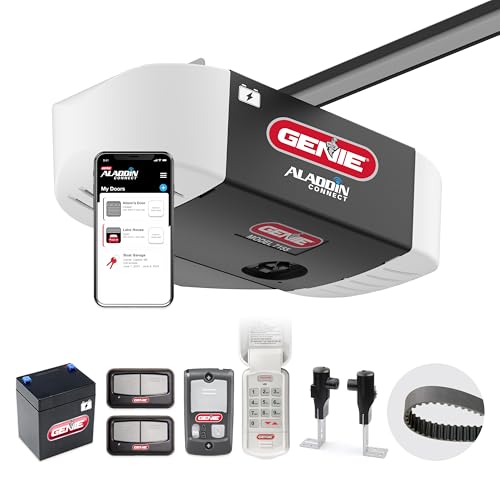
Best for the quietest operation, for a garage attached to living space.
- Belt drive for quiet operation.
- Built-in smart connectivity.
- Over 5,000 verified owner ratings.
- Battery backup included.
Why buy it: A quiet belt-drive motor with a deep review base, worth the premium over a chain drive for anyone with a garage under or beside a bedroom.

Best for a smart opener bundled with a wireless keypad out of the box.
- WiFi smart connectivity built in.
- Wireless keypad included.
- Quiet belt-drive operation.
- Over 1,900 verified owner ratings.
Why buy it: Bundles a wireless keypad with the opener itself, removing the need for a separate accessory purchase.
Comparison Table
| Product | Best for | Buy |
|---|---|---|
| Genie Chain Drive 550 Garage Door Opener | Best Overall | Price |
| Genie StealthDrive Connect Belt Drive Opener | Best Quiet Operation | Price |
| Genie QuietLift Connect | Best with Wireless Keypad | Price |
How We Rank
We do not buy or physically install these openers. Every star rating and review count comes from licensed Amazon data. Full method on how we rank.
What to Look For
Lifting capacity matched to your door. Check each model's rated lifting capacity against your specific door's weight and size — an insulated, oversized, or double-wide door needs more capacity than a standard single garage door, and manufacturer specifications list which door types and sizes each opener is rated for.
Drive type for your garage's location. Chain drive for a detached garage or one with no adjacent living space; belt drive if the garage shares a wall or ceiling with a room where noise matters.
Smart connectivity, if you want it built in. The StealthDrive Connect and QuietLift Connect have Aladdin Connect Wi-Fi built in from the factory; the Chain Drive 550 doesn’t, and needs Genie’s separate Aladdin Connect add-on for app control.
Included accessories. A wireless keypad, remotes, and safety sensors are usually included, but the exact bundle varies by model — the Genie QuietLift Connect bundles a wireless keypad, while the other two typically don't, though a keypad can always be added separately afterward.
Warranty coverage. Warranty terms differ between the lines: Genie lists a limited 10-year motor warranty on the Chain Drive 550 and a limited lifetime motor warranty on the belt-drive QuietLift Connect and StealthDrive Connect (the StealthDrive’s also covers the belt).
Chain Drive vs Belt Drive
Chain drive is the traditional, proven mechanism: a metal chain pulls the trolley along the rail, and it's typically the most affordable and durable option for a detached garage or one with no adjacent living space. Belt drive replaces that metal chain with a steel-reinforced belt, which runs meaningfully quieter — this is a genuine mechanical difference, not just marketing, and it's the single most commonly cited reason reviewers choose belt drive over chain drive. If the garage shares a wall or ceiling with a bedroom or living room, belt drive's extra cost is usually worth paying; if it's fully detached, chain drive delivers the same underlying reliability for less money.
When to Replace the Whole Opener
A full replacement is the right move when the existing motor itself is the problem: it's failing intermittently, straining audibly, or simply too loud for where it's installed. A retrofit smart controller — see a ranked list of smart garage door openers — only adds app control on top of an existing motor and can't fix any of those underlying mechanical issues. If your current opener runs reliably and quietly enough, and the only thing missing is a smartphone app, a retrofit controller is the cheaper, faster fix; a full motor replacement is reserved for when the mechanism itself needs to go.
Installation and Safety
A full opener installation is a bigger job than a retrofit controller — expect roughly a half-day for a first-time DIYer, working overhead near a garage door's torsion spring system, which carries real mechanical tension. The work covers removing the old motor and rail, mounting the new unit, wiring the wall control panel and safety sensors, and calibrating the door's travel limits and closing force. All three openers on this page include the safety features the federal standard (16 CFR Part 1211) requires on residential units: photo-eye sensors that stop and reverse the door if the beam near the floor is broken, and auto-reverse if the door meets resistance while closing. If you're not fully comfortable working around a loaded torsion spring, hiring a professional installer is the safer route — and read the warranty terms in the manual before you start. Either way, budget the extra time compared with a retrofit controller's under-an-hour job, since a full opener swap genuinely is a bigger project.
Will It Fit Your Existing Door?
Opener motors are largely universal across standard sectional garage doors, since they connect through a rail-and-trolley system rather than being tied to a specific door brand. The two things actually worth verifying before buying are your door's weight rating against the opener's lifting capacity, and enough ceiling clearance above the door for the rail and motor unit to be mounted. Genie rates the Chain Drive 550 and QuietLift Connect for residential sectional doors up to 7 feet high, and sells extension kits for taller doors — the Chain Drive 550 needs one for an 8-foot door. A licensed garage-door technician can confirm the exact weight and height of your specific door if you're not certain, which is worth doing before ordering rather than after the box arrives.
Which One Should You Buy?
Most buyers replacing a failing or unreliable opener on a budget: the Genie Chain Drive 550, the highest-rated and lowest-priced of the three, and a genuinely reliable choice for any detached garage.
A garage attached to living space, where noise matters: the Genie StealthDrive Connect's belt drive, worth its premium the very first time the door opens or closes without waking anyone up in an adjacent room.
Buyers who want a wireless keypad bundled in without a separate accessory purchase: the Genie QuietLift Connect.
Going Deeper: Chain, Belt, Screw and DC Motors: How the Drives Differ
Every opener does the same basic job: a motor moves a trolley along a rail, and the trolley pulls the door. The drive type is how the motor's power reaches that trolley, and it explains most of the differences in noise, upkeep and price. Genie's own product-selection guidance describes chain drive openers as among the most affordable in the industry, with a rugged, time-tested design that is durable and long-lasting. That's the Chain Drive 550's appeal on this page.
Belt drives swap the chain for a belt, which on the StealthDrive Connect Genie describes as steel-reinforced. Genie says they are ultra quiet because they are smooth and have no metal-on-metal contact in the rail, and that with proper periodic maintenance belt units offer years of trouble-free service. That missing metal-on-metal contact is the mechanical reason reviewers keep citing noise as the deciding factor for the StealthDrive Connect and QuietLift Connect.
Genie also makes a third type not ranked on this page, the screw drive, which Genie describes as a solid-steel direct drive with no belts, chains or gears that wear out. And separately from the drive, the motor itself can be AC or DC. Genie describes one of its DC-motor models as near-silent, with soft-start and soft-stop actions and speeds of up to 12 inches per second.
Whatever drive you choose, installation ends with calibration, and that step exists for safety. Federal rules require residential openers to reverse if they hit something. Under 16 CFR 1211.7, a door that contacts a 1-inch-high object on the floor must reverse within 2 seconds and return to the fully open position. Setting the travel limits and closing force correctly during installation is what lets the opener meet that test on your door. After any install, it's worth checking the reversal yourself with a small, sturdy object on the floor under the door, following the manual's instructions.
The Verdict
The Genie Chain Drive 550 is the right default for most full-replacement buyers — highest rating, lowest price of the three. Choose the StealthDrive Connect if quiet operation near living space matters, and the QuietLift Connect if a bundled wireless keypad appeals. Whichever model you choose, confirm its rated lifting capacity against your specific door's weight before ordering, and don't attempt the install yourself if you're not genuinely comfortable working near a loaded torsion spring.
Sources & References
- Chain Drive 550 Model 2035 — The Genie Company
- StealthDrive Connect Model 7155 — The Genie Company
- QuietLift Connect Model 3053TKV — The Genie Company
- 16 CFR 1211.7 — Inherent entrapment protection requirements — Cornell Law School Legal Information Institute
- 16 CFR 1211.8 — Secondary entrapment protection requirements — Cornell Law School Legal Information Institute
- What's the Difference Between Belt Drive, Screw Drive and Chain Drive? — The Genie Company