
Affiliate Disclosure: Some links on this page are affiliate links. As an Amazon Associate, we earn from qualifying purchases — at no extra cost to you. We do not buy, install, or physically handle the cameras we cover; our rankings come from aggregated owner reviews, ratings and expert consensus. Commissions never change our verdicts. We're reader-supported: commissions fund hosting, research and updates, so if a guide helped, buying through our links keeps it going. How we rank · full disclosure.
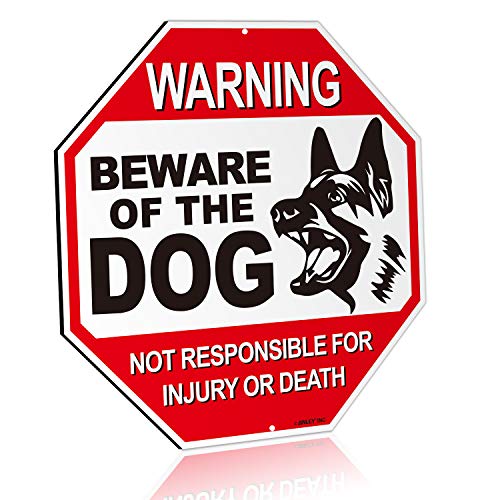
Anley Beware of The Dog Aluminum Warning Sign
The highest-rated deterrent sign this site tracks — a durable aluminum warning sign for a fraction of a camera’s cost.
Check Price →
In Plain English
This is a metal warning sign that says "Beware of the Dog." You screw it to a fence, gate or door. It doesn't plug in, doesn't need batteries and doesn't record anything. Its only job is to make someone pause before they walk onto your property, a bit like a speed bump for bad ideas.
Why it matters: it costs very little, and owners use it whether or not they have a dog. It is made of aluminum, which doesn't rust the way steel does, so it suits wet or coastal weather. The one thing to do is put it where people see it first, at eye level on the front gate or main entry. And remember it is a warning, not a security system, so pair it with a light or camera if you can.
Full Specifications
| Material | Aluminum, weatherproof |
| Mounting | Fence, gate, or door |
| Size | Check current listing for dimensions |
Summary
The Anley Beware of The Dog Sign holds the highest rating of any deterrent sign this site tracks, across a deep base of verified owner ratings. It’s a durable aluminum warning sign, positioned as a low-cost visual deterrent layer alongside cameras and lighting. Among the passive deterrent signs reviewed on this site, it consistently comes out ahead on both rating and review depth.
What owners praise
Print and material quality holding up outdoors over time is the most repeated positive, along with the low price relative to any camera-based deterrent. Reviewers frequently mention buying it regardless of actually owning a dog, purely for the deterrent value.
What owners complain about
As with any static sign, its deterrent effect is unverifiable and depends entirely on context — a fair, honest limitation to note rather than a product flaw. A small number of reviews mention mounting hardware isn’t always included.
Design and Build Quality
The sign is stamped aluminum, not the thin plastic used on many bargain warning signs. Owners describe the metal as rigid, with rounded corners and pre-drilled mounting holes. The printed graphic sits under a protective coating on most batches, which reviewers say resists scratching from everyday handling. Text and imagery are bold and legible from a normal walking distance, which matters for a sign meant to be read at a glance rather than studied up close. The overall look reads as a genuine warning sign rather than a novelty item, which owners say helps it pass as credible to a passerby.
Sizing and Mounting Options
Check the current listing for exact dimensions, since sign sizes vary by seller listing and by which variant is in stock. Most owners mount it with basic screws or zip ties through the pre-drilled holes, and a few use outdoor-rated adhesive strips instead when drilling into a fence or gate isn't practical. Reviewers who mounted it at eye level on a front gate say it gets noticed more reliably than one placed low on a fence line. The aluminum is thin enough to cut with tin snips if a buyer wants a custom shape, though that voids any implied warranty and isn't something the manufacturer recommends.
Placement and Real-World Effectiveness
A warning sign works through psychology, not hardware. It gives a passerby a reason to hesitate or move on to an easier target. Owner reviews consistently describe it as cheap insurance, bought and mounted regardless of whether a dog actually lives at the property. Research on burglar decision-making supports the broader idea: in a UNC Charlotte survey of incarcerated burglars, respondents said they weighed signs of increased security, including alarm signs, dogs and outdoor cameras, when choosing a target, and the Center for Problem-Oriented Policing notes that most burglars avoid houses with dogs. No study isolates a beware-of-dog sign on its own, and no sign can guarantee an outcome. Reviewers who pair it with a camera or motion light say the combination feels more complete than any single layer alone.
Durability Outdoors Over Time
Aluminum resists rust, unlike steel or tin alternatives, which is a real advantage for something meant to stay outdoors year-round. Owners in humid and coastal climates specifically call out the lack of rust spots after extended exposure. UV fading on the printed graphic is the main long-term wear factor reviewers mention, tracking with what's typical for any printed outdoor sign rather than being unique to this product. Multi-year owner reviews describe the sign as still legible and structurally sound well after the first season.
Signage vs. Active Deterrents
A static sign is the cheapest layer in a deterrent strategy, but it's also the most passive. It can't record anything, alert anyone or react to movement. Reviewers weighing options generally treat it as a complement to cameras or motion lighting, not a replacement. Buyers wanting an active visual deterrent that at least looks like it's recording should compare it against a dummy camera instead, which adds the appearance of surveillance on top of the warning message.
Price and Value in a Layered Strategy
The Anley sign costs a small fraction of any camera on this site, which is exactly why reviewers describe it as a natural first purchase in a broader security plan. It doesn't replace a camera's ability to actually catch an incident on video, but it adds a first line of psychological friction at a price low enough to buy several and place them at every approach point. Owners who've built out a full deterrent layer — signage, lighting, and a camera — consistently say the sign was the cheapest and easiest piece to add, and one they'd buy again without hesitation.
Who It’s For
Any homeowner wanting a cheap, durable, well-reviewed layer to add to a broader deterrent strategy. It particularly suits a front gate, fence line or side entrance where a quick visual warning does real work before someone gets close to the house, whether or not an actual dog lives on the property.
Who Should Skip It
If you want an active deterrent rather than passive signage, see BNT Dummy Camera review.
Cleaning and Long-Term Care
Upkeep is minimal. Most owners just hose it down or wipe it with a damp cloth when dirt or pollen builds up. No special cleaner is needed for the printed coating. Reviewers say avoiding abrasive scrubbing pads keeps the graphic looking sharp for longer, since scrubbing can dull the protective coating over repeated use. Beyond that, there's nothing to maintain: no battery to check, no firmware to update, and no moving parts to wear out over years of outdoor exposure.
Pros and Cons
Pros: highest-rated deterrent sign this site tracks, durable weatherproof aluminum, very low cost, strong review base, rust-resistant material, works with no power or app needed.
Cons: deterrent effect is unverifiable, mounting hardware not always included, purely passive with no recording or alert capability.
Going Deeper: What a Dog Sign Means for Liability
Most people buy a beware-of-dog sign as a deterrent, but if you do own a dog, the sign sits alongside a separate question: who pays if the dog bites someone. That is decided by state law, and the Insurance Information Institute describes three different approaches. Under a strict-liability dog-bite statute, the owner is automatically liable for injuries or property damage the dog causes without provocation. Under the one-bite rule, the owner is responsible only if they knew the dog was likely to cause that type of injury, and the victim has to prove that knowledge. Under negligence laws, the owner is liable if they were unreasonably careless in controlling the dog.
That is why a sign is not legal protection. None of the three approaches, as the Institute describes them, turns on whether a warning sign was posted: they turn on the dog's behavior, what the owner knew and how carefully the owner controlled the dog. None of this means you shouldn't post one. It means the sign's job is to discourage intruders and alert visitors, not to shift responsibility for a bite.
The stakes are real. The Institute reports 28,450 dog-bite claims in 2025, with an average cost of $65,450 per claim and a total of about $1.86 billion. It notes that homeowners and renters policies typically cover dog-bite liability legal expenses up to the policy's liability limit, typically $100,000 to $300,000, and that the owner is responsible for anything above that. California led the country with 2,830 claims in 2025, and New York had the highest average cost per claim.
For a homeowner, the practical takeaway is simple. If the sign is purely a deterrent and there is no dog, it works as a cheap psychological layer. If there is a dog, check how your state handles bites and confirm what your insurance policy covers, and treat the sign as a courtesy to visitors rather than a shield. As the review notes, this is general information, not legal advice.
Verdict
A well-evidenced, inexpensive addition to any layered deterrent strategy. It won't stop a determined intruder on its own, but reviewers consistently rate it as cheap, durable insurance that earns its low price many times over. Given the near-zero cost of trying it, there's little reason for a homeowner not to add one alongside whatever else is already protecting the property. See the security deterrents hub for how it compares against the field.
Alternatives to Consider
- BNT Dummy Fake Camera review
- WALI CCTV Dome Fake Camera review
- Best Fake Security Camera — the full ranked field
Sources & References
- Through the Eyes of a Burglar: Study Provides Insights on Habits and Motivations — UNC Charlotte
- Burglary of Single-Family Houses — ASU Center for Problem-Oriented Policing
- Spotlight on: Dog Bite Liability — Insurance Information Institute