
Affiliate Disclosure
Some links on this page are affiliate links. As an Amazon Associate, we earn from qualifying purchases — at no extra cost to you. We do not buy, install, or physically handle the cameras we cover; our rankings come from aggregated owner reviews, ratings and expert consensus. Commissions never change our verdicts. How we rank · full disclosure.
Short version: a driveway alarm or motion sensor gives you an instant alert — a chime, a notification, a flashing light — the moment something crosses its detection zone, with no camera and no recorded footage. It’s a fundamentally different device than a security camera, and the two pair well together rather than compete: the alarm tells you something happened right now, a camera shows you what it was.
How we work: we do not buy, install or physically handle these devices. Every ranking here comes from aggregated owner reviews, star ratings weighted by review volume, and expert consensus. Method on how we rank; funding on our affiliate disclosure. Ready for models? Go to best driveway alarm for long-range outdoor picks.
Top Recommended Motion Sensor Alarms

The TECKNET holds the highest star rating of any motion sensor alarm tracked on this site, from a deep base of owner ratings, functioning as both a security alert and a customer or visitor entry chime. Fast PIR detection triggers a 5-second alert interval to avoid repeat notifications. No WiFi or subscription is required. Owners consistently value its dual role as both a door chime and a basic security alert.
Why You Should Get This
If you want the single highest-rated indoor motion alert device tracked on this site, doubling as a door chime, this is the default.
Benefits
- Highest star rating of any motion sensor alarm tracked on this site.
- Doubles as both a security alert and an entry chime.
- No WiFi or subscription required.
Pros and Cons
- Largest, most trustworthy rating in this category.
- Fast PIR detection.
- Simple no-subscription setup.
- Indoor use only.
- No smartphone alert, local chime only.
- Basic feature set versus connected alarms.
Features
- Fast PIR detection.
- 5-second alert interval.
- No WiFi or subscription.
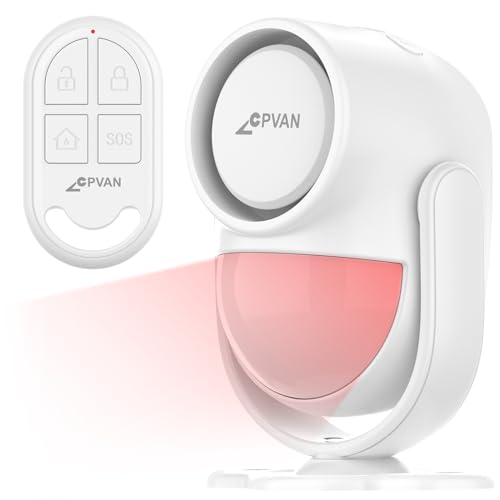
The CPVAN delivers the loudest alarm in this comparison at 125dB, holding a solid rating from a deep review base, for situations where a genuine siren matters more than a subtle chime. A wireless PIR motion detector pairs with an included remote control. Owners consistently value the alarm volume for attention-grabbing deterrence rather than a quiet notification. It suits a different use case than the door-chime-style TECKNET.
Why You Should Get This
If you want a genuinely loud, attention-grabbing alarm rather than a subtle chime, this is the pick built for that.
Benefits
- Loudest alarm in this comparison at 125dB.
- Wireless PIR motion detector.
- Remote control included.
Pros and Cons
- Genuinely loud, attention-grabbing siren.
- Wireless, no complex install.
- Remote control for easy arming.
- Lower star rating than the TECKNET.
- Loud siren may be excessive for some indoor uses.
- No smartphone alert, local siren only.
Features
- 125dB alarm siren.
- Wireless PIR detector.
- Remote control included.

Driveway Alarms vs Indoor Motion Sensors
Driveway alarms are built for long-range outdoor detection — a vehicle or person entering a property along a driveway, gate or perimeter, with a range commonly rated up to 1/2 mile in open conditions. Indoor motion sensor alarms and door chimes are built for shorter-range detection at an entry point — a shop door, a back room, a specific doorway — and typically double as a customer-entry or activity chime rather than a security-focused early-warning system.
Wireless and Solar: No WiFi, No Subscription
Every device on this hub communicates directly between its sensor and receiver over a dedicated wireless signal — no home WiFi, no app, no subscription. Solar-powered sensors remove the battery-replacement chore for an outdoor sensor exposed to the elements, similar to the tradeoffs seen with solar security cameras and lights.
How We Rank
Every product ranked on this hub is scored the same way the rest of the site is: aggregated owner star ratings weighted by review volume, recurring themes in negative reviews, and specification differences owners raise unprompted. We never buy, install or physically test these devices, and every star rating and review count comes from licensed Amazon data. Full method on how we rank.