
Affiliate Disclosure: Some links on this page are affiliate links. As an Amazon Associate, we earn from qualifying purchases — at no extra cost to you. We do not buy, install, or physically handle the cameras we cover; our rankings come from aggregated owner reviews, ratings and expert consensus. Commissions never change our verdicts. We're reader-supported: commissions fund hosting, research and updates, so if a guide helped, buying through our links keeps it going. How we rank · full disclosure.
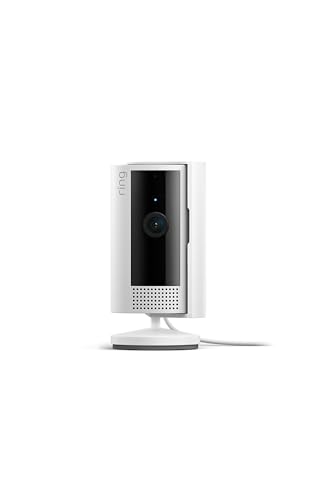
Ring Indoor Cam (2nd Gen)
A plug-in indoor camera with a manual privacy cover and the highest owner rating of any camera in Ring's current lineup.
Check Price →
In Plain English
The Ring Indoor Cam is a small plug-in camera for inside your home. Owners rate it highly mostly for one reason: when something moves, the alert reaches your phone quickly and reliably.
Its most useful feature is simple. A privacy cover closes by hand over the lens and blocks the microphone too. You can see at a glance that it is off, instead of trusting an app setting. It is like drawing a curtain rather than asking someone not to look.
The trade-off is storage. There is no memory card slot. Without a Ring Home plan (a monthly subscription, formerly called Ring Protect), it saves no video at all; you only get live view and alerts. The picture is 1080p, which is enough to recognize people in a room but behind newer 2K cameras.
The one thing to decide first: if you will not pay a monthly fee, choose a different camera.
Full Manufacturer Specifications
Sourced from Ring's official product page (ring.com/products/mini-indoor-security-camera-plug-in).
| Resolution | 1080p HD video with color night vision |
| Field of view | 115° horizontal, 60° vertical |
| Power source | Plug-in power (standard outlet) |
| Recording | Motion-event recording with a Ring Home subscription; 24/7 recording requires Ring's 24/7 Continuous Recording add-on (cloud-stored up to 14 days) |
| Motion detection | Motion alerts with advanced pre-roll |
| Privacy | Manual audio & video privacy cover |
| Two-way audio | Yes, two-way talk |
| Mounting | Flat surface, ceiling, or wall |
| Colors | White and black |
| WiFi | Single-band 2.4 GHz |
| Storage / subscription | Live view free; no recorded history without a Ring Home plan (formerly Ring Protect), no local storage option |
Note: the WiFi band comes from Ring's device comparison table; Ring's product page does not publish exact dimensions for this model — we report only what Ring discloses.
Summary
The Ring Indoor Cam holds the highest star rating of any current Ring product, across one of the deepest review bases we track, and it earns that on reliability rather than spec-sheet impressiveness — it's 1080p in a market where 2K is now common, and its main functional differentiator is a physical privacy cover you close by hand.
What Owners Praise
Notification reliability is the theme that shows up most often and most emphatically — alerts arriving quickly and consistently is repeatedly cited as the reason owners keep the camera running long-term. The manual privacy cover draws specific praise as the one privacy control that doesn't require trusting an app setting. Reviews also note units still functioning years after purchase, an unglamorous but meaningful longevity signal.
What Owners Complain About
The subscription requirement is the dominant complaint, consistent across the whole Ring range — there is no local storage option at all on this model, so a lapsed or never-purchased Ring Home plan (formerly Ring Protect) means zero recorded history. 1080p resolution is noted as behind competitors' 2K and 2.5K options at similar prices. Some owners also report the 115-degree field of view feeling narrower than expected for corner-mounting a larger room.
App Experience, Motion Alerts and Notification Reliability
The Ring app is the single interface for live view, event history, motion settings and the Ring Home subscription itself. Setup is a standard plug-in-and-pair process, and most owners describe it as quick, especially for anyone already on Ring's ecosystem from a doorbell or another camera. What sets this camera apart in owner reviews isn't a long feature list — it's that alerts consistently arrive fast and rarely get missed, which is the property that matters most for a camera's actual job. Motion sensitivity and detection zones are both adjustable in the app, letting you tune out a ceiling fan or a flickering TV screen in the same room without losing genuine motion events entirely.
Resolution and What a Ring Home Plan Adds
This model's resolution is 1080p, not the 2K resolution of Ring's separate Indoor Camera 2K Plus (the model people often search for as the Ring Indoor Cam Plus). A Ring Home subscription doesn’t change that resolution figure, but it does unlock recorded video history, richer event search and more advanced motion filtering on top of the free live-view tier.
Physical Design and Plug-In Setup
The Indoor Cam is a small, plug-in unit on a swivel mount, designed to sit on a flat surface or mount to a wall or ceiling, powered by the included USB cable. It's compact and deliberately unobtrusive by design, available in white or black, and doesn't draw much attention the way a larger, bulkier camera might in a shared living space. Setup is plug-in power, connect to WiFi through the app, and position — there's no battery to manage. Build quality across the plastic housing matches the rest of Ring's current indoor lineup, described consistently in owner reviews as solid for the price rather than genuinely premium.
The Manual Privacy Cover in Daily Use
The physical privacy cover is the feature reviewers single out most specifically as a genuine differentiator, not a marketing checkbox. Closing it by hand blocks both the lens and the microphone at once, which is verifiable just by looking at the camera rather than trusting an app toggle that could theoretically be reversed remotely. This matters most in a shared living space, a home office on video calls, or any room where the camera shouldn't always be recording — closing the cover during those windows is a simple physical habit that doesn't depend on remembering to open the app first.
Where to Place the Ring Indoor Cam
A plug-in camera is naturally positioned wherever a convenient outlet exists, which is both its main practical constraint and part of why placement matters more here than on a battery model that can go anywhere. An entry hall, living room corner, or a spot with a clear view of the main walkway through a home are the positions owner reviews most commonly describe, since notification speed is this camera's strongest property and those are the spots where fast alerts matter most. A 115-degree field of view suits a single room rather than a wide open-plan space — for a larger room, positioning it to cover the main entry point rather than trying to capture every corner gets the most value from the coverage it actually has. Elevated placements, a bookshelf or a high corner shelf, generally give a more useful vantage than a low tabletop position, since the wider vertical spread from height helps compensate for the moderate 60-degree vertical field of view.
Who It's For
Alexa/Ring-ecosystem households that want the single most reliably-alerting indoor camera in the lineup and are comfortable paying for a Ring Home plan. It's a strong default pick for an entry hall, living room, or any indoor position where notification speed matters more than raw resolution.
Who Should Skip It
Buyers who want local, subscription-free recording should look elsewhere entirely — there's no card slot on this model. See our best indoor security cameras roundup for local-storage alternatives like Tapo and Wyze.
Pros and Cons
Pros: highest-rated current Ring product, very reliable notifications, physical privacy cover, simple plug-in install, large and mature review base.
Cons: 1080p only, no local storage option at all, subscription required for any recorded history, field of view narrower than some competitors at this price.
Going Deeper: Why a Physical Cover and Account Security Both Matter
The case for a physical privacy cover is easiest to understand through the FTC’s 2023 action against Ring. According to the FTC’s announcement, one Ring employee viewed thousands of video recordings belonging to female users over several months, including from cameras in spaces such as bathrooms and bedrooms, before a colleague caught it. The FTC also alleged that Ring did not implement multi-factor authentication despite multiple credential-stuffing attacks in 2017 and 2018, and that hackers accessed about 55,000 customer accounts and used cameras’ two-way functionality to harass and threaten people.
The settlement required Ring to pay $5.8 million in consumer refunds, to implement a privacy and security program, and to delete customer videos and face data it obtained before 2018, along with data, models and algorithms derived from videos it unlawfully reviewed.
Against that background, a manual cover does something no setting can. Ring says the Indoor Camera (2nd Gen)’s manual privacy cover “turns off your Indoor Camera (2nd Gen) until you need it next” (Ring). Once it is closed, what the camera can see and hear no longer depends on who has access to the account or on an app toggle staying where you left it — which is why owners single it out as the privacy control they can verify by looking.
The cover only protects the moments it is closed, so the account still needs locking down. The FTC’s guidance on using IP cameras safely recommends a strong password that would be hard to guess rather than any default, two-factor authentication on the cloud account, keeping software updated, and securing the home router with a strong password, its firewall and “WPA3 or WPA2” encryption. For a camera whose recordings live entirely in the cloud, those account steps are the other half of its privacy.
Verdict: Final Review Summary
The Ring Indoor Cam earns its strong average rating on the property that matters most in daily use — alerts that arrive, reliably, every time — and the manual privacy cover is a genuinely useful feature most competitors skip. Buy it if you're already committed to a Ring Home plan; if a subscription is a dealbreaker, the field opens up considerably at best indoor security cameras.
Accessories for This Camera

Best for local recording on a camera with a card slot.

Best for angling this camera precisely under an eave, soffit or shelf.

Best for a clean, weatherproof cable entry point on an outdoor mount.
Alternatives to Consider
- Blink Mini Pan-Tilt Camera review
- Google Nest Cam Indoor (Wired, 3rd Gen) review
- Best Indoor Security Cameras — the full ranked field
Sources & References
- Ring Indoor Camera (2nd Gen) — Ring
- Nest Cam Indoor (wired, 3rd gen) Tech Specs — Google Store
- Tapo C211 Pan/Tilt Home Security Wi-Fi Camera — TP-Link
- FTC Says Ring Employees Illegally Surveilled Customers, Failed to Stop Hackers from Taking Control of Users’ Cameras — Federal Trade Commission
- Using IP Cameras Safely — Federal Trade Commission