
Affiliate Disclosure: Some links on this page are affiliate links. As an Amazon Associate, we earn from qualifying purchases — at no extra cost to you. We do not buy, install, or physically handle the cameras we cover; our rankings come from aggregated owner reviews, ratings and expert consensus. Commissions never change our verdicts. We're reader-supported: commissions fund hosting, research and updates, so if a guide helped, buying through our links keeps it going. How we rank · full disclosure.
Short answer: a doorbell camera that keeps missing people is usually dealing with one of three issues: motion detection lag that takes a beat too long to register someone walking directly toward the door, a field of view too narrow to capture the actual approach angle, or a sensitivity setting tuned too conservatively to avoid false alerts at the cost of missing genuine ones. Each has a specific, checkable fix, and working through them in order resolves the large majority of "kept missing the delivery person" complaints.
Recommended Doorbells for Reliable Detection

Best for a head-to-toe frame built to reduce exactly this problem.


Best for a budget option worth checking for the same motion-lag issue.
Why Does My Doorbell Camera Keep Missing People? The Detection-Angle Problem
Motion detection generally works best when a subject moves across the camera's field of view rather than directly toward the lens, because the pixel-level change between frames is more pronounced for lateral movement than for someone walking straight at the camera, whose size in frame changes more gradually. A person walking directly up a front path toward a doorbell mounted at the door itself is, ironically, one of the harder detection angles for many motion algorithms, which is a big part of why doorbell cameras miss the exact scenario — someone approaching the door — that owners care about most.
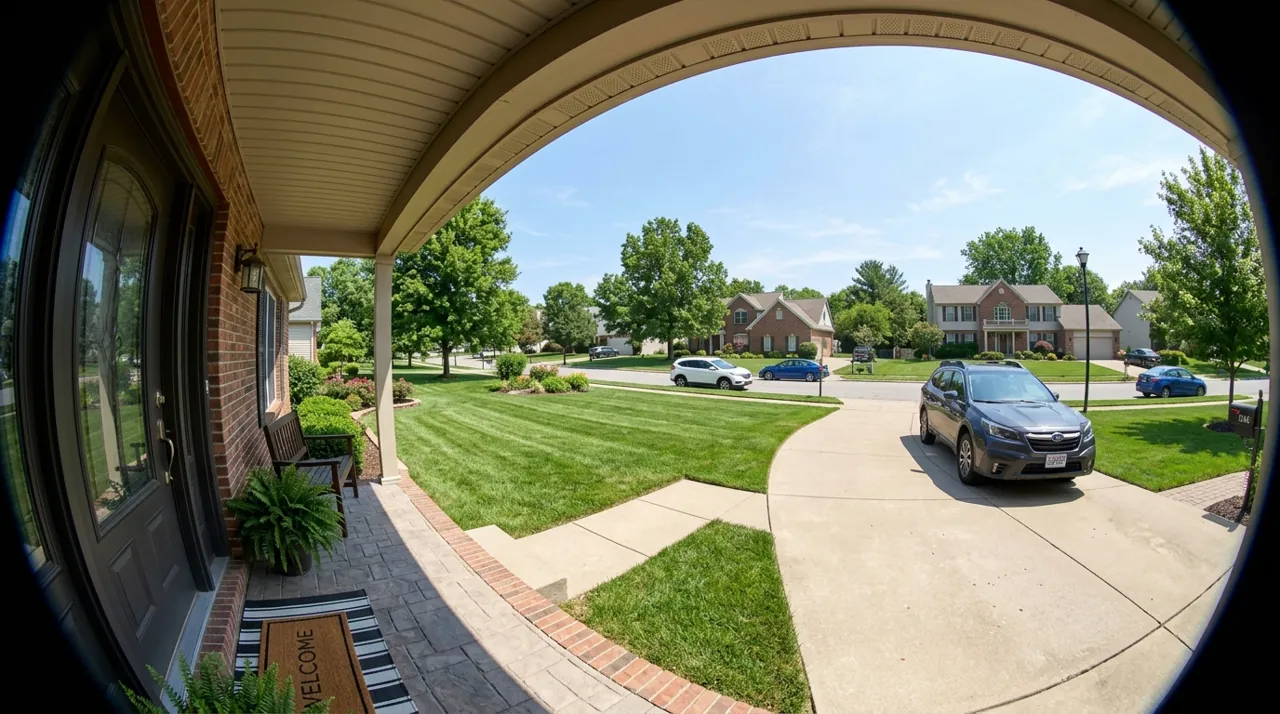
This is precisely why doorbell manufacturers increasingly design for a taller, wider field of view specifically covering the full approach path from a greater distance, rather than a narrow frame that only captures someone once they are already at the doorstep. A wider frame gives the motion algorithm more distance and more lateral pixel change to work with before the person actually reaches the door, catching the event earlier and more reliably.
Sensitivity Settings and the False-Alert Tradeoff
Many doorbells ship with motion sensitivity set conservatively by default, specifically to reduce false alerts from cars, blowing leaves and passing pedestrians on the street — a reasonable default for a busy urban setting, but one that can genuinely cause the doorbell to under-trigger for a quieter position where higher sensitivity would not create a false-alert problem. Reviewing and adjusting sensitivity in the app, along with checking that activity zones are not inadvertently excluding part of the actual approach path, resolves a meaningful share of missed-detection complaints.
When the Camera Detects Fine but the Alert Arrives Late
Sometimes the doorbell genuinely detects the person correctly and records the event, but the push notification itself arrives late enough that the moment has already passed by the time you check — this looks identical to a missed detection but is actually a notification-delay problem, often tied to WiFi signal quality or general network congestion rather than the detection algorithm itself. Ring, for example, rates a signal strength (RSSI) between -70 and -80 as poor, with possible delays and interruptions in service. Checking the recorded event history, rather than relying only on whether a notification arrived promptly, is a useful way to distinguish a true miss from a delayed alert.
Placement and Mounting Angle Mistakes
Even a doorbell built with a wide, head-to-toe field of view can still miss people regularly if it is mounted at the wrong height or angle for the approach it is meant to cover. Manufacturers generally recommend a mounting height in a fairly narrow range — commonly around four feet, with Ring and Reolink both specifying 48 inches — specifically because it centers the detection zone on a person's torso and legs rather than only their head, which gives the motion algorithm more of the body to register early in the approach. A doorbell mounted noticeably higher than recommended, often because it sits at eye level for the installer rather than at the manufacturer's specified height, systematically narrows the useful part of its own field of view without the owner ever realizing the mounting height was the actual cause.
Distance from the actual walking path matters just as much as height. A doorbell set back from a long path, deep porch or a walkway that curves before reaching the door can miss the early part of an approach simply because the person has not yet entered the camera's effective detection range, even though the field of view on paper looks wide enough. Checking the doorbell's stated detection range against the real distance from the door to the property line or the start of the path is worth doing at installation, not after missed events start accumulating.
PIR vs. Video-Based Motion Detection
Older and budget doorbells generally rely on a passive infrared, or PIR, sensor to trigger motion detection — a simple, low-power sensor that reacts to a change in heat crossing its field, which works reasonably well for lateral movement but is comparatively weak at detecting someone walking directly toward the camera, since the heat signature changes less dramatically in that direction; Reolink, for one, states plainly that its PIR sensor is more sensitive to side-to-side movement than to movement heading straight toward the camera. Newer doorbells increasingly pair PIR with video-based or AI-assisted motion detection that analyzes the actual image for a human shape rather than relying on heat alone, and this combination is measurably better at catching a person approaching head-on, which is precisely the angle a front-door camera needs to handle well.
This is one of the clearer cases where a spec sheet difference translates directly into the real-world complaint owners describe. If missed detections are a recurring, unresolved problem after adjusting sensitivity and checking mounting height, checking whether the specific model uses PIR alone or PIR plus video-based detection is worth doing, since it points at a structural limitation of the sensor itself rather than a setting that can be tuned away.
Practical Steps to Fix Missed Detections
Start by reviewing the doorbell's mounting height and angle against the manufacturer's recommendation, since even a well-designed wide-frame doorbell mounted too high or angled wrong can still miss the ideal detection zone. Adjust sensitivity upward incrementally rather than to maximum, watching for an acceptable balance between catching real events and tolerating a reasonable number of false ones. And check WiFi signal strength at the doorbell's specific position, since a weak connection contributes to both notification delay and occasional dropped events.
Working through a short checklist after installation, rather than waiting for a specific missed event to investigate, catches most of the common causes before they become a recurring complaint. Confirm the doorbell is mounted at the manufacturer's recommended height, not simply at a convenient existing hole from a previous doorbell. Walk the actual approach path — the driveway, the front walk, the porch steps — and confirm it falls inside the doorbell's stated field of view and detection range rather than assuming it does. Review sensitivity and activity-zone settings once during setup rather than leaving untouched defaults tuned for a different kind of property. And check WiFi signal strength at the doorbell's specific position again after any change, since a weak connection affects notification reliability independently of detection itself. See stop security camera false alerts for the sensitivity-tuning side of this same balance, and video doorbells for models designed with wider approach-path coverage.