
Affiliate Disclosure: Some links on this page are affiliate links. As an Amazon Associate, we earn from qualifying purchases — at no extra cost to you. We do not buy, install, or physically handle the cameras we cover; our rankings come from aggregated owner reviews, ratings and expert consensus. Commissions never change our verdicts. We're reader-supported: commissions fund hosting, research and updates, so if a guide helped, buying through our links keeps it going. How we rank · full disclosure.
The short version: Ring and Wyze sit at opposite ends of this category’s price and philosophy spectrum. Ring’s Indoor Cam rates highest of any current Ring product, backed by one of the deepest review bases we track, and leans on polish, ecosystem depth and the most trusted notification pipeline in this comparison set. Wyze’s Cam v4 typically costs less, out-resolves Ring at 2.5K, adds a spotlight for color night vision, and records with zero required subscription — with a publicly documented security history worth weighing for sensitive placements.
In Plain English
Ring and Wyze both sell small indoor cameras that plug into the wall and send alerts to your phone. They sit at opposite ends of the market: Ring is polished and costs more to run; Wyze is cheaper and sharper, but less refined.
The key difference is where your recordings live. Ring keeps them online, which is like renting a storage unit: convenient, but you pay every month (a subscription). Wyze saves them on a memory card inside the camera (microSD), which is like keeping boxes in your own garage: free, but it is up to you. Wyze also shows a clearer picture and can switch on a small light to show color at night. Ring’s app, though, is better at telling you quickly that something happened. Both companies have had security problems made public, so for a camera in a bedroom or nursery, read up on both track records first.
Top Picks: Ring, Wyze and an Alternative
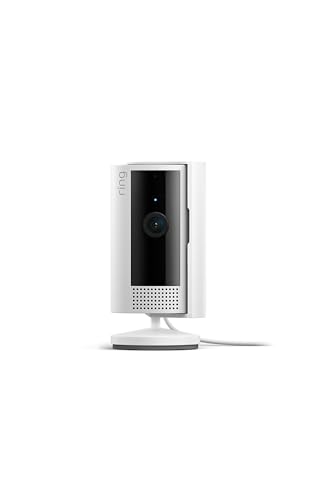
The most reliable notifications and the deepest review base in this category, backed by one of the highest ratings we track. 1080p HD video with two-way talk and a physical privacy cover. Plug-in power means nothing to recharge.
Why You Should Get This
If notification speed and app polish matter most, this is the most review-validated pick.
Benefits
- Largest review base of any indoor camera tracked here.
- Fastest, most reliable notification pipeline.
- Physical privacy cover.
Pros and Cons
- Massive, trustworthy review base.
- Widely regarded as the most polished app.
- Simple plug-in setup.
- Recorded clip history needs a Ring subscription.
- 1080p rather than Wyze’s 2.5K.
- No free local storage (Ring Edge needs a paid plan).
Features
- 1080p HD, two-way talk.
- Physical privacy cover.
- Plug-in power.

Sharper 2.5K resolution with no required subscription, at an entry-level price and a solid owner rating. Color night vision and a built-in siren round out the hardware. Local microSD recording works with no plan required at all.
Why You Should Get This
If sharper resolution and a genuine no-subscription option matter more than Ring’s app polish, this is the pick.
Benefits
- Sharper 2.5K resolution than Ring’s 1080p.
- Genuine no-subscription local recording.
- Lower price than Ring.
Pros and Cons
- Best resolution-to-price ratio of the two.
- No subscription required for core recording.
- Built-in spotlight and siren.
- Smaller ecosystem and review base than Ring.
- MicroSD card sold separately.
- Cam Plus needed for smart detection.
Features
- 2.5K, color night vision.
- Local microSD recording.
- Indoor/outdoor rated.

A third budget option worth comparing: the cheapest genuinely well-reviewed indoor camera tracked on this site, at an entry-level price with a deep base of owner ratings. It records 1080p video with night vision and two-way audio, with local microSD storage.
Why You Should Get This
If price is the deciding factor over either Ring or Wyze, this is the lowest-cost well-reviewed option.
| Resolution | 1080p HD (1920x1080) |
| Field of view | 117° diagonal (98.8° horizontal) |
| Power | Plug-in, standard outlet |
| Night vision | Infrared, up to 30ft |
| Audio | Two-way audio |
| Storage | MicroSD up to 128GB, or cloud |
| Smart home | Works with Alexa and Google Home |
Benefits
- Cheapest genuinely well-reviewed camera of the three.
- MicroSD local recording with no forced subscription.
- Solid review base for the price.
Pros and Cons
- Lowest price of the three cameras.
- No subscription required.
- Works with Alexa and Google Home.
- Fixed lens, no pan-tilt coverage.
- Lower resolution than Wyze’s 2.5K.
- Basic motion detection.
Features
- 1080p, night vision.
- MicroSD local recording.
- Two-way audio.
Representative Products Compared
Where the Real Differences Are
Price. Wyze undercuts Ring modestly up front, and the gap widens enormously over time once Ring’s subscription is factored in.
Subscription. Ring requires a paid plan for any recorded history; Wyze records to a microSD card with zero required fee.
Resolution. Wyze’s 2.5K beats Ring’s 1080p on this specific comparison; both list color night vision.
Notification reliability and polish. Ring’s clearest, most consistently reported advantage across owner reviews in this entire category.
Company security track record. Wyze’s publicly documented history (sourced in the Wyze worth-it verdict) is a real factor for a bedroom or nursery placement specifically; Ring has its own documented history too, including a 2023 FTC settlement over employee and contractor access to customer videos and weak protection against account takeovers.
Video Quality and Field of View
Wyze Cam v4 records at 2.5K, a genuine resolution advantage over Ring Indoor Cam's 1080p, and the difference is visible when zooming into a recorded clip to check a face or a license plate. Both use a wide-angle lens sized for covering a single room from a shelf or wall mount: Ring lists 115° horizontal for the Indoor Cam, slightly wider than Wyze's 98.5° horizontal (115.8° diagonal), so Ring takes in a little more of the room while Wyze resolves more detail. For most buyers, Ring's advantage isn't resolution — it's how reliably and quickly the app tells you something happened in the first place. Owner reviews of both cameras describe daytime footage as clean and usable at typical indoor viewing distances; the resolution gap becomes most noticeable when zooming into a still frame after the fact rather than during ordinary live viewing.
Night Vision
Both cameras list color night vision. Wyze Cam v4 backs its version with a built-in 72-lumen white spotlight as well as 850 nm infrared LEDs, while Ring lists Color Night Vision for the Indoor Cam (2nd Gen) without a spotlight. Color night modes that rely on ambient light generally fall back to a black-and-white infrared picture in a fully dark room, so Wyze's ability to add its own light makes it the more useful implementation when you want color overnight.
Power and Installation
Both cameras are primarily plug-in powered, so setup is the same either way: mount or stand the camera near an outlet, connect to WiFi through the app, and confirm the live feed. Neither requires drilling for the base install. If wire-free, battery-powered placement is what you actually need, look at Ring's battery doorbell and stick-up cam line, or Wyze's own battery-powered models — these two specific indoor cameras are both wired.
Connectivity, App and Ecosystem
Ring connects over WiFi and lives inside an app widely regarded as the category's most polished, with routines and notifications that integrate tightly into Alexa specifically. Wyze also connects over WiFi and works reasonably with both Alexa and Google Assistant, without being purpose-built for either. Ring's accessory ecosystem — doorbells, spotlight cams, floodlight cams, alarm sensors and chimes — is considerably larger than Wyze's, which matters most to a household planning to add several devices over time rather than buying one camera and stopping there. Wyze has broadened its own device range in recent years to include smart locks, contact sensors and plugs, so the ecosystem gap has narrowed somewhat, but Ring still leads on breadth. On voice-assistant support, Wyze is actually the more flexible of the two, since it works with both Alexa and Google Assistant while Ring is built around Alexa.
Storage and Subscription
This is the structural core of the Ring-versus-Wyze decision. Wyze Cam v4 records continuously or on motion to a microSD card inserted directly into the camera, sold separately, with zero subscription required to view or export that footage. Ring has no free local storage (its Ring Edge option needs a Ring Alarm Pro and a paid Ring Pro plan) — a Ring plan is required for any recorded history at all, with live view, two-way talk and standard motion notifications the free-tier functions. Over several years, that gap compounds into a meaningful cost difference in Wyze's favor for anyone who wants recorded footage without an ongoing bill. Wyze does offer an optional Cam Plus cloud plan for AI-based smart detection (person versus pet versus vehicle) and cloud backup, so the "no subscription" claim applies specifically to core motion-triggered local recording rather than every feature on the camera. Ring's smart detection, by contrast, is bundled into the same paid plan required for any recorded history, so there's no free path to it at all.
Price and Who Should Buy Which
Wyze Cam v4 typically costs less than Ring Indoor Cam upfront, and needs nothing further to record locally. Choose Ring if app polish, notification speed and a large accessory ecosystem matter more than resolution or price, and you're comfortable paying for a plan. Choose Wyze if sharper resolution, a spotlight for color night vision and genuinely free local recording matter more than Ring's app refinement, and you've weighed Wyze's documented security history for the specific room you're placing it in. Buying two or three cameras rather than one is where the price gap matters most: the per-camera hardware saving multiplies, and a Ring plan for recorded history adds an ongoing cost Wyze's local recording avoids, which tilts a multi-room setup further toward Wyze on price alone.
Winner by Use Case
Best notifications and overall polish, subscription accepted: Ring.
Best value and sharpest resolution per dollar: Wyze.
Never paying a subscription: Wyze, structurally.
A privacy-sensitive indoor position (bedroom, nursery): weigh both brands’ documented histories honestly — Wyze’s incidents and Ring’s 2023 FTC settlement — before choosing a camera for that specific spot.
Read More
See Ring Indoor Cam review, Wyze’s worth-it guide, and top-rated budget security cameras for the wider field.
Going Deeper: What the Ring FTC Case Teaches About Camera Security
In 2023 the Federal Trade Commission took action against Ring, and the FTC’s announcement sets out what went wrong. The agency said one employee viewed thousands of video recordings belonging to female users over several months, including cameras watching bathrooms and bedrooms. It also said Ring failed to protect against “credential stuffing” and “brute force” attacks — automated attempts to log in with leaked or guessed passwords — and did not deploy multi-factor authentication until 2019. Hackers used those weaknesses to access the accounts of about 55,000 U.S. customers.
The remedies show what good practice looks like. The proposed order required a privacy and security program with safeguards on human review of videos, multi-factor authentication for both employee and customer accounts, deletion of certain customer videos and data, and $5.8 million in consumer refunds. None of that depends on which brand you buy; it describes the controls any company storing camera footage in the cloud should have in place.
Owners can cover the rest themselves. The FTC’s consumer guide to securing home security cameras advises choosing a camera that encrypts account information, livestreams and archived videos; never keeping the default username and password or reusing an old password; turning on two-factor authentication for the cloud account where it is offered; checking regularly for software updates; and using permission levels to limit who can view feeds and change settings. Local recording, as on Wyze’s microSD card, reduces how much footage sits on remote servers, but the account and the app still control the live feed and need the same protection.
Verdict
Choose Ring if the smoothest experience and the deepest review-backed confidence are worth the price and the subscription to you. Choose Wyze if price and resolution matter more, and you’re comfortable with its documented security history for the position you’re covering.
Sources & References
- Wyze Cam v4 — Wyze
- Indoor Cam (2nd Gen) tech specs — Ring
- Ring Pro plan — Ring
- Ring Protect subscription plans — Ring
- FTC says Ring employees illegally surveilled customers, failed to stop hackers from taking control of users' cameras — Federal Trade Commission
- Wyze camera breach may have let 13,000 customers peek into others' homes — CBS News
- How to secure your home security cameras — Federal Trade Commission