
Affiliate Disclosure: Some links on this page are affiliate links. As an Amazon Associate, we earn from qualifying purchases — at no extra cost to you. We do not buy, install, or physically handle the cameras we cover; our rankings come from aggregated owner reviews, ratings and expert consensus. Commissions never change our verdicts. We're reader-supported: commissions fund hosting, research and updates, so if a guide helped, buying through our links keeps it going. How we rank · full disclosure.
Short version: an NVR or DVR needs a surveillance-rated hard drive, not a repurposed desktop drive, because it writes continuously across multiple camera streams 24 hours a day. The Seagate SkyHawk 4TB is the standard, lowest-priced capacity for a typical 4-6 camera home system. The WD Purple 4TB carries the highest star rating of the field at a real price premium. Step up to the Seagate SkyHawk 6TB for larger systems, 4K recording, or a longer retention window.
This page covers the best hard drives for NVR security systems, meaning the drive itself, which slots into an NVR system. For the systems these drives power, see the NVR camera systems hub and top-rated security camera systems. For the switch that networks and powers a multi-camera PoE setup, see best PoE switches.
In Plain English
An NVR (network video recorder) is the box your wired cameras send their video to. Inside it sits a hard drive that records every camera, all day and all night, and writes over the oldest footage when it fills up.
A normal computer hard drive is like a family car. It is fine for daily trips but is not built to run flat out around the clock. A surveillance drive is more like a delivery van made for nonstop shifts. It is designed for constant recording, the heat and shaking inside a recorder box, and many video streams at once.
Size matters too. More cameras, sharper video and a longer history all need more space. About 4TB suits a typical four to six camera 1080p home system with a couple of weeks of footage.
The one thing to do: check your recorder’s manual for the largest drive it accepts, then buy a surveillance-rated drive of that size or smaller.
Top Rated Picks at a Glance
The Ranked Field: Star Rating, Consensus and Price

Best for most 4-8 camera NVR or DVR systems recording at 1080p-4K.
- Purpose-built for DVR/NVR 24/7 continuous write cycles.
- SkyHawk Health Management monitors drive condition under surveillance workloads.
- SATA 6Gb/s interface; Seagate lists 256MB cache for the current ST4000VX016 (the older ST4000VX007 has 64MB).
- 3-year Rescue Data Recovery Services plan from Seagate (region-dependent).
Why buy it: The lowest-priced surveillance drive on this page and the standard capacity for a typical home NVR system — deep enough storage without paying for capacity most systems never fill.

Best for buyers who want the highest-rated drive here or a second trusted surveillance-storage brand.
- WD AllFrame technology tuned for multi-stream surveillance recording.
- Over 4,400 verified owner ratings — the deepest review base of the three drives here.
- 5400 RPM design optimized for continuous write reliability over raw speed.
- SATA 6Gb/s interface matching standard NVR bays.
Why buy it: The highest star rating of the three drives on this page, backed by a review base almost three times deeper than the Seagate 4TB, at a real price premium over it.
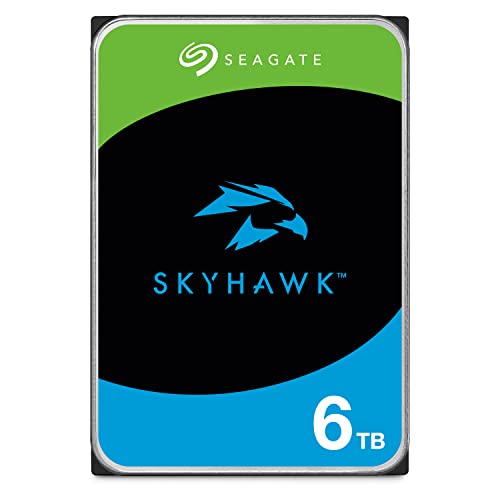
Best for 8+ camera systems, longer retention windows, or 4K recording across multiple cameras.
- 6TB capacity for extended retention or larger multi-camera systems.
- 256MB cache, per Seagate’s data sheet for the ST6000VX001.
- Same SkyHawk Health Management and rescue service as the 4TB model.
- Rated for the same 24/7 surveillance duty cycle.
Why buy it: The right upgrade path once 4TB is not enough — 50% more capacity for systems running more cameras or higher resolutions.
Comparison Table
| Product | Best for | Buy |
|---|---|---|
| Seagate SkyHawk 4TB Surveillance Hard Drive | Best Overall | Price |
| WD Purple 4TB Surveillance Hard Drive | Best Rated / Alternative Brand | Price |
| Seagate SkyHawk 6TB Surveillance Hard Drive | Best for Larger Systems | Price |
How We Rank
We do not buy or physically install these drives. Every star rating and review count comes from licensed Amazon data, weighted by review volume. Full method on how we rank.
Buying Guide: Capacity, Cache and Duty Cycle
Sizing Capacity to Your System
Camera count, resolution and desired retention window all multiply together to determine how much storage you actually need. A rough starting point: 4TB comfortably covers a 4-6 camera 1080p system (or fewer 2K cameras) with a couple of weeks of footage retained; larger systems, 4K resolution, or longer retention windows push that toward 6TB or beyond. Most NVR manufacturers publish or embed a storage calculator based on your exact configuration — use it rather than guessing.
Why "Surveillance-Rated" Matters
Surveillance drives are built and firmware-tuned for sustained multi-stream write workloads — both SkyHawk and WD Purple are rated for 180TB/year and up to 64 HD cameras, and Western Digital puts that workload at up to three times a desktop drive's — including vibration tolerance for multi-drive NVR enclosures and error-recovery behavior suited to continuous recording rather than the burstier pattern a desktop drive expects. Both SkyHawk and WD Purple are established, purpose-built lines in this category with long track records.
Cache Size and Multi-Camera Performance
A larger cache helps smooth out simultaneous write streams from multiple cameras, which becomes more relevant as camera count and resolution climb. Seagate’s data sheet lists 256MB for both the current 4TB SkyHawk (ST4000VX016) and the 6TB (ST6000VX001), but only 64MB for the older 4TB ST4000VX007 — so check the exact model number on a listing, since cache differs more by model generation than by capacity.
RAID and Multi-Drive NVR Considerations
Larger NVR systems with multiple drive bays can often run RAID for redundancy, an option worth understanding before you buy matched drives for a bigger system. RAID 1 mirroring writes the same data to two matched drives simultaneously. If one fails, the other still has a full copy, and you swap the failed drive without losing footage. The tradeoff is usable capacity. Two 4TB drives in RAID 1 give you 4TB of usable storage, not 8TB, since the second drive is a live mirror rather than added space. Not every consumer NVR supports RAID out of the box, and not every RAID level suits a continuous surveillance recording workload equally well. Check your specific NVR's own documentation carefully before buying a matched pair of drives for this purpose, and remember that RAID only protects against a single drive failure event. It does not replace a genuine off-system backup of footage you can't afford to lose.
SkyHawk and WD Purple Lifespan, Warranty and Failure Signs
Both the SkyHawk and WD Purple lines are rated for continuous 24/7 operation and carry 3-year limited warranties, a reasonable proxy for expected service life under normal conditions. Real-world lifespan still depends heavily on ambient heat, mechanical vibration and how many camera streams are actually writing to the drive simultaneously at any given time. A lightly loaded 2-camera system will generally outlast a maxed-out 8-camera 4K setup running the same drive model. Watch for the classic warning signs of a failing surveillance drive: unusual clicking or grinding noises, recording gaps the NVR reports, a steadily growing bad-sector count, or noticeably slower playback and file export. Most surveillance-rated drives include health-monitoring features, like Seagate's SkyHawk Health Management, that can flag degrading performance before a full failure happens.
Installing a Surveillance Hard Drive in Your NVR or DVR
For most consumer and prosumer NVRs, installing a surveillance drive is a genuinely simple job. It's typically a tray-and-screw or tool-less bay swap, followed by the NVR formatting the new drive through its own menu system. No separate PC or external formatting tool is usually needed. Check your specific NVR model's manual for the exact steps first, since the process varies slightly between brands, and confirm the maximum drive capacity your specific NVR model actually supports before buying — some older or budget models cap out below what a current 6TB or larger drive offers. Once installed and formatted, the drive begins recording immediately according to your NVR's existing camera and retention settings, with no further configuration typically required on most consumer systems.
Noise, Heat and 24/7 Operation in Multi-Bay Enclosures
Surveillance drives like the SkyHawk and WD Purple don't inherently run hotter or louder than a comparable desktop drive. Both spin at speeds comparable to many desktop drives, and Seagate lists rotational vibration sensors on the SkyHawk models covered here for multi-drive enclosures, which is actually where they have an edge. A generic desktop drive dropped into a tightly packed multi-bay NVR can pick up resonance from its neighbors, worsening both noise and long-term wear. Airflow and case design in the NVR itself usually matter more for overall heat and noise than the drive model choice alone. A well-ventilated NVR case with adequate spacing between drive bays keeps any surveillance-rated drive running comfortably within its normal temperature range, even in a densely packed 4-drive or larger multi-bay configuration running around the clock.
Going Deeper: What “Surveillance-Rated” Means on a Data Sheet
Surveillance drives look like ordinary 3.5-inch hard drives, so the difference lives in the firmware and the ratings. Western Digital’s WD Purple data sheet says every WD Purple drive has AllFrame technology, which it says helps reduce video frame drops and improves recording and playback. Seagate describes its ImagePerfect firmware in similar terms in the SkyHawk data sheet, designed for seamless capture in 24×7 workloads recording video from up to 64 HD cameras.
The duty rating is the headline number. Both lines are rated for a workload of 180TB a year, and Seagate lists 8,760 power-on hours a year, so the drive is expected to spin every hour of every day. Western Digital puts that workload at up to three times a desktop drive’s. It also says WD Purple is engineered for the heat fluctuations and vibration inside an NVR, while an average desktop drive is built to run only for short intervals.
Vibration is the reason multi-bay recorders care. Seagate says SkyHawk’s built-in rotational vibration sensors let drives maintain performance in multi-bay systems, and both brands list support for recorders with up to 16 drive bays, depending on the model. Western Digital adds that WD Purple is designed with RAID error recovery control to help reduce failures in supported recorders. That matters if you plan to mirror two drives as described above.
Two more figures are worth reading carefully. Both brands list an MTBF of up to 1 million hours alongside a 3-year limited warranty, and the warranty is the more practical number to plan around. Seagate also warns that operating at higher temperatures will reduce a drive’s useful life, which backs up the advice to keep your NVR somewhere with decent airflow.
The Verdict
The Seagate SkyHawk 4TB is the sensible default for most home NVR systems — proven capacity, purpose-built for the workload, and the lowest-priced option here. If the higher star rating and deeper review base of the WD Purple matters more to you than the price gap, that is the reasonable upgrade. And once 4TB genuinely is not enough — more cameras, 4K, or longer retention — the Seagate SkyHawk 6TB is the straightforward next step up.
Sources & References
- SkyHawk 3.5 Hard Drive Data Sheet — Seagate
- WD Purple Surveillance Hard Drive Data Sheet — Western Digital
- SkyHawk Video Hard Drives — Seagate