
Affiliate Disclosure: Some links on this page are affiliate links. As an Amazon Associate, we earn from qualifying purchases — at no extra cost to you. We do not buy, install, or physically handle the cameras we cover; our rankings come from aggregated owner reviews, ratings and expert consensus. Commissions never change our verdicts. We're reader-supported: commissions fund hosting, research and updates, so if a guide helped, buying through our links keeps it going. How we rank · full disclosure.
The short answer: a car break in at home is best handled in layers: remove any reason to look inside, light the area where the car sits, aim a camera at the vehicle, and add a dash cam with parking mode if you want recording when it is elsewhere. No single device stops a determined thief, but layers raise the odds of detection and give you footage if it happens anyway. For a driveway or curb-side car, a floodlight camera is the strongest single home-side upgrade.
How we work: we do not buy, install or physically test these devices. Rankings come from aggregated owner reviews and published manufacturer specs. Method on how we rank; funding on our affiliate disclosure. Related reading is in the use-case guides hub.
In Plain English
Most car break-ins are quick and opportunistic. Someone walks a street, glances into parked cars, and smashes a window when they spot something worth grabbing. They want a fast, low-risk job.
Your aim is to make your car look like more trouble than it is worth. That starts with the cheapest fix: take bags, devices and loose items out of sight, or out of the car. Then add light, because thieves prefer dark and hidden spots. Then add a camera watching the car, so a break-in would be recorded and you would be alerted.
A dash cam covers the other half of the problem, the times the car is not at home. Be realistic, though. Cameras and lights discourage some thieves and give you evidence, but they do not stop a person who has already decided to smash a window. Think of each item as one more reason for a thief to walk on to the next car.
Recommended Gear

Best for lighting and recording a driveway or curb-side car from one wired fixture.
- Two 2000 lumen floodlights, per Ring.
- 1080p video with a 105 dB remote-activated siren.
- Customizable motion zones.
Why buy it: Light plus video plus siren in one place is the strongest single home-side layer for a parked car.

Best for recording the car itself with front and rear coverage.
- 4K front and 1080P rear.
- Parking mode with time-lapse or G-sensor recording.
- Hardwire kit sold separately for parking mode.
Why buy it: It records when the car is parked, which a home camera may not cover.

Best for a low-cost dash cam that still triggers on impact.
- 2304 x 1296 recording at 130 degrees.
- G-sensor triggers a 30-second clip on collision.
- Parking surveillance needs the hardwire kit.
Why buy it: The cheapest way in, if you accept the extra hardwire kit for parked recording.
Why Some Cars Get Hit and Others Do Not
Police research points to opportunity. The ASU Center for Problem-Oriented Policing guide on thefts from cars in parking facilities says thieves report being able to break into most makes and models in minutes, if not seconds. It also finds that risk rises where lighting, attendants or access barriers are missing, and falls where a location is visible to nearby businesses and passers-by, because that creates natural monitoring.
The guide studied parking facilities, not driveways, so treat it as a principle rather than a home statistic. But the logic carries over: a car parked in a dark, unobserved spot that a passer-by can inspect is easier to hit than one in a lit, watched, out-of-the-way position. That is why the first steps are about visibility and light, not gadgets.
Step One: Remove the Reason to Look
The cheapest layer is an empty-looking car. Take bags, laptops, phones, chargers, loose change and garage remotes with you, or lock them in the trunk before you arrive, not after you park in view. A visible charging cable can suggest a device is hidden nearby, so put cables away too. Keep spare keys and paperwork with the title out of the vehicle.
Lock every door and close every window, including sunroofs, every time. It sounds trivial, and the POP Center guide cautions that lock-your-car campaigns alone showed little discernible impact at the facility level, which is a reminder that basic habits reduce opportunity but do not stop a committed thief. Use them as the foundation, not the whole plan.
Step Two: Light the Place the Car Sits
The same guide lists lighting among the measures it recommends, noting it is especially useful when many thefts occur at night. At home, that means a motion-activated light aimed at the driveway or curb-side spot. Ring lists two 2000 lumen floodlights on the Floodlight Cam Wired Plus, a 1080p camera with a 140 degree horizontal field of view, and a remote-activated 105 dB siren, which puts light, recording and sound in one fixture.
A wired floodlight needs an existing weatherproof electrical box or an electrician, so if you cannot wire one, look at plug-in or solar options in our security lighting hub and the best floodlight cameras ranking. Avoid lights that blind neighbors or shine into windows, and set the sensitivity so passing cars and cats do not trigger it all night.
Step Three: Aim a Camera at the Car
A camera only helps if the car is in frame. Mount it at a height that keeps faces visible, and angle it to cover the vehicle and its approach rather than the whole street. Use motion zones so the road does not trigger constant alerts, and check night footage, since headlights and reflections can wash out a windshield. If you park on the street, a camera on the front of the house may only show part of the car, so test the view before you rely on it.
Remember what footage is for. It can help police and insurers, and the sight of a camera and light may put off an opportunist. It does not prevent the break-in. Keep expectations modest, and see where to place security cameras for the height and angle rules that make footage usable.
Step Four: A Dash Cam With Parking Mode
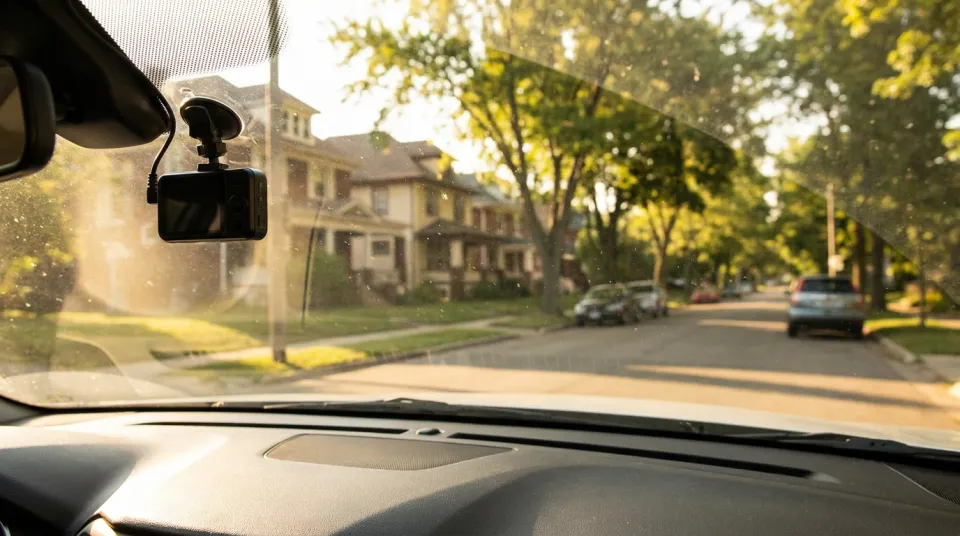
A home camera cannot follow the car to work or the mall. A dash cam can, but the key feature is parking mode. REDTIGER says the F7NP offers time-lapse recording or a G-sensor mode that records when a collision is detected, and that a hardwire kit sold separately is required. 70mai says the same of the M310, whose hardwire kit is required for all parking surveillance functions.
Consumer Reports gives the trade-off in its dash cam buying guide: a hardwire kit connects the camera to the fuse block for continuous recording while parked, but this can drain the battery over extended periods. Ask your installer or read the kit instructions about a low-voltage cutoff, and skip parked recording if the car sits unused for long stretches.
Dash cams also raise rules of their own: where they may be mounted on a windshield, and whether audio may be recorded. Both vary by state, so check local rules. Our best dash cam for car page compares models, and best security camera for car covers other options.
If It Happens Anyway
Report it to police, take photos of the damage before you clean up, and contact your insurer. Export the camera footage right away, since many systems overwrite old clips, and note the time. List what was taken, including serial numbers where you have them. If you have a dash cam, save the clip from the card before it is overwritten. Check your own policy, because coverage for items stolen from a car and for glass repair varies.
Going Deeper: What Policing Research Says About Layers
The ASU Center for Problem-Oriented Policing guide is written for police and facility owners, but its findings on theft from cars are a useful frame for homeowners. It says an effective strategy involves several different measures, and lists surveillance, lighting, access control and security patrols among the more promising ones. It also says car alarm promotion and lock-your-car campaigns had little discernible impact, and that law enforcement responses alone are seldom effective.
Translate that to a home. Surveillance becomes a camera and a visible doorbell. Lighting becomes a motion floodlight. Access control becomes a closed garage or a spot away from a public footpath. Patrols become neighbors who notice, which is why sharing a quick note about local break-ins with the people next door has value. None of these is a guarantee, and the guide studied commercial parking facilities, so treat the parallels as reasonable inference rather than a measured result for driveways.
A separate study helps explain why visible layers matter. University of North Carolina at Charlotte researchers, interviewing convicted burglars, found that offenders weigh factors including closeness of other people and the presence of alarms, dogs and cameras. That study looked at burglary of buildings rather than car break-ins, so it is a hint about deterrence, not proof for vehicles.
The practical takeaway is to spend in the order of cost-effectiveness. Empty the car for nothing. Light the spot for a modest sum. Add a camera for a bigger one. Add a dash cam with parking mode last, and only if you will maintain it. Each layer catches some of what the others miss, and none needs to be perfect to be worth having.
The Verdict
For a car parked at home, start with an empty interior and a motion floodlight, then add a floodlight camera such as the Ring Floodlight Cam Wired Plus if you have the wiring. For the car away from home, a dash cam with parking mode and a hardwire kit is the only option that records where it is parked. Choose the level of layering that fits your risk, and be honest that footage is evidence, not protection.
Sources & References
- Thefts of and from Cars in Parking Facilities — ASU Center for Problem-Oriented Policing
- Thefts of and from Cars in Parking Facilities: Summary — ASU Center for Problem-Oriented Policing
- Floodlight Cam Wired Plus Information — Ring
- REDTIGER F7NP 4K Dash Cam Front and Rear — REDTIGER
- 70mai Dash Cam M310 specifications — 70mai
- How to Choose a Dash Cam for Your Car — Consumer Reports
- Through the Eyes of a Burglar: Study Provides Insights on Habits and Motivations — UNC Charlotte