
Affiliate Disclosure
Some links on this page are affiliate links. As an Amazon Associate, we earn from qualifying purchases — at no extra cost to you. We do not buy, install, or physically handle the cameras we cover; our rankings come from aggregated owner reviews, ratings and expert consensus. Commissions never change our verdicts. How we rank · full disclosure.
Short version: a trail camera is built to detect and photograph wildlife on a trail or feeder, running for weeks or months on batteries with no network required, or optionally with a cellular SIM for real-time alerts. For most hunters and land owners who check a camera periodically in person, a non-cellular card-based model is the standard, lowest-cost choice. For a remote property you cannot easily visit, a cellular model earns its monthly data cost by sending photos straight to your phone.
How we work: we do not buy, install or physically handle these cameras. Every ranking here comes from aggregated owner reviews, star ratings weighted by review volume, and expert consensus. Method on how we rank; funding on our affiliate disclosure. Ready for models? Go to best trail camera for non-cellular picks, or best cellular trail camera for real-time alerts.
Top 3 Recommended Trail Cameras
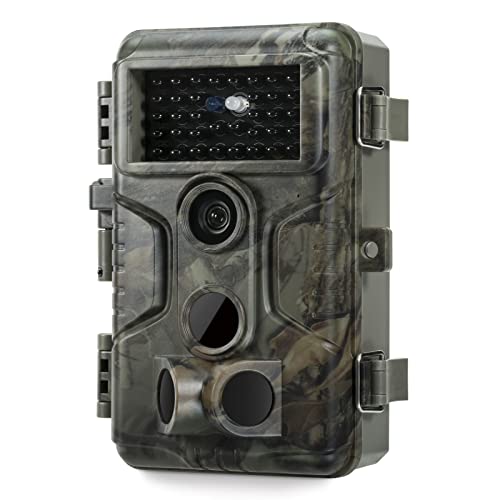
The GardePro A3S suits most hunters and landowners checking a camera every week or two, holding a solid rating from a deep review base. It pairs a fast 0.1-second trigger with genuinely high 64MP photo resolution and 1296P HD video with sound. No-glow night vision avoids spooking game. Owners consistently value the trigger speed paired with resolution at a mid-range price.
Why You Should Get This
If you want a well-rounded trail camera with a fast trigger and genuinely high resolution, this is the mid-range default.
Benefits
- Fast 0.1-second trigger speed.
- 64MP photo resolution, high for the category.
- No-glow night vision.
Pros and Cons
- Strong combination of speed and resolution.
- Solid review base at a mid-range price.
- Records video with sound.
- Non-cellular, requires a site visit to retrieve photos.
- Mid-range price versus budget options.
- No WiFi transfer.
Features
- 64MP photo, 1296P HD video with sound.
- 0.1s trigger speed.
- No-glow night vision.

The WOSPORTS holds the deepest review base of any budget trail camera tracked on this site, backed by a solid owner rating, cheap enough to place several around a property. It delivers 30MP photo and 1080P HD video with motion-activated infrared night vision in a compact, easy-to-conceal body. Owners consistently value the low cost for multi-position coverage. Resolution trails the GardePro’s.
Why You Should Get This
If you want to place several cameras around a property without a large budget, this is the deepest-reviewed budget option.
Benefits
- Deepest review base of any budget trail camera tracked on this site.
- Cheap enough to buy multiple for full-property coverage.
- Compact, easy-to-conceal body.
Pros and Cons
- Largest review base at this price point.
- Low cost enables multi-camera coverage.
- Compact, discreet body.
- Lower resolution than the GardePro A3S.
- Non-cellular, requires site visits.
- Basic feature set versus mid-range models.
Features
- 30MP photo, 1080P video.
- Motion-activated infrared night vision.
- Compact body.

The Meidase P70 2-pack is the straightforward way to cover two trails or feeders at once, with a solid owner rating and zero cellular or WiFi dependency. It matches the GardePro’s 64MP photo and 1296P HD video specs, with no-glow infrared night vision. Owners consistently value covering two positions from a single purchase with no network dependency to worry about at a remote site. It ships fully non-cellular, card-based only.
Why You Should Get This
If you need to cover two trails or feeders at once with zero network dependency, this two-pack solves it in one purchase.
Benefits
- Two cameras in one purchase, covers two positions.
- Matches the GardePro’s high resolution.
- Zero cellular or WiFi dependency.
Pros and Cons
- Two cameras for the price of covering two spots separately.
- High resolution matching the category leader.
- No network dependency at a remote site.
- Fully card-based, no remote photo delivery.
- Requires retrieving both cameras to view photos.
- No stated trigger-speed figure.
Features
- 64MP photo, 1296P HD video.
- No-glow infrared night vision.
- Fully non-cellular, card-based.
Cellular vs Non-Cellular: The Core Decision
Everything else in this category follows from one choice. Non-cellular cameras write photos and video to a memory card that you retrieve by visiting the camera — cheaper hardware, zero monthly cost, and the standard setup for hunters checking a stand or feeder every week or two anyway. Cellular cameras add a SIM card and send photos to an app in near-real time, which is worth the monthly data plan specifically when the property is far enough that a physical check is a real trip, or when you want to know about activity as it happens rather than days later.
Trigger Speed and Detection Range
Trigger speed — how quickly the camera fires after detecting motion — is the specification that decides whether you get a usable photo of an animal or an empty trail. Under half a second is the practical threshold for reliable capture; the fastest cameras trigger in 0.1-0.2 seconds. Detection range matters alongside it: a camera covering a wide feeder area needs a longer detection range than one aimed at a narrow game trail.
Battery Life and Weatherproofing
Battery life depends heavily on trigger frequency and whether the camera is transmitting over cellular — a quiet trail can run a set of batteries for months, while a busy trail or a cellular model sending every photo can drain in weeks. Every camera on this hub needs a genuine outdoor weatherproof rating, since these are mounted outside for extended periods with no daily attention.
How We Rank
Every product ranked on this hub is scored the same way the rest of the site is: aggregated owner star ratings weighted by review volume, recurring themes in negative reviews, and specification differences owners raise unprompted. We never buy, install or physically test these cameras, and every star rating and review count comes from licensed Amazon data. Full method on how we rank.
Not Hunting? Looking for a Security Camera Instead
If the goal is watching a property, gate or driveway rather than wildlife, a purpose-built security camera is usually the better fit — see best trail camera for security for the honest tradeoffs, or go straight to the no-WiFi and cellular cameras hub for cameras designed specifically for that job.