
Affiliate Disclosure: Some links on this page are affiliate links. As an Amazon Associate, we earn from qualifying purchases — at no extra cost to you. We do not buy, install, or physically handle the cameras we cover; our rankings come from aggregated owner reviews, ratings and expert consensus. Commissions never change our verdicts. We're reader-supported: commissions fund hosting, research and updates, so if a guide helped, buying through our links keeps it going. How we rank · full disclosure.
Short answer: yes. Security cameras survive winter cold well: the overwhelming majority of outdoor-rated consumer models are rated to keep working below freezing. What actually changes in the cold is performance, not survival. Battery runtime drops meaningfully as temperature falls. LCD or touch elements can respond more sluggishly. A lens can fog or accumulate frost the same way a car windshield does, all without the camera itself being damaged. Wired and PoE cameras sidestep the battery-specific problems entirely. Their power draw comes from a continuous source rather than a chemical battery whose capacity genuinely shrinks in cold temperatures.
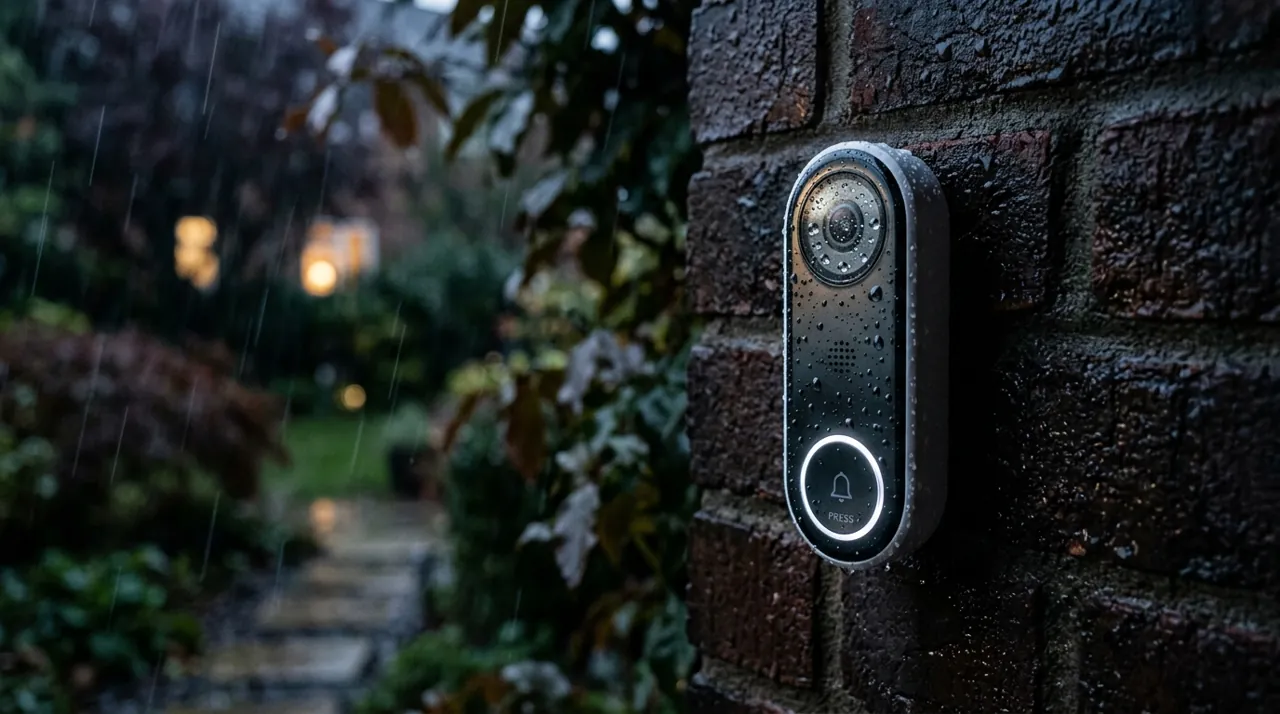
Recommended Cold-Weather-Ready Cameras

Best for wired power that avoids cold-weather battery drain entirely.

Best for a widely-reviewed camera with documented cold-weather performance.

Best for a doorbell that can trickle-charge from existing wiring through winter.
Can Security Cameras Survive Winter Cold? What the Specs Actually Say
Manufacturers publish an operating temperature range for outdoor-rated cameras. Most consumer models cover a genuinely wide span, typically running from well below freezing up to a warm summer extreme. Within that published range, the camera is designed and tested to function normally. For many US winters the hardware itself is not the limiting factor, but lows in northern states can drop below the 14°F (-10°C) floor some brands, including Reolink for its IP cameras, publish. Anyone in an extreme cold-climate region should check the specific published range rather than assuming every camera handles the same lower bound. Some budget models have a narrower cold tolerance than premium ones. A handful of models are specifically marketed with extended cold-weather ratings, and in some cases, built-in heating elements, for exactly this use case.
Lithium-ion batteries, the type used in nearly every battery-powered camera, are the component most affected by cold. Their chemistry genuinely loses usable capacity as temperature drops. Battery University notes that a lithium-ion battery delivering full capacity at 80°F typically delivers only about half at 0°F, though that capacity returns once the cell warms up. That is why the same camera that runs for months in a mild fall can drop to a fraction of that runtime through a hard winter. This is a real chemical limitation, not a defect. It affects every brand using the same underlying battery technology similarly.
What Actually Causes Problems in Cold Weather
Beyond battery runtime, the most common cold-weather complaint is lens fogging or frost. It is caused by the same condensation dynamics that fog a car window: warm, moist air meeting a cold surface. A properly sealed camera housing reduces this, but it does not eliminate it entirely, particularly during rapid temperature swings common in shoulder seasons. Snow accumulation directly on the lens or blocking a PIR sensor is a separate, purely physical problem. Periodic clearing resolves it, and it is distinct from any electronic or battery issue.
Display or button responsiveness on some camera accessories, like a keypad or a chime unit, can also slow down in extreme cold, since LCD screens in particular react more slowly at low temperatures. It is a minor but real annoyance some owners report during the coldest weeks of winter.
Why Wired Cameras Have a Real Cold-Weather Advantage
A wired or PoE camera draws continuous power from the grid rather than a battery. That sidesteps the entire cold-weather capacity-loss problem affecting battery cameras. This is a genuine, structural advantage for anyone specifically worried about winter performance, not just a marketing point. A wired camera performs essentially the same in January as it does in July, apart from the physical fogging and snow-clearing issues that affect every camera type regardless of power source.
For households committed to battery cameras despite this, positioning units to minimize direct wind exposure helps. Accepting a shorter recharge interval through the coldest months, as a normal seasonal pattern rather than a fault, is the practical approach most owners settle into.
Preparing Cameras for Winter Before It Arrives
A pre-winter check is worth doing every year, regardless of camera type. Clean the lens thoroughly. Verify the mounting bracket and any cable connections are secure against wind and ice load. For battery cameras, top off the charge fully going into the season, since a partially charged battery in cold weather runs down faster than a full one. Clearing snow and ice from the camera and any nearby fixture after storms keeps both the image and detection working as intended through the season. See how long do security camera batteries last for the fuller battery arithmetic, and wired PoE cameras for the cold-resilient power option.
Solar Cameras Face a Compounding Winter Problem
Solar-powered cameras deserve a specific mention, because winter compounds two separate problems for them at once. Cold weather reduces battery capacity the same way it does on any battery camera. Shorter winter days and lower sun angles simultaneously reduce how much charge the solar panel can recover to offset that drain. A solar camera that runs comfortably through summer on panel charging alone can genuinely struggle to keep pace through a short, overcast winter, particularly in northern climates. Position the panel for maximum available winter sun angle. Accept that solar may need occasional manual top-up charging during the darkest months, rather than assuming solar performs identically year-round.
Ice Load and Mounting Hardware Through Winter
Ice accumulation on a mounting arm or bracket adds real weight that most brackets are not tested against as a routine condition. A camera mounted on a loose or marginal bracket going into winter is far more likely to sag, tilt or fail once ice builds up on the housing and arm together. Check that mounting screws are fully tight and that any adjustable arm joint is locked down firmly before the first hard freeze. A camera that shifts angle under an ice load can lose coverage of the exact area it was installed to watch, which usually goes unnoticed until footage is needed and the frame turns out to be aimed at the wrong spot.
Gutter-mounted and downspout-clamped cameras deserve an extra check, since ice damming in a gutter can shift the clamp point slightly as the season progresses. A quick visual check after the first few hard freezes catches this before it becomes a real problem.
Warranty Coverage for Cold-Weather Issues
A camera failure genuinely caused by operating outside its published temperature range is not usually a covered warranty claim, in the same way a phone battery drained by extreme cold is not treated as a manufacturing defect. A camera that fails within its stated operating range, or one with a genuine hardware fault unrelated to temperature, is a different matter, and normal warranty terms apply. Keep the published operating range on hand, along with a note of the actual conditions during any failure. That makes a warranty conversation with support faster if one is ever needed.
Sources & References
- Can Reolink Cameras Work under Cold Weather — Reolink
- Reolink RLA-BP1 Battery Pack Operating Temperature Guidelines — Reolink
- Battery Video Doorbell Tech Specs — Ring
- BU-502: Discharging at High and Low Temperatures — Battery University (Cadex Electronics)