
Affiliate Disclosure: Some links on this page are affiliate links. As an Amazon Associate, we earn from qualifying purchases — at no extra cost to you. We do not buy, install, or physically handle the cameras we cover; our rankings come from aggregated owner reviews, ratings and expert consensus. Commissions never change our verdicts. We're reader-supported: commissions fund hosting, research and updates, so if a guide helped, buying through our links keeps it going. How we rank · full disclosure.
The short version: Tapo and Wyze are the two most credible rock-bottom-price, no-subscription-required brands covered on this site, and this comparison is genuinely close. Tapo’s C100 costs less than half of Wyze’s Cam v4 and rates marginally higher, but Wyze answers back with meaningfully sharper 2.5K resolution and color night vision.
In Plain English
Tapo and Wyze make two of the cheapest well-reviewed indoor cameras. Both plug into the wall, send alerts to your phone and save video on a small memory card (microSD) inside the camera, so there is no monthly fee to keep recordings.
The trade-off is simple. Tapo costs about half as much. Wyze costs more but gives a sharper picture and color at night. It is like choosing between a standard and a higher-definition TV: both show the same picture, one shows more detail. For a baby’s room, Tapo’s infrared night vision (lighting the room with light people can’t see) is marketed as invisible, so there is no glow. Wyze’s color night view needs some room light or its own small spotlight, which you can see. Buy the card separately — a 64GB or 128GB card is a sensible start. If you need several cameras, Tapo’s lower price adds up quickly.
Top Picks: Tapo, Wyze and an Alternative

The lowest price and invisible night vision for a nursery, at an entry-level price with a deep base of owner ratings. It records 1080p video with night vision and two-way audio, storing locally to a microSD card with no forced subscription.
Why You Should Get This
If the lowest possible price for a genuinely well-reviewed camera is the priority, this is the pick.
| Resolution | 1080p HD (1920x1080) |
| Field of view | 117° diagonal (98.8° horizontal) |
| Power | Plug-in, standard outlet |
| Night vision | Infrared, up to 30ft |
| Audio | Two-way audio |
| Storage | MicroSD up to 128GB, or cloud |
| Smart home | Works with Alexa and Google Home |
Benefits
- Cheapest genuinely well-reviewed camera of the two.
- MicroSD local recording with no forced subscription.
- Infrared night vision doesn’t give away camera position with visible light.
Pros and Cons
- Lowest price of the two.
- No subscription required.
- Solid review base for the price.
- Fixed lens, no pan-tilt coverage.
- 1080p rather than Wyze’s 2.5K.
- Basic motion detection.
Features
- 1080p, night vision.
- MicroSD local recording.
- Two-way audio.

Sharper 2.5K resolution and color night vision, at an entry-level price and a solid owner rating. Local microSD recording works with no plan required at all. Rated for indoor or outdoor use, unusual at this price point.
Why You Should Get This
If sharper resolution and color night vision matter more than the absolute lowest price, this is the pick.
Benefits
- Sharper 2.5K resolution with color night vision.
- Rated for indoor or outdoor use.
- Genuine no-subscription local recording.
Pros and Cons
- Sharper resolution than Tapo.
- Indoor/outdoor rated, unlike Tapo C100.
- Built-in spotlight and siren.
- Higher price than Tapo.
- Slightly lower star rating than Tapo.
- Cam Plus needed for smart detection.
Features
- 2.5K, color night vision.
- Local microSD recording.
- Indoor/outdoor rated.
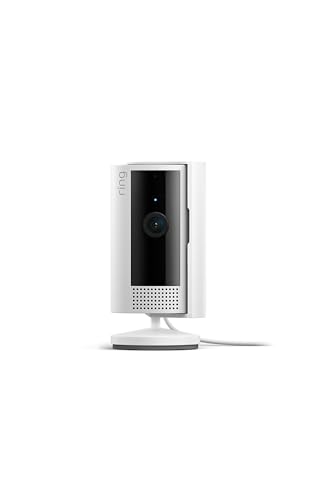
A third budget-adjacent option worth comparing: the largest review base and fastest notifications tracked on this site, with one of the highest ratings we track, though at a higher price than either Tapo or Wyze.
Why You Should Get This
If notification reliability matters more than price, this is the alternative worth comparing.
Benefits
- Largest review base of any indoor camera tracked here.
- Fastest, most reliable notification pipeline.
- Physical privacy cover.
Pros and Cons
- Massive, trustworthy review base.
- Widely regarded as the most polished app.
- Higher star rating than either Tapo or Wyze.
- Recorded clip history needs a Ring subscription.
- Higher price than Tapo or Wyze.
- 1080p resolution.
Features
- 1080p HD, two-way talk.
- Physical privacy cover.
- Plug-in power.
Representative Products Compared
Where the Real Differences Are
Price. Tapo’s C100 is roughly half the price of the Wyze Cam v4, making it one of the cheapest credible cameras covered on this entire site.
Resolution and night vision. Wyze’s 2.5K sensor with color night vision is a genuine step up in image detail over Tapo’s 1080p infrared-only night vision. For a nursery specifically, Tapo’s IR, which TP-Link markets as invisible, may be preferable regardless of resolution.
Subscription model. Identical on both — local microSD recording with no required fee, an optional cloud tier on each.
Company track record. Wyze has a detailed, sourced public incident history covered in Wyze pricing and value. We do not have comparably specific, sourced reporting on TP-Link/Tapo incidents to make a fair direct claim here.
Video Quality and Field of View
Wyze's 2.5K sensor beats Tapo's 1080p on raw detail. That gap shows up most when you zoom into a saved clip to check a face. Both use a fixed wide-angle lens sized for one room. Neither offers pan-tilt movement, so where you mount it matters more than it would on a moving camera. Their published fields of view are nearly identical (117° diagonal for Tapo, 115.8° for Wyze), so neither covers noticeably more of a room. Owner reviews of both cameras describe daytime footage as clear and usable at normal indoor viewing distances, with the resolution gap mattering most when you zoom in after the fact rather than during everyday live viewing.
Night Vision
This is where the two cameras split on philosophy, not just spec sheet. TP-Link markets the C100's infrared night vision as invisible, without the distraction of visible red lights in a dark room. Wyze's color night vision needs some ambient light or its built-in white spotlight to work, and that spotlight is a visible light source. For a nursery, Tapo's invisible IR is usually the better fit. For a living room with a nightlight or streetlamp glow, Wyze's color image gives more usable detail. Wyze also has infrared LEDs for when you don't want the spotlight, but Tapo's C100 has no color night mode, so if color at night matters, only Wyze offers it.
Power and Installation
Both cameras plug into a wall outlet. Neither runs on battery, so there's no recharge schedule, but you do need a nearby power point and a visible cable. Setup on either is simple: stand or mount the camera, plug it in, and connect to WiFi through the app. The whole process takes under ten minutes on both brands, with no drilling or technician required. If you move house or rearrange a room, both cameras unplug and remount in a new spot just as easily as they went up the first time.
Connectivity, App and Ecosystem
Both cameras connect over WiFi and work with Alexa and Google Assistant for basic voice commands. Neither is purpose-built for one ecosystem the way Ring leans into Alexa specifically, so the integration feels similar on both. Tapo lives inside the TP-Link Tapo app alongside other Tapo smart plugs and bulbs. Wyze lives inside its own app alongside a wider range of Wyze locks, sensors and robot vacuums. Wyze's broader device catalog gives it a slight edge for a household planning to add more smart-home gear over time. Both apps handle the basics well: live view, motion alerts and clip playback are all covered, and playback is straightforward to scrub through. Neither app carries the polish owners consistently praise in Ring's app, but at this price point, that's a reasonable tradeoff most buyers accept.
Storage and Subscription
Both record locally to a microSD card, sold separately, with no subscription required for that core function. Both also offer an optional cloud plan for off-site backup and smarter detection. Neither brand hides local recording behind a paywall, which is the whole reason this pairing sits at the budget end of the comparison set. The real question is which cloud add-on, if any, you actually need beyond the free local option. A 64GB or 128GB card is a reasonable starting point on either camera for a week or two of rolling motion-triggered footage before the oldest clips get overwritten, though actual retention depends on how much motion the camera sees.
Price and Who Should Buy Which
Tapo's C100 costs roughly half of Wyze's Cam v4, and it's one of the cheapest genuinely well-reviewed cameras on this whole site. Buy Tapo if price is the deciding factor, or if invisible night vision matters for a nursery or bedroom. Buy Wyze if sharper resolution and color night vision are worth close to double the price, or if you're already building out a wider Wyze smart-home setup. Buying several cameras on a tight budget tips the decision further toward Tapo, since the price gap compounds fast across two or three units. A mixed setup is also common and perfectly workable: Tapo on lower-priority positions like a garage or a side door, and Wyze on the one spot where the sharper image genuinely matters, such as a front room or a baby monitor position with steady ambient light.
Winner by Use Case
Absolute lowest price: Tapo, by a wide margin.
Sharpest image and color night vision: Wyze.
A nursery or baby’s room: Tapo’s invisible night vision is the more purpose-built choice.
Buying multiple cameras on a tight budget: Tapo — the price gap compounds fast across two or three units.
Read More
See Tapo C100 review, the Wyze owner-sentiment summary, and a ranked list of budget security cameras for the wider low-cost field.
Going Deeper: How microSD Recording Works on These Cameras
Both cameras write video straight to a card inside the camera, and the card sets how much you can keep. TP-Link’s Tapo C100 specifications list microSD support up to 512GB, continuous recording to the card, 1080p (1920 x 1080) video and 2.4 GHz Wi-Fi. Wyze’s Cam v4 specifications list cards up to 256GB, “24/7 Local Recording,” 2.5K (2560 x 1440) video and H.264 encoding at 20 frames per second by day and 15 at night. More pixels mean more data for every minute recorded, so the same card holds fewer hours from the sharper camera.
Continuous recording is also hard on the card itself. SanDisk’s High Endurance data sheet notes that writing and rewriting can take its toll on a memory card, which is why it rates its surveillance-oriented cards in recording hours: up to 5,000 hours of Full HD video for a 64GB card and up to 10,000 hours for 128GB, with fewer hours for 4K. It markets the line for home monitoring systems and dash cams. That is the reasoning behind this site’s advice to buy an endurance-rated card rather than a generic one for a camera that records around the clock.
Local storage also changes the security picture. The Tapo C100 lists 128-bit AES encryption with SSL/TLS. The FTC’s guide to securing home security cameras recommends choosing cameras that encrypt account information, livestreams and archived videos, replacing default passwords with strong unique ones, turning on two-factor authentication where it is offered, and checking the manufacturer’s site for software updates. Keeping footage on the card limits what sits in the cloud, but the app account still controls access to the live feed, so it deserves the same care.
Verdict
Choose Tapo if price is the deciding factor or the position is a nursery where invisible night vision matters. Choose Wyze if sharper resolution and color night vision are worth roughly double the price to you. Both are genuinely subscription-free, which is the reason either belongs on a budget shortlist in the first place.
Sources & References
- Tapo C100 home security Wi-Fi camera — TP-Link
- Wyze Cam v4 — Wyze
- Wyze camera breach may have let 13,000 customers peek into others' homes — CBS News
- Tapo C100 specifications — TP-Link
- SanDisk High Endurance microSD card data sheet — SanDisk (Western Digital)
- How to secure your home security cameras — Federal Trade Commission