
Affiliate Disclosure
Some links on this page are affiliate links. As an Amazon Associate, we earn from qualifying purchases — at no extra cost to you. We do not buy, install, or physically handle the cameras we cover; our rankings come from aggregated owner reviews, ratings and expert consensus. Commissions never change our verdicts. How we rank · full disclosure.
The short version: an RV camera has one requirement a home camera doesn't — it can't depend on a WiFi network you control, because you're frequently somewhere you don't own the network. For campgrounds with decent WiFi, a standard weather-resistant battery camera like the Ring Outdoor Cam works fine. For boondocking or unreliable campground WiFi, a cellular camera like the Tactacam Defend 360 is the more dependable answer, at the cost of a required data plan.

Top Picks at a Glance
The Ranked Field

Best for weather-resistant coverage that mounts anywhere on an RV exterior.
- Weather-resistant, battery or solar powered.
- Flexible freestanding, wall or ceiling mount.
- Color night vision.
- One of the deepest review bases we track.
Why buy it: Mounting flexibility matters more for an RV than a fixed home, and this camera works without any wiring at all.
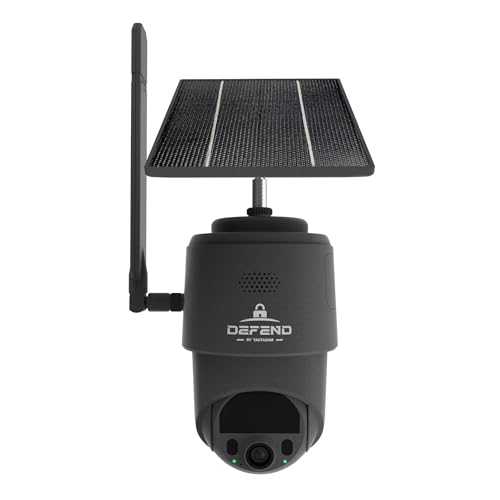
Best for RV parks and boondocking sites with no reliable WiFi.
- LTE cellular, no WiFi required at all.
- Solar-assisted battery power.
- 360° manual pan-tilt-zoom.
- Works anywhere with cell coverage.
Why buy it: A home WiFi network genuinely does not exist most places an RV parks, which is exactly the gap a cellular camera fills.

Best for a cheap interior camera watching the RV door or main living area.
- 2.5K with color night vision.
- Indoor-or-outdoor rated.
- Local recording, no subscription required.
- A deep base of owner ratings.
Why buy it: Cheap enough to run two or three around a rig without a meaningful cost, and it needs no monthly fee while you are off-grid.
Comparison Table
| Product | Best for | Price | Buy |
|---|---|---|---|
| Ring Outdoor Cam (Stick Up Cam) | Best Overall | $79.99 | Price |
| Tactacam Defend 360 | Best for No Campground WiFi | $159.99 | Price |
| WYZE Cam v4 | Best Budget | $39.99 | Price |
How We Rank
We do not buy, install or physically handle these cameras. This ranking is built from aggregated owner star ratings weighted by review volume and manufacturer specifications relevant to mobile/RV use. Full method on how we rank.
Which One Should You Buy?
You mostly stay at campgrounds with WiFi: the Ring Outdoor Cam, for flexible weather-resistant mounting with no cellular data plan required.
You boondock or frequent sites with unreliable WiFi: the Tactacam Defend 360, since it doesn't depend on any network you don't control.
Watching the interior or the door specifically: the Wyze Cam v4, cheap enough to place two or three around the rig.
Pros and Cons for RV-Specific Use
Ring Outdoor Cam (campground WiFi): pros — flexible mounting, weather-resistant, no cellular plan needed; cons — depends entirely on campground WiFi quality, which varies enormously site to site.
Tactacam Defend 360 (no WiFi needed): pros — works anywhere with cell coverage, solar-assisted; cons — a data plan is mandatory, and manual (not automatic) pan-tilt-zoom.
Wyze Cam v4 (interior/budget): pros — cheap enough to run several around the rig, color night vision; cons — needs WiFi like the Ring option, no cellular fallback.
eufy's solar cameras are also worth a look for RV use specifically because they eliminate the recharge-cycle maintenance that battery cameras add to an already busy travel schedule — see eufy SoloCam S340 review.
Warranty Notes for Mobile Use
Standard manufacturer warranties generally assume normal stationary household use, and none of these brands specifically certify their mounts for the vibration of highway driving — a secure, vibration-resistant mount beyond the standard bracket is a sensible add-on if the camera stays in place while the RV is moving, since warranty coverage is unlikely to address mount failure from road vibration specifically.
Buying Guide: Matching a Camera to Your Travel Pattern
The direct answer: classify your typical stops before shopping — full-hookup campgrounds with reliable WiFi, mixed sites with unpredictable WiFi, or genuine boondocking with no infrastructure at all — because each category points to a structurally different camera, not just a different price point.
Full-hookup, WiFi-reliable campgrounds: a standard battery or plug-in camera works exactly as it would at a fixed home, and you avoid a cellular data plan entirely.
Mixed reliability: a camera with genuinely free local backup storage (like Blink's Sync Module option) means you still have footage even during the stretches where the campground WiFi is unusable.
True boondocking or dispersed camping: only a cellular camera works reliably, and the data plan is simply part of the cost of coverage in that scenario — there's no way around it.
Mounting also deserves a second thought for a vehicle that moves: a bracket rated for stationary wall-mounting isn't necessarily rated for highway vibration, so budget for a more secure mount if the camera stays attached while driving.
Verdict
Match the camera to your actual travel pattern rather than defaulting to whatever's popular for a fixed home. If connectivity is ever in doubt at your typical stops, the cellular option is worth the data plan. See no-WiFi and cellular cameras for the wider category, and wireless and battery cameras for standard WiFi options.
Related Accessories

Best for local recording on a camera with a card slot.

Best for angling a camera precisely under an eave, soffit or shelf.

Best for a clean, weatherproof cable entry point on an outdoor mount.