
Affiliate Disclosure
Some links on this page are affiliate links. As an Amazon Associate, we earn from qualifying purchases — at no extra cost to you. We do not buy, install, or physically handle the cameras we cover; our rankings come from aggregated owner reviews, ratings and expert consensus. Commissions never change our verdicts. How we rank · full disclosure.
Short answer: a video doorbell is a purpose-built camera for one job — seeing who is at your door, what they left on the step, and letting you talk to them — while a general security camera is built to watch an area. The practical difference shows up in the shape of the picture. Doorbells use a tall, vertical field of view so a face at the top and a parcel on the ground both fit in frame. Outdoor cameras use a wide, horizontal field of view to cover a driveway or a yard. Neither shape does the other job well, which is why plenty of households end up owning both.
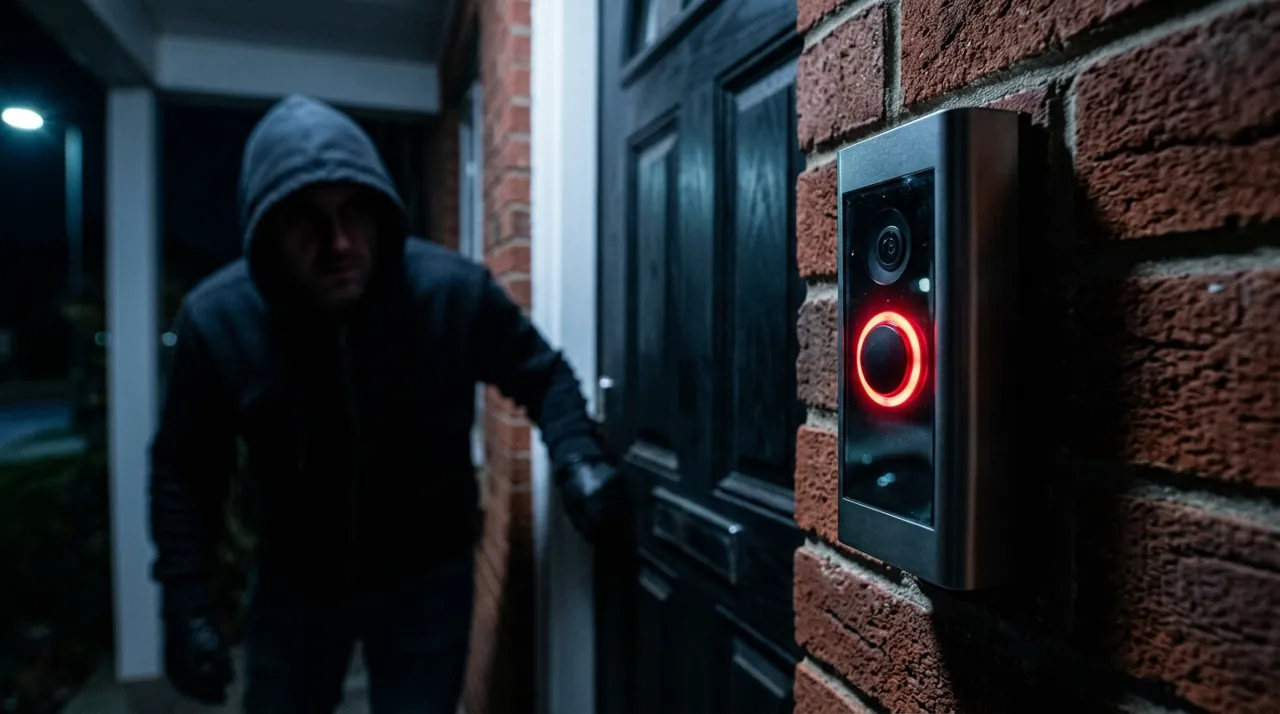
The other difference is the event itself. A doorbell has a button. When someone presses it, that is an unambiguous signal that a person is deliberately at your entrance, and it triggers a chime, a notification and a recording that no motion-based system can match for clarity. A general camera has no equivalent — everything it reports has to be inferred from movement.
Recommended Cameras

Best for wired outdoor coverage with the deepest review base tracked on this site.

Best for front-door coverage with no wiring required.

Best for a no-subscription camera with local microSD recording.
Field of View: Why the Picture Is a Different Shape
This is the whole distinction in one sentence: doorbells are portrait, area cameras are landscape.
A doorbell is mounted low by necessity — beside a door frame at roughly chest to shoulder height, because that is where a doorbell button belongs and where existing chime wiring runs. From that spot, at arm’s length from the visitor, a normal wide horizontal lens would deliver a close-up of a torso. So doorbell cameras use a tall aspect ratio, often something close to square or taller than wide, giving a frame that reaches from above an adult’s head down to the doormat. That is what lets one unit show you a face for identification and a box on the step at the same time.
A general outdoor camera is mounted high — seven to nine feet is the usual recommendation — and aimed at ground people cross fifteen or twenty feet away. It wants width: a wide horizontal frame that takes in a driveway, a gate and a stretch of lawn in one view. Extra vertical coverage there would mostly photograph sky and roofline.
Put a doorbell where an area camera belongs and you get a narrow slice of a wide space. Put an area camera at doorbell height and you get an excellent view of a chest and no view of the parcel. The mount height and the frame shape are matched to each other, and that pairing is not interchangeable.
What Each One Is Actually For
Reading the two as competitors is the mistake. They answer different questions.
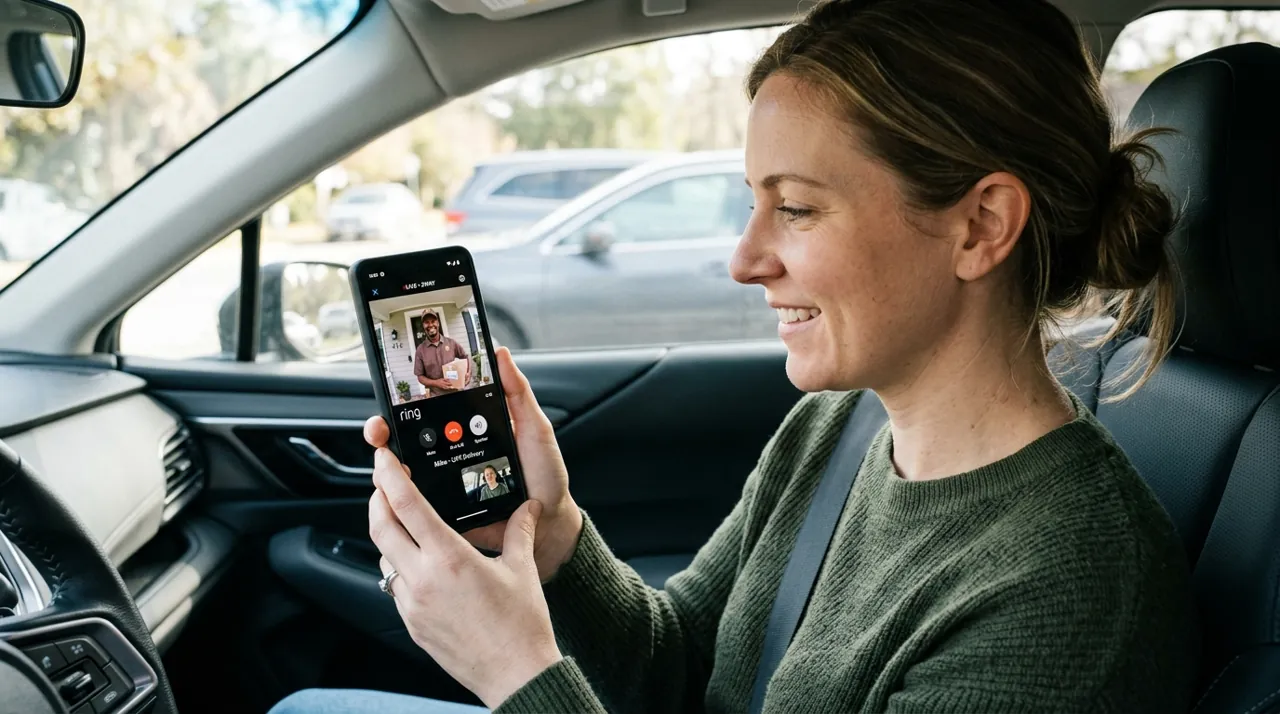
A video doorbell answers "who is at my door and what did they do there?" Its strengths are the doorbell press event, two-way talk with someone standing right in front of it, a frame that includes the step, and — on most platforms — pre-written quick-reply messages for when you cannot take the call. It is the right tool for deliveries, unexpected visitors, service calls and porch activity. It is also the single most commonly bought first camera, because that is the interaction most households have every week.
A general security camera answers "what happened in this area?" Its strengths are coverage, positioning freedom and specification. You can mount it where the useful sight line is rather than where a doorbell has to go, choose a spotlight or a siren model, aim it along a fence line, or pick a higher-resolution sensor for a longer view. It is the right tool for a driveway, a backyard, a side gate, a garage, a shed and any approach that does not pass your front door.
There is real overlap at the front of the house, and that overlap is where the question usually comes from. If your only concern is the front door itself, a doorbell is generally the better single purchase. The moment a second approach exists — a side gate, an alley, a detached garage — a doorbell cannot reach it at any price.
The Other Differences Worth Knowing
- Power and install. Doorbells come in wired and battery versions. A wired doorbell taps existing low-voltage chime wiring, which is convenient where that wiring exists and awkward where it does not, and some homes need a chime adapter or a transformer with enough capacity. Battery doorbells install anywhere but need recharging, and a busy front door drains them faster than a quiet side path. General cameras have the full range of options — battery, plug-in, solar and PoE — and PoE in particular has no doorbell equivalent in most lineups.
- Position freedom. A doorbell must sit at the door, at doorbell height, aimed the way the door frame allows. Angle wedges help a little. A general camera can be mounted almost anywhere, which is often the deciding factor when a driveway runs beside the house rather than in front of it.
- Night performance. Doorbells work at close range under porch light and their infrared reach is short, which is fine for two feet away. Area cameras need real night reach across twenty or thirty feet, so spotlights and color night vision matter far more there.
- Detection tuning. A doorbell facing a public sidewalk is one of the noisiest positions in home security, since every passer-by crosses the frame. Both need activity zones; doorbells arguably need them more.
How to Decide for Your House
Walk the property once and count the approaches. Not the doors — the approaches, meaning every route by which someone can reach the building.
If there is genuinely one, and it is the front door, buy a doorbell and stop. If there are two or three, the usual sensible arrangement is one doorbell at the front and one wider camera covering whichever secondary approach is least visible from inside — typically a side gate or a driveway. That combination covers most detached homes at a lower cost than the number of devices suggests, because the two cover different ground rather than duplicating it.
If you rent or live in an apartment, the calculation changes again: many buildings do not permit a doorbell replacement at all, in which case an indoor camera aimed at the entry, or a peephole-style unit, is the practical answer.
Whichever way it lands, the subscription question applies equally to both categories and is usually the larger long-run cost. Our current rankings sit in best video doorbell cameras and best outdoor security cameras, with the full category context in the video doorbells and outdoor cameras hubs. If you are buying both at once, mounting position should shape the order you buy in — the reasoning is in our installation guide.