
Affiliate Disclosure
Some links on this page are affiliate links. As an Amazon Associate, we earn from qualifying purchases — at no extra cost to you. We do not buy, install, or physically handle the cameras we cover; our rankings come from aggregated owner reviews, ratings and expert consensus. Commissions never change our verdicts. How we rank · full disclosure.
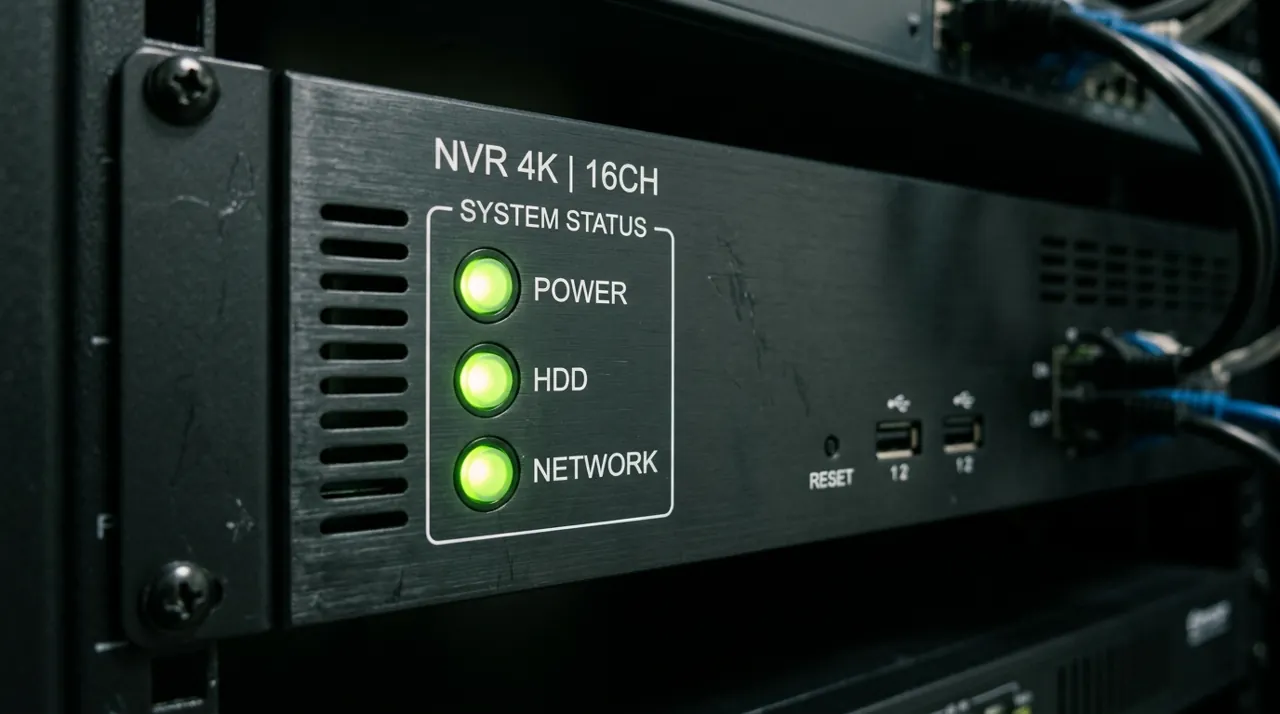
Short answer: an NVR (network video recorder) records digital video sent over standard network cable from IP cameras, and a DVR (digital video recorder) records analog video sent over coax cable from analog cameras. The two terms describe different camera technologies, not two flavors of the same product — you do not choose an NVR because you like it better, you end up with one because you bought IP cameras, or a DVR because you bought analog ones. Nearly every home security system marketed today, including every PoE camera kit on this site, uses an NVR.
Recommended Systems

Best for a complete NVR kit that records continuously to an owned drive.

Best for local microSD recording with no NVR or DVR box required.

Best for the cloud-recording model that skips both boxes entirely.
What Actually Separates Them
The distinction sits entirely in how the camera captures and sends its signal. Analog cameras, the older technology, convert what they see into an analog electrical signal carried over coax cable, and the DVR does all the digital conversion and compression at the recorder end. IP cameras, the technology behind almost every modern consumer system, digitize the video themselves and send a compressed digital stream over an Ethernet cable, typically carrying both data and power in the same run through PoE. The NVR simply receives and stores that already-digital stream.
That difference in where the conversion happens has real consequences. IP-camera-and-NVR systems generally deliver sharper resolution, better compression efficiency for a given amount of storage, and simpler cabling because one cable per camera carries both power and data. Analog-and-DVR systems remain in commercial and older installations mainly because the coax runs already exist and replacing them is expensive, not because the technology is preferred for new builds.
NVR vs DVR: Why Resolution and Cabling Diverge
The practical gap between the two shows up most clearly in image quality and in what the cable itself has to carry. Because an IP camera on an NVR system digitizes and compresses video at the camera before sending it, the resolution ceiling is set by the camera's own sensor rather than by anything downstream, which is why 4K and 5MP IP cameras are common while analog DVR cameras have historically topped out lower. Coax cable also only carries the analog signal, so an analog-and-DVR system needs a separate power run to every camera, while a PoE-fed NVR system carries power and data together on the same Ethernet cable. That single difference is why most new installers default to NVR systems even before resolution enters the conversation.
Owners who have lived with both generally describe the transition the same way: the DVR system worked, but the NVR system's picture, app experience and cabling were all a clear step up once they made the switch, which is consistent with how much camera technology has moved on since analog was the default.
NVR and DVR in Everyday Security Camera Shopping
In practice, almost nobody buying security cameras today shops by NVR-versus-DVR terminology at all — they shop by camera type, and the recorder comes along as part of that decision. A listing for "wired security cameras" or "PoE security camera system" is, functionally, an NVR system; a listing explicitly mentioning "CCTV" or "coax cameras" is more likely to be DVR-based, though the terminology in retail listings is not always precise. Reading the camera specifications rather than the recorder name is the more reliable way to know which technology you are actually buying, since a listing can say "security camera system" without specifying either term at all.
This terminology confusion is a genuine, common source of buyer frustration, particularly for anyone trying to add a camera to an existing system. Confirming whether the household's existing recorder is an NVR or a DVR — checking the connector type on the existing cameras is the fastest way — avoids buying a camera that turns out to be incompatible with what is already installed.
Which One a New Buyer of Security Cameras Should Get
For a home system bought today, this is not really a live decision — buy an IP camera kit, and it will include an NVR. Analog-and-DVR kits still exist and are sometimes marketed as budget options, but the resolution and feature gap has widened enough that the savings rarely justify the older technology for a fresh installation. The one scenario where a DVR genuinely makes sense is retrofitting a property that already has coax runs from a prior system, where reusing the existing cable saves a real amount of labor.
If continuous, subscription-free local recording is the goal, an NVR-and-IP-camera kit is the standard modern answer, and it is what every complete system covered in NVR camera systems and wired PoE cameras uses. For single cameras that skip both boxes entirely, see how local storage compares to a cloud plan in local storage vs cloud.