
Affiliate Disclosure
Some links on this page are affiliate links. As an Amazon Associate, we earn from qualifying purchases — at no extra cost to you. We do not buy, install, or physically handle the cameras we cover; our rankings come from aggregated owner reviews, ratings and expert consensus. Commissions never change our verdicts. How we rank · full disclosure.
Short answer: a PoE (Power over Ethernet) security camera gets both its power supply and its video connection through a single Ethernet cable, instead of needing a separate power cord plugged into an outlet. The cable runs from the camera to a PoE switch, a PoE-enabled NVR, or a standalone PoE injector, and that device supplies electricity along the same line that carries the video data. One cable, two jobs — which is the entire appeal.
Recommended PoE Cameras

Best for a single wired PoE camera with 12MP detail.

Best for covering two positions with one PoE cable run each.

Best for a complete six-camera PoE-and-NVR system.
What Is a PoE Security Camera, in Plain Terms?
Restated simply: a PoE security camera is any camera that draws its electricity from the same Ethernet cable carrying its video data, rather than from a separate power cord or a battery. The term itself comes from Power over Ethernet, the underlying networking standard that lets a cable rated for data also safely carry low-voltage DC power alongside it. Any camera labeled PoE in its product listing is built around this standard, and it will not power on from a data-only network connection — it specifically needs a PoE-capable source on the other end of the cable.
Why PoE Exists and What It Solves
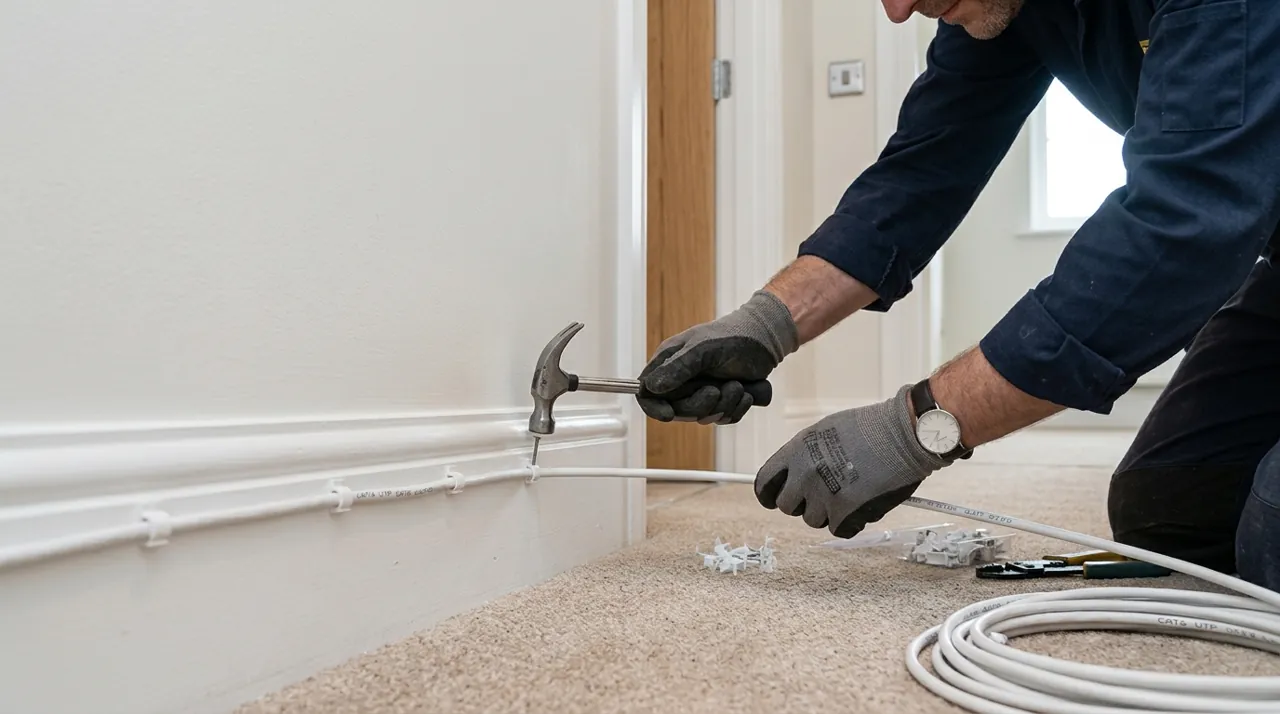
Before PoE, a wired security camera needed two separate runs to the mounting position: a power cable to an outlet, and a data cable back to a recorder, or it relied on WiFi for data and still needed power from somewhere. PoE collapses that into one cable, which matters enormously for exterior camera positions where running two separate cables through walls, soffits or conduit doubles the labor of an already involved job. A single Ethernet run, terminated with the right connector, is the entire cable path a PoE camera needs.
The data side of PoE also brings a real reliability advantage over WiFi: a wired connection does not suffer from signal dropout, interference from other devices, or range limits the way wireless does. That is why PoE systems are the standard choice for anyone who wants genuinely continuous, uninterrupted recording rather than the intermittent motion-triggered clips typical of battery and WiFi cameras.
What a PoE Setup Actually Requires
Three components, beyond the camera itself. First, a PoE power source — most commonly a PoE-enabled NVR that ships as part of a camera system kit, though a standalone PoE switch or a single-camera PoE injector both work for smaller setups. Second, standard Ethernet cable, typically Cat5e or Cat6, run from the camera position back to that power source; the practical limit on a single run without a repeater is around 300 feet, well beyond what most home installs need. Third, weatherproof connectors and, for exterior runs, some attention to routing the cable through conduit or under eaves rather than leaving it exposed.
What a PoE setup does not need is an outlet anywhere near the camera, which is the entire reason installers favor it for positions like a garage peak, a detached shed, or a corner of the yard with no nearby power.
How PoE Compares to WiFi and Battery Cameras
The comparison owners make most often is PoE against WiFi, and the honest answer is that each wins on a different axis. WiFi cameras win on installation speed and flexibility — no cable run, mount it and pair it in minutes. PoE cameras win on reliability and continuous recording — a wired connection does not drop the way WiFi occasionally does under interference or distance, and PoE-fed systems are the ones capable of genuinely uninterrupted 24/7 recording rather than motion-triggered clips. Battery cameras trade both of those for the least commitment of all: no cable, no outlet, but a recurring recharge cycle that PoE and most WiFi-plus-outlet cameras avoid entirely.
Who Should Actually Buy a PoE Security Camera System
PoE is the right answer for anyone who wants continuous, subscription-free recording across multiple cameras and is willing to do a real cabling job once rather than manage batteries or WiFi range indefinitely afterward. It is the wrong answer for a renter, an apartment, or anyone who wants a camera running within the hour — battery and WiFi cameras exist precisely to serve that faster, drill-free use case instead. The full range of PoE systems, from single cameras to complete multi-camera kits, is covered in wired PoE cameras, and the broader power-source comparison — outlet, PoE, solar or battery — is in how to power an outdoor security camera.
Shopping for a PoE Security Camera in Practice
When browsing listings, look for explicit PoE labeling in the title or specifications rather than assuming a wired camera supports it — some wired cameras use a standard barrel power connector with a separate Ethernet or WiFi data link instead, which is a genuinely different product despite looking similar in a photo. Kits sold as complete systems, bundling cameras with a PoE-enabled NVR, are the simplest entry point because compatibility between the camera and the power source is already guaranteed by the manufacturer. Buying individual PoE cameras piecemeal works too, but only once you have confirmed the PoE switch or injector you already own, or plan to buy, supplies enough wattage for every camera on the line — a common oversight that leaves the last camera on a run underpowered.