
Affiliate Disclosure
Some links on this page are affiliate links. As an Amazon Associate, we earn from qualifying purchases — at no extra cost to you. We do not buy, install, or physically handle the cameras we cover; our rankings come from aggregated owner reviews, ratings and expert consensus. Commissions never change our verdicts. How we rank · full disclosure.
Short answer: manufacturers generally quote one to six months per charge, but a doorbell mounted somewhere with real foot traffic — a busy street, a shared entry, a household with several deliveries a week — commonly reports three to eight weeks in practice. The gap exists because the box figure is measured under light, idealized usage, and a doorbell's battery drain is driven almost entirely by how often it actually does something: rings answered, motion events recorded, and live views opened from the app.
Recommended Battery Doorbells

Best for the most-reviewed battery doorbell tracked on this site.

Best for the longest quoted battery life of any doorbell in this comparison.

Best for sharper 2K video on the same removable-battery design.
Doorbell Battery Life: Box Figure vs Owner Reports
The manufacturer's quoted figure is measured under a fixed set of assumptions — a certain number of rings and motion events per day, a moderate temperature, and a specific detection setting — that rarely matches a real front door's actual traffic. Owner reviews across every major battery doorbell brand converge on the same pattern regardless of the specific product: real-world battery life lands well below the box number for anyone in a busy position, and much closer to it for anyone with genuinely light traffic. Reading the negative reviews for any battery doorbell is one of the fastest ways to gauge honestly how it performs in a busy household, because battery complaints are almost always the largest single category.
What Actually Drains a Video Doorbell Battery
Every event costs power, and a busy doorbell simply has more events than a quiet one. A ring triggers a full video call between the doorbell and your phone. A motion event triggers recording, even without a ring. Opening a live view from the app to check who is there manually is one of the biggest single drains, because it keeps the radio and camera active continuously rather than waking briefly for an event. A doorbell facing a sidewalk that also triggers on every passing pedestrian or car will burn through its charge far faster than the same doorbell facing a private driveway with genuinely limited traffic.
Cold weather compounds this. Lithium batteries lose usable capacity as temperature drops, so the same doorbell that lasted two months through a mild fall can drop to three or four weeks in a cold winter, independent of any change in traffic. Owners in cold climates consistently report this pattern regardless of brand.
Removable Battery vs Built-In: Why It Matters for Downtime
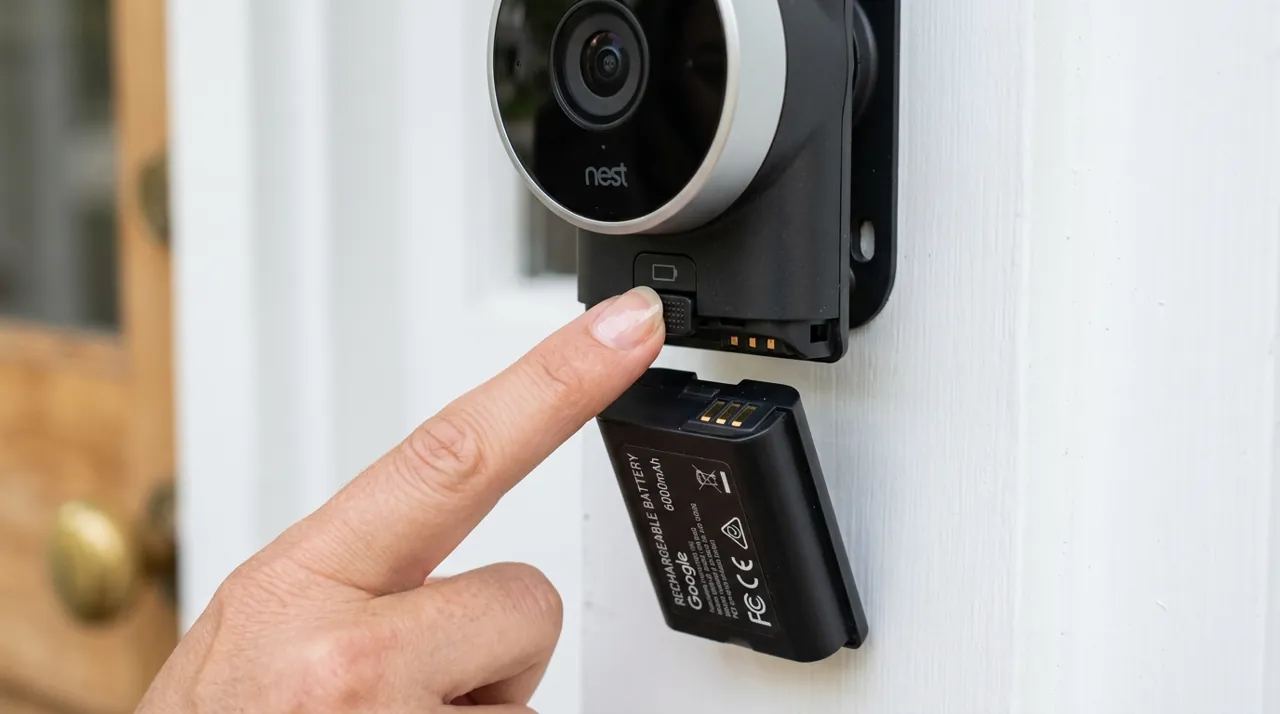
How a doorbell charges matters as much as how long it lasts, because it decides how much time the door goes uncovered. A removable battery pack pops out for charging while a spare goes back in immediately, so the door is never without coverage for more than the swap itself takes. A built-in, non-removable battery generally means taking the whole unit down and charging it via USB, which leaves the entrance uncovered — sometimes for hours — until it goes back up. For a front door that genuinely needs continuous coverage, a removable-battery model or a wired-and-trickle-charged setup avoids that gap entirely.
How to Actually Extend It
Motion zone tuning is the single biggest lever available. Narrowing detection to the entry path itself, rather than the full field of view including the street and sidewalk, cuts a large share of the events a busy doorbell would otherwise record. Lowering motion sensitivity and disabling less essential alert types where the app allows it compounds that reduction further. Where existing low-voltage doorbell wiring is present, connecting it — even on a battery model that supports it — turns the battery into a buffer rather than the sole power source, which is functionally close to eliminating the recharge problem entirely.
If none of that gets you to an acceptable interval, the honest fallback is a fully wired doorbell with no battery dependency at all, which trades the flexibility of a drill-free install for genuinely unlimited runtime.
Notification Settings Are a Hidden Battery Cost
Beyond motion zones, the specific alert types a doorbell sends also affect runtime, and this is a setting most owners never touch. A doorbell configured to send a rich notification with a thumbnail image or a short video preview for every single motion event, rather than a simple text alert, does noticeably more processing per event than the minimal option. On models that offer a choice between "rich" and "basic" notifications, switching to basic where the app allows it is a small, underused lever that adds up over weeks of otherwise identical usage.
See how long do security camera batteries last for the same arithmetic applied to standalone battery cameras, and video doorbells for the full range of battery and wired options.