
Affiliate Disclosure
Some links on this page are affiliate links. As an Amazon Associate, we earn from qualifying purchases — at no extra cost to you. We do not buy, install, or physically handle the cameras we cover; our rankings come from aggregated owner reviews, ratings and expert consensus. Commissions never change our verdicts. How we rank · full disclosure.
Short answer: yes, virtually every security camera sold today records after dark — but the two technologies that make it possible give you very different footage. Infrared (IR) night vision works in total darkness and returns a monochrome, black-and-white image. Color night vision keeps the color but needs light to do it, either from a built-in spotlight or from ambient street and porch lighting. If your goal is identifying a person rather than simply knowing that something moved, color is the more useful of the two — and it only works when the light is actually there.
That distinction is the whole answer to this question. A camera that "works in the dark" is a low bar; nearly all of them clear it. A camera that produces footage good enough to recognize a face at 11pm is a much narrower category, and it usually involves a spotlight.
Recommended Cameras

Best for wired outdoor coverage with the deepest review base tracked on this site.

Best for front-door coverage with no wiring required.

Best for a no-subscription camera with local microSD recording.
Infrared Night Vision: Works Always, Monochrome Only
Infrared is the default. The ring of small LEDs you can see around a camera lens emits light at a wavelength just outside human vision, the sensor reads what bounces back, and the processor renders it as a grayscale image. It needs no ambient light whatsoever — a windowless garage at midnight is fine.
The trade-off is information loss. Everything arrives in shades of gray, so clothing color, vehicle color, hair color and skin tone are gone. In a police report, "a person in a dark jacket" is roughly all an IR clip supports. Range is finite too: consumer specifications generally claim somewhere between 30 and 100 feet, while the realistic distance at which you can tell a person from a large dog is closer to 15 to 30 feet. IR light falls off fast with distance, and anything past the LEDs' reach is simply black.
Two practical quirks are worth knowing. Highly reflective surfaces close to the lens — a white wall, a metal downspout, falling snow, rain, a spider web — bounce IR straight back and wash out the frame, which is why night footage sometimes looks like a white fog. And IR reflects off glass, which is why pointing a camera through a window at night generally fails. Standard 850nm LEDs give off a faint red glow at the lens; 940nm "no-glow" versions are invisible but shorter-ranged.
Color Night Vision: Better Identification, Needs Light
Color night vision is what almost everyone actually wants, because color is what turns footage into evidence. A red hoodie, a silver sedan, a specific delivery uniform — those details survive in color and vanish in grayscale. It comes about in one of two ways.
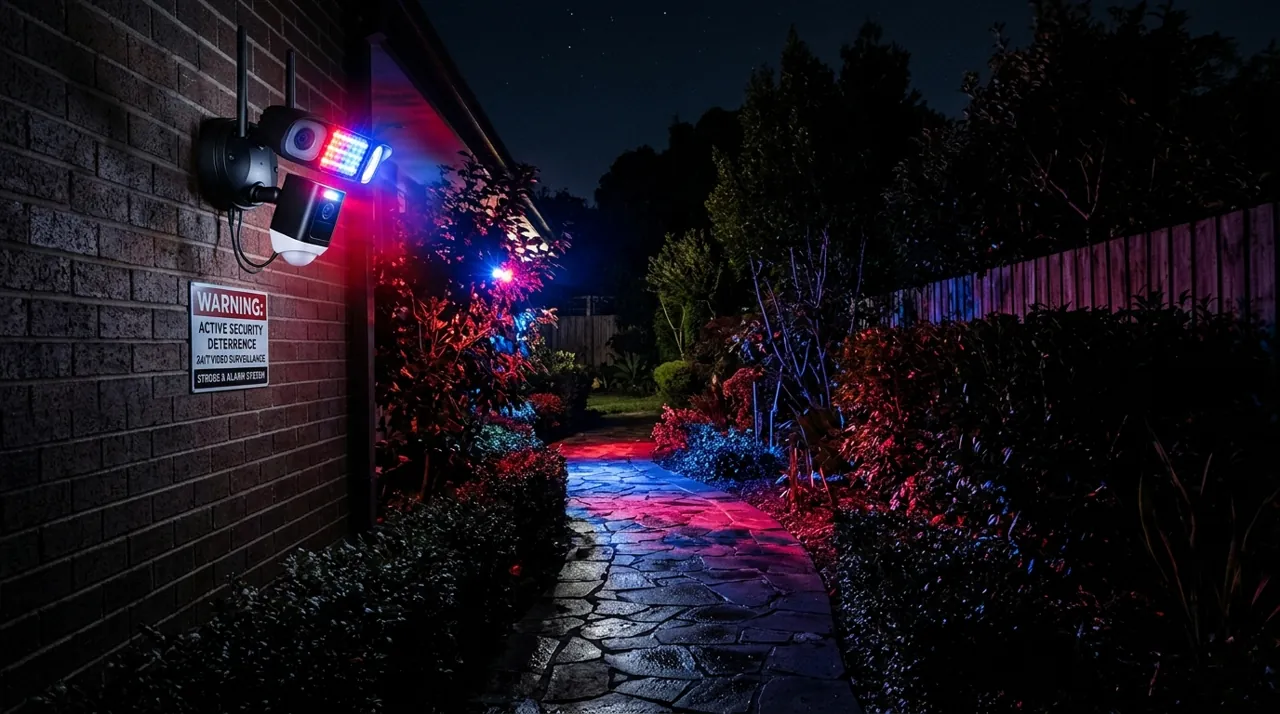
The first is a built-in spotlight. The camera detects motion, fires a bright white LED, switches the sensor out of IR mode and records in color. This is the arrangement on most floodlight and spotlight models, and it works reliably because the camera brings its own light. The side effects are that the spotlight announces the camera’s presence, it draws significant power (a real concern on battery models), and neighbors may notice it firing at 2am.
The second is a large aperture and a bigger, more sensitive sensor gathering whatever ambient light already exists — street lights, a porch light, a neighbor’s security lamp, moonlight on a clear night. Marketing names vary by brand, but the physics do not: with genuinely no light in the scene, this approach produces a dark and grainy frame, and most cameras fall back to infrared rather than show you noise. It works beautifully on a lit suburban street and poorly on an unlit rural driveway.
Which Is Better for Identifying Someone?
Color, when the light supports it. Grayscale tells you a person was present and roughly how big they were. Color tells you what they were wearing and what they were driving, and that is the difference between a clip worth handing over and a clip worth deleting.
The realistic conclusion from comparing specifications and owner reports across the category is that you should not choose between the two. Buy a camera that does both and switches automatically: infrared as the floor that never fails, spotlight-assisted color for the moments that matter. That combination is now standard on most mid-range outdoor cameras and is worth insisting on.
Do temper expectations about distance. Night vision does not extend a camera’s useful reach — it shortens it. A face that is recognizable at fifteen feet in daylight is a gray shape at the same distance under weak IR. If night identification is the priority, mount closer to the path people actually walk rather than higher and wider.
Brands and Tiers That Offer Each
Infrared is universal, including on the cheapest cameras on the shelf. There is no tier at which you have to pay for basic IR night vision, and a budget model’s IR is often specified similarly to a premium one’s.
Spotlight-assisted color night vision generally begins in the mid tier and above. Ring, Arlo, Eufy, Reolink, Google Nest, TP-Link Tapo and Wyze all field models with integrated spotlights, and floodlight cameras from any of them handle color at night by definition, since the floodlight is the light source. Premium models mainly buy you a better sensor, so the color image holds up in dimmer conditions before the camera gives up and reverts to IR.
One caveat that catches buyers out: on several platforms, the smarter night features — person detection versus generic motion, and access to recorded night clips at all — sit behind a subscription. Confirm what the camera does without a plan before assuming the night footage will be there when you look for it.
For the current picks in each environment, the outdoor rankings are the relevant place to start, since outdoor is where night performance is decided: see best outdoor security cameras. Indoors, the calculus differs — there is usually some ambient light, distances are short, and IR is often adequate — so the best indoor security cameras comparison weighs night vision less heavily than field of view and privacy features.
Getting Better Night Footage From the Camera You Have
Three adjustments account for most of the improvement people report. Clean the lens — spider webs strung across an IR emitter are one of the most common causes of hazy night video, and spiders are drawn to the warmth. Move the camera away from a nearby reflective surface, because a white soffit or gutter within a foot of the lens will bounce IR back and blow out the exposure. And add ambient light if you can: a plain porch light left on overnight often does more for night identification than upgrading the camera, because it lets the sensor stay in color mode all night instead of dropping to infrared.